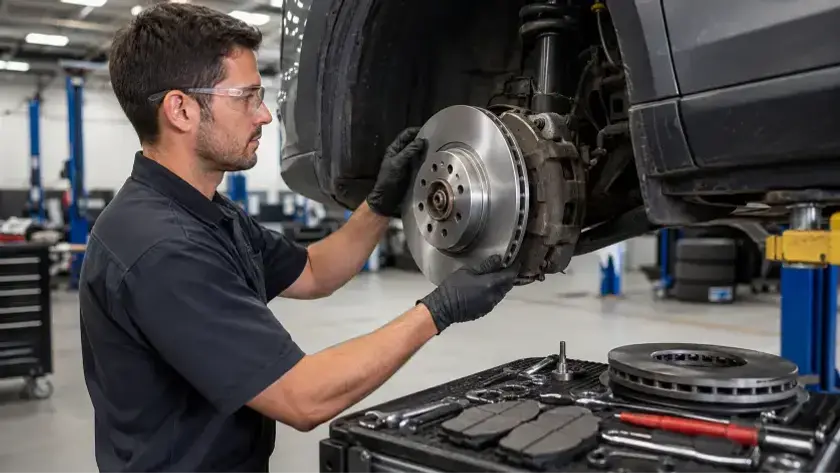
Brake rotor replacement is needed when rotors are worn below minimum thickness, scored beyond resurfacing, or warped in a way that cannot be corrected on the brake lathe. At KMF Automotive in Burnaby, rotors are measured before any replacement is recommended. If resurfacing is possible, that is the recommendation. If replacement is genuinely needed, it is done right alongside a full brake pad change. Call 604-438-0222 to book at 7080 Macpherson Ave today.
What is brake rotor replacement?
Brake rotor replacement is the process of removing worn, damaged, or undersized brake rotors from your vehicle and installing new ones in their place. Rotors are the circular metal discs that your brake pads clamp against to slow and stop the vehicle. Over time they absorb enormous amounts of heat and friction and eventually wear to the point where they can no longer perform safely or be restored through resurfacing.
Not every rotor issue requires full replacement. Many rotors with surface wear, minor scoring, or slight heat discolouration can be restored on a brake lathe through resurfacing. Brake rotor replacement is only needed when the rotor has worn below the manufacturer minimum disc thickness, developed scoring or warping that cannot be corrected through resurfacing, or cracked from severe heat exposure.
At KMF Automotive in Burnaby, every rotor is measured before any replacement recommendation is made. A proper brake inspection in Burnaby includes rotor thickness measurement at every corner so the recommendation is based on actual numbers, not assumptions.
How does brake rotor replacement work?
Here is the complete process for a brake rotor replacement at KMF Automotive from the initial inspection through the final road test.
Pre-service inspection
- Your vehicle is lifted, and all four wheels are removed to give the technician direct access to the full brake assembly at every corner.
- Rotor disc thickness is measured at multiple points using a micrometer and compared to the manufacturer’s minimum specification for that specific vehicle.
- Rotor surfaces are examined for scoring depth, heat cracking, surface discolouration, and any lateral warping that produces pedal pulsation.
- The rotor is assessed for whether resurfacing is possible given the current thickness. A rotor that is already at or below the minimum resurfacing allowance must be replaced rather than machined.
- Brake pad thickness is measured at the same time. Brake rotor replacement is almost always performed alongside brake pad replacement because installing new rotors under worn pads wastes the new rotor surface immediately.
- Brake fluid condition is assessed because a rotor replacement performed alongside a pad change is the most efficient time to also flush degraded fluid.
- Caliper condition is checked before new rotors are installed since a leaking or seized caliper will damage new rotors through uneven pressure.
- Every finding is documented and explained before any replacement is recommended or approved.
During the brake rotor replacement
- The brake caliper is unbolted and carefully suspended to avoid stressing the brake hose.
- The worn rotor is removed from the wheel hub.
- The hub surface is cleaned of any rust, debris, or buildup that could prevent the new rotor from sitting flush against the hub face.
- The new rotor is mounted onto the hub and confirmed to sit flat with no runout caused by debris or hub irregularities.
- The brake caliper bracket is reinstalled with new brake pads installed simultaneously.
- Caliper slide pins are cleaned and relubricated to ensure even pad pressure against the new rotor surface from the first stop.
- The caliper is reinstalled, and all fasteners are torqued to manufacturer specification.
- Rotor runout is checked after installation to confirm the new rotor is seated correctly with no lateral movement.
After the brake rotor replacement
- All four wheels are reinstalled and torqued to the correct vehicle specification.
- A controlled brake bed-in process is performed to transfer an even layer of pad material to the new rotor surface and condition both components for consistent, predictable braking.
- A full road test confirms firm pedal feel, no pulling, no pulsation, no noise, and reliable stopping performance before the vehicle is returned.
- A written service record documents every rotor measurement, the specification compared against, every component replaced, and the road test confirmation.
Why does brake rotor replacement matter?
Rotors are the surface your brake pads work against. When that surface is damaged, worn, or warped the entire braking system underperforms regardless of how new the pads are.
A warped rotor produces pulsation through the pedal under braking. That pulsation is uncomfortable and it indicates uneven pad-to-rotor contact that reduces stopping efficiency. A scored rotor with deep grooves accelerates brake pad wear because the pad material is being abraded by the grooves rather than providing smooth, consistent friction. A rotor below minimum thickness cannot absorb and dissipate braking heat properly, creating risk of brake fade under extended or heavy braking conditions.
The most preventable cause of brake rotor replacement is delayed brake pad replacement. When brake pads wear through completely, the metal backing plate contacts the rotor surface directly. Every stop after that point scores grooves into the rotor that are too deep to resurface. What would have been a pad replacement at the first squeal becomes a pad and rotor replacement that costs significantly more.
KMF Automotive was founded in 1989 by Khosro Khandashti to give Burnaby drivers honest guidance on brake repair in Burnaby including clear advice on whether a rotor needs resurfacing or replacement based on actual measured findings. Over 35 years that honesty has not changed.
Who needs brake rotor replacement and when?
Brake rotor replacement is needed in specific, measurable situations. Here is the complete list of when rotor replacement is the correct recommendation.
- Rotor disc thickness has worn to or below the manufacturer minimum safe specification. This is the primary measured trigger for replacement.
- The rotor surface has deep scoring or grooves from metal on metal contact caused by worn-through brake pads. Scoring too deep to resurface requires a new rotor.
- The rotor shows lateral warping that produces pedal pulsation and cannot be corrected by resurfacing because the rotor is already too thin to machine.
- Heat cracking is visible on the rotor surface. Cracked rotors are a safety risk and require immediate replacement regardless of thickness.
- The rotor has severe corrosion from extended periods of non-use that has penetrated past the surface layer.
- You feel pulsation or vibration through the brake pedal during normal braking. A rotor measurement during inspection will confirm whether resurfacing or replacement is the appropriate response.
- You have been quoted rotor replacement and want a second measurement-based opinion from KMF Automotive.
Signs that your rotors may need attention, whether resurfacing or replacement:
- Vibration or pulsation through the brake pedal when stopping.
- Visible grooves or scoring on the rotor surface visible through the wheel spokes.
- Squealing that persists after a brake pad change, suggesting uneven rotor surface contact.
- Extended stopping distances or reduced braking confidence.
Book your brake rotor replacement assessment in Burnaby at KMF Automotive. A measurement-based inspection confirms whether your rotors need resurfacing, replacement, or are still within acceptable service limits.
Common myths about brake rotor replacement
Myth 1: “Brake rotors always need replacing when brake pads are replaced.” This is the most common brake upsell in the industry. Rotors are replaced only when inspection measurements confirm they are below minimum thickness, scored beyond resurfacing, or otherwise damaged. Rotors within specification are resurfaced rather than replaced. At KMF Automotive, a micrometer reading at each corner determines the recommendation, not habit or revenue.
Myth 2: “Resurfacing rotors is always good enough.” Resurfacing removes a layer of metal from the rotor surface to restore smoothness. A rotor that is already close to minimum thickness does not have enough material remaining to resurface safely. Resurfacing it would bring it below the minimum, creating a rotor that cannot handle braking heat properly. When thickness is marginal, replacement is the correct and safer choice.
Myth 3: “I only need to replace one rotor since only one is damaged.” Rotors are always replaced in pairs on the same axle. A new rotor on one side and a worn rotor on the other produces uneven braking force that causes the vehicle to pull toward the side with the better rotor. This is a safety concern and will cause the new rotor to wear unevenly from the first stop. Both rotors on the same axle are always replaced together.
Myth 4: “Brake rotor replacement is too expensive to do without checking the pads first.” Brake rotor replacement is always assessed in the context of the full brake system. At KMF Automotive, rotor replacement is never recommended without simultaneously checking pad thickness, caliper condition, and fluid quality. Replacing rotors without addressing worn pads or contaminated fluid wastes the investment in the new rotors immediately.
Myth 5: “Aftermarket rotors are always inferior to OEM rotors.” Quality varies significantly across aftermarket rotor manufacturers. Some aftermarket options match or exceed OEM quality. Others are below standard. KMF Automotive uses quality rotors in the correct specification for your vehicle. The recommendation is based on fit, specification, and performance, not on brand assumption.
Services We Offer
KMF Automotive is a full service auto repair shop in Burnaby. The team at 7080 Macpherson Ave handles everything your vehicle needs to stay safe and running properly.
| Service | Description | Best Use Case | Book Now |
|---|---|---|---|
| Brake Inspection | A thorough examination of the entire brake system including pads, rotors, shoes, fluid levels, and all components. Recommended regularly to ensure vehicle and passenger safety. | Annual maintenance, pre-purchase checks, or any time braking feels off. | Brake inspection Burnaby |
| Brake Pad Replacement | Removal of worn friction pads and installation of new pads on front, rear, or all four corners. Pads must be replaced when worn below safe thickness. | Squealing brakes, reduced stopping power, or scheduled maintenance. | Brake pad service Burnaby |
| Brake Rotor Service | Resurfacing or full replacement of brake rotors that have become worn, scored, or warped over time. | Pulsation through the pedal, vibration when braking, or grooved rotor surfaces. | Rotor repair Burnaby |
| Hydraulic Brake Fluid | Removal of contaminated brake fluid and replacement with fresh fluid to restore proper hydraulic braking performance. | Soft or spongy pedal, discoloured fluid, or every two years as preventive maintenance. | Brake fluid flush Burnaby |
| Brake Shoes | Replacement of worn brake shoes in drum brake systems that press against the drum to slow or stop the vehicle. | Rear drum brake vehicles with reduced stopping power or grinding from the rear. | Brake shoe service Burnaby |
| Electronic ABS Sensors | Inspection and replacement of sensors that monitor wheel speed and activate the anti-lock braking system when needed. | ABS warning light, ABS not engaging correctly, or sensor fault codes present. | ABS sensor service Burnaby |
| Power Brake Booster | Diagnosis and replacement of the booster that amplifies pedal force to make braking easier and more responsive. | Hard or stiff brake pedal, or noticeably increased effort required to brake. | Brake booster repair Burnaby |
| Wheel Alignment | Adjustment of wheel angles to manufacturer specifications to restore straight tracking, even tire wear, and proper handling. | Vehicle pulling to one side, uneven tire wear, or after hitting a curb or pothole. | Wheel alignment Burnaby |
| Exhaust and Muffler Repair | Inspection, repair, and replacement of exhaust components including mufflers, pipes, and catalytic converters. | Loud rumbling noise, exhaust smell inside the vehicle, or visible rust or damage under the car. | Exhaust repair Burnaby |
| Oil Change | Drain and replacement of engine oil and filter to keep your engine properly lubricated and running clean. | Every 5,000 to 8,000 km depending on oil type and vehicle, or as recommended by your manufacturer. | Oil change Burnaby |
| Tire Repair | Inspection, patching, and replacement of tires that are damaged, punctured, or worn below safe tread depth. | Flat tire, slow leak, uneven wear, or tires approaching the end of their service life. | Tire repair Burnaby |
| Timing Belt Replacement | Inspection and replacement of the timing belt that synchronises your engine camshaft and crankshaft rotation. | Manufacturer-recommended interval, usually every 100,000 to 160,000 km, or if the belt shows cracking or fraying. | Timing belt Burnaby |
| Clutch Repair | Diagnosis and repair or replacement of clutch components including the disc, pressure plate, and flywheel in manual transmission vehicles. | Slipping clutch, difficulty shifting, grinding when engaging gears, or a high clutch engagement point. | Clutch repair Burnaby |
| AC Services | Inspection, recharge, and repair of your vehicle air conditioning system to restore proper cooling performance. | Weak or warm airflow from vents, unusual smells when AC is on, or AC not engaging at all. | AC service Burnaby |
Brake Rotor Replacement in Burnaby Done the Right Way
Brake rotor replacement in Burnaby is the right service when measurements confirm it is genuinely needed. At KMF Automotive, that determination is always based on a micrometer reading against manufacturer specification, not on assumption or habit. If your rotors can be resurfaced, they are. If they need replacing, the job is done correctly with new pads, caliper pin service, and a full road test. The team at 7080 Macpherson Ave has been making that call honestly since 1989. Book your rotor assessment today.
Book Your Brake Rotor Assessment Today
KMF Automotive is open Monday to Friday, 9:00 AM to 5:00 PM. Call 604-438-0222, email [email protected], or use the contact page to book. A measurement-based rotor assessment, honest recommendation on resurfacing versus replacement, and complete brake service from a Burnaby team with over 35 years behind them.
Contact KMF Automotive Book My Brake Rotor Assessment
Frequently Ask Questions: brake rotor replacement
How do I know if I need brake rotor replacement or just resurfacing in Burnaby?
The answer comes from measuring rotor disc thickness with a micrometer and comparing it to the manufacturer minimum specification for your vehicle. If the rotor is above minimum with resurfaceable surface issues, resurfacing is the correct service. If it is at or below minimum, or has damage that cannot be corrected through machining, replacement is needed. KMF Automotive measures every rotor before making any recommendation.
How much does brake rotor replacement cost in Burnaby?
Brake rotor replacement cost depends on your vehicle make and model because different vehicles use different rotor specifications and sizes. Replacing rotors on both sides of an axle is standard practice. The cost also includes new brake pads installed at the same time. Email [email protected] for a free quote specific to your vehicle after an inspection.
Do I need to replace brake pads when I replace brake rotors?
Yes. Installing new rotors under worn pads wastes the new rotor surface immediately. New pads go in alongside every brake rotor replacement at KMF Automotive. The inspection before the replacement confirms pad condition and the appropriate pad specification for your vehicle.
Do both rotors on the same axle need to be replaced at the same time?
Yes. Rotors are always replaced in pairs on the same axle. A new rotor on one side and a worn rotor on the other produces uneven braking force that causes pulling and causes the new rotor to wear unevenly. Both sides of the axle are always replaced together.
Can I get a second opinion on a brake rotor replacement recommendation in Burnaby?
Absolutely. KMF Automotive welcomes second opinions and provides documented rotor thickness measurements at every corner so you can compare findings directly with any previous recommendation. If resurfacing is possible based on the measurements, that is what will be recommended.
Why choose KMF Automotive for brake rotor replacement in Burnaby?
KMF Automotive has been performing measurement-based brake rotor assessments and replacements in Burnaby since 1989. Every rotor decision is backed by a micrometer reading against manufacturer spec. Rotors that can be resurfaced are resurfaced. Rotors that genuinely need replacing are replaced correctly with new pads, caliper pin service, and a road test confirmation.
Key Takeaways: brake rotor replacement
- Brake rotor replacement is only needed when rotors are below minimum thickness, scored beyond resurfacing, or cracked. Not every brake service requires rotor replacement.
- KMF Automotive measures every rotor with a micrometer before recommending replacement versus resurfacing. The decision is always based on measured findings.
- Rotors are always replaced in pairs on the same axle. Replacing only one side produces uneven braking and uneven wear from the first stop.
- Brake rotor replacement always includes new brake pads at the same time. New rotors under worn pads waste the new surface immediately.
- The most preventable cause of brake rotor replacement is delayed brake pad replacement. Metal-on-metal contact from worn-through pads scores rotors beyond resurfacing.
- Caliper slide pin lubrication is included in every brake rotor replacement at KMF Automotive. It ensures even pad pressure against the new rotor surface from day one.
- KMF Automotive has performed brake rotor replacements in Burnaby since 1989 at 7080 Macpherson Ave, open Monday to Friday 9 AM to 5 PM.