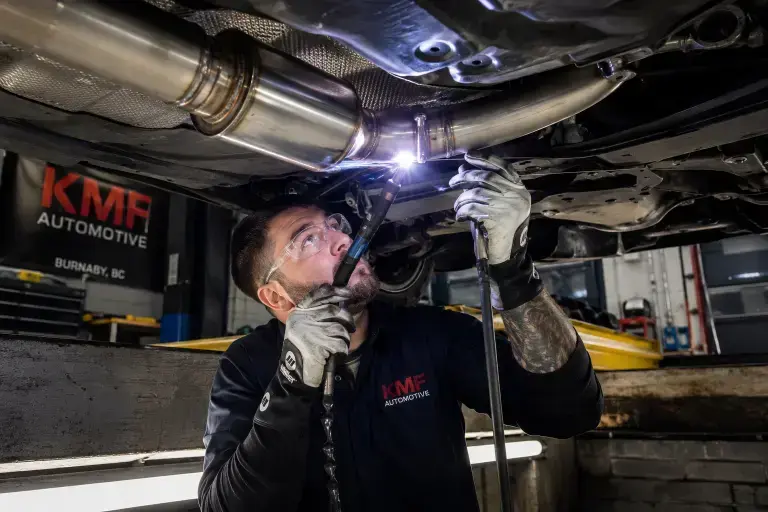
If your car is sounding like a freight train, shaking violently at idle, or failing its emissions footprint, your exhaust layout is compromised. At KMF Automotive, a complete diagnostic assessment or minor muffler weld typically takes between 30 and 60 minutes, while complex manifold or catalytic converter overhauls may require a few hours of specialized shop floor bench time. Operating a broken exhaust system leaks dangerous carbon monoxide gas into your passenger cabin and ruins your fuel economy. Contact us directly or visit our facility in Burnaby today to secure an honest, upfront quote and restore your vehicle’s factory-quiet operation.
The Core Architecture of Your Vehicle’s Exhaust System
When local drivers look for reliable exhaust repair in Burnaby, BC, they are often dealing with much more than a loud, rattling noise under their floorboards. Your vehicle’s exhaust configuration is a continuous, tightly sealed structural corridor engineered to achieve three vital functions: routing toxic combustion gases away from passengers, neutralizing harmful atmospheric pollutants, and dampening the acoustic shockwaves generated by your internal combustion engine.
Understanding how these parts fit together makes it easy to understand why a leak anywhere along this line can disrupt your vehicle’s mechanical balance:
- The Exhaust Manifold: Bolted directly to your engine’s cylinder head, this high-temperature cast iron or stainless steel collection unit captures raw, scorching combustion gases from each individual cylinder and channels them into a singular downpipe.
- The Catalytic Converter: Acting as the primary emissions shield, this crucial component utilizes an internal ceramic honeycomb structure coated with precious metals (platinum, palladium, and rhodium). It sparks a chemical redox reaction to convert highly toxic carbon monoxide ($CO$) and hydrocarbons into harmless water vapor and carbon dioxide ($CO_2$).
- Oxygen ($O_2$) Sensors: These digital probes constantly monitor the chemical composition of raw and treated exhaust streams, sending real-time electrical feedback to your engine control module ($ECM$) to calculate the perfect air-fuel ratio.
- The Resonator and Muffler: These chambers use internal acoustic baffling, sound-absorption materials, and tuned geometric tubes to force sound waves to bounce against and cancel one another out, silencing your engine notes down to a comfortable level.
Hidden Failure Points Caused by Pacific Northwest Driving
Vehicles navigating the Lower Mainland are exposed to unique environmental elements that accelerate the deterioration of exhaust components. The primary mechanical enemy we encounter on our service bays is severe oxidation and rust. While modern factory exhaust systems use aluminized steel or mid-grade stainless steel, winter road maintenance practices rely on road salt and chemical de-icers. When these compounds mix with puddles and splash onto a hot pipe, it triggers a rapid chemical degradation that thins out metal tubes until they rust open.
Furthermore, your exhaust system expands and contracts continuously. When you fire up your engine, internal exhaust gas temperatures can exceed 400°C to 700°C within minutes, causing the metal pipes to swell. When you park your car in cold, damp, rainy weather, the metal snaps right back down.
This endless thermal expansion cycle places immense stress on your structural weld joints, mounting brackets, and flexible rubber isolation hangers. Over time, this stress leads to cracks near the flanges, broken exhaust hangers, and blown-out gaskets that leak raw, unfiltered exhaust fumes into your undercarriage long before the actual muffler gives out.
Diagnostic Insights Warning Signs You Cannot Ignore
Catching an exhaust leak early can be the difference between a simple patch repair and an expensive component overhaul. If you pay close attention to your vehicle’s behavior, it will telegraph a failing exhaust layout through distinct symptoms:
Distinctive Exhaust Noises
- A Loud, Deep Roar: A sudden booming roar during acceleration points directly to a major breach in your muffler shell or a completely broken connection pipe.
- A Rhythmic Ticking or Hissing: A sharp, high-pitched ticking or hissing sound that speeds up perfectly with your engine RPMs usually signals a failing exhaust manifold gasket or a cracked manifold runner up near the engine block.
- A Metallic Rattling: A persistent metallic vibration or buzzing sound at idle typically means an internal ceramic brick inside your catalytic converter has shattered, or a loose metal heat shield is vibrating against the chassis.
Smell and Performance Red Flags
- Pungent Exhaust Odors: Smells resembling rotten eggs indicate your catalytic converter is chemically exhausted or overheating. Meanwhile, raw fuel odors indicate a leak upstream from your muffler.
- Decreased Fuel Efficiency: When an exhaust leak forms ahead of your primary oxygen sensor, external air gets drawn into the pipe. This tricks your engine’s computer into believing the motor is running lean, causing it to inject excess fuel and tank your fuel economy by 10% to 15%
Professional Diagnostic Procedures vs. Dangerous DIY Guesswork
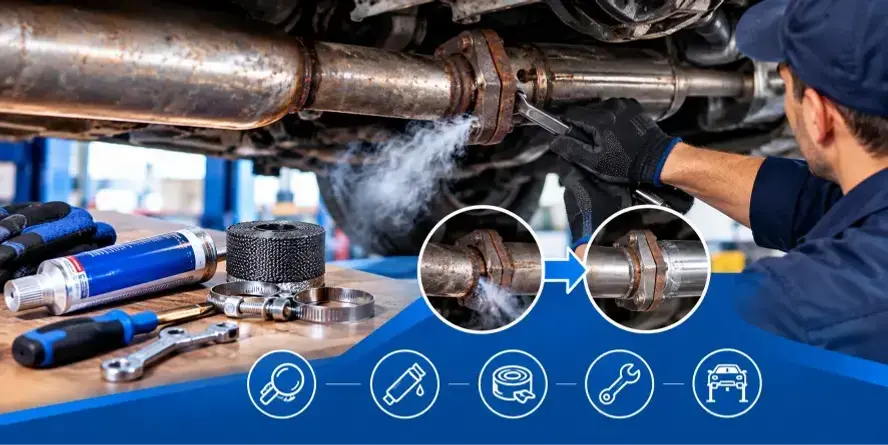
Many internet tutorials showcase backyard mechanics using tin cans, exhaust tape, and cheap hardware store paste to seal up a blowing exhaust pipe. While these quick fixes might muffle the noise for a day or two, they are highly prone to blowing open under high highway gas pressures. More importantly, makeshift repairs do nothing to stop the silent, lethal hazard of carbon monoxide creeping into your vehicle through floorpan grommets or climate control intakes.
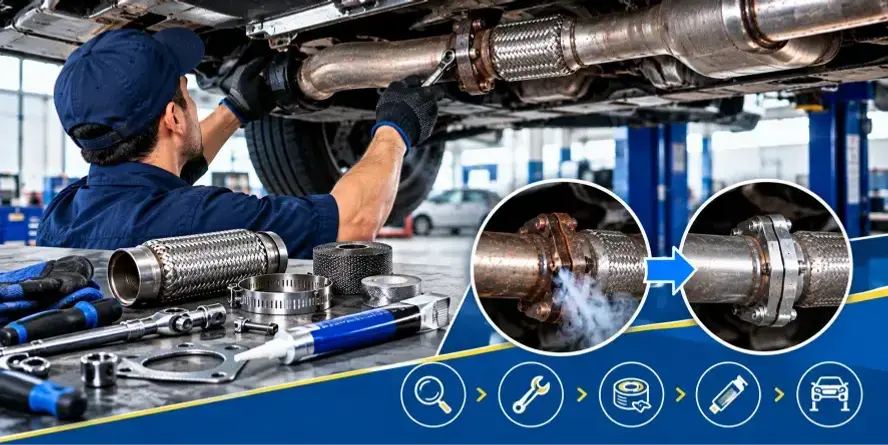
When you roll your vehicle into KMF Automotive, our certified mechanics carry out an intensive, systematic diagnostic routine. We raise your car on a hydraulic hoist and execute a pressurized smoke test, injecting synthetic vapor into the tailpipe to trace exactly where a micro-hairline crack is hiding.
We also use digital thermal imaging to check the temperature differential across your catalytic converter, verifying that it is reaching its optimal light-off temperature to clear away emissions. If a pipe section is thin or broken, our team utilizes professional MIG or TIG welding machinery to fuse thick-walled replacement steel in place, delivering a strong, leak-free seal that matches factory specifications.
The Crucial Connection Between Your Exhaust and Your Tires
It is easy to view your exhaust layout and your vehicle’s tires as completely independent systems, but a hidden, cascading mechanical relationship exists between them. When your exhaust system suffers from broken metal hangers or stretched rubber isolation loops, the heavy steel pipes begin to sag and sag under the chassis. During hard cornering or driving over standard speed bumps, this loose piping shifts out of position, often pressing up against your rear suspension components, brake lines, or inner tire sidewalls.
A hot exhaust pipe resting near a tire or suspension bushing transfers extreme thermal energy into those components. This heat can cook control arm bushings, fry grease seals, or degrade your tire’s rubber compound, setting you up for an unexpected failure.
If your car took a hard hit that bent your tailpipes or jarred your undercarriage, it is highly wise to pair your exhaust fix with a precise computerized wheel alignment in Burnaby. Ensuring your suspension angles are set perfectly prevents secondary component strain and keeps your tires rolling cleanly without scrubbing across the pavement.
Comprehensive Automotive Care at KMF Automotive
At KMF Automotive, we operate a full-service, owner-operated mechanical workshop designed to manage your vehicle’s entire maintenance needs. While our licensed technicians are under the chassis securing your exhaust system, it provides a highly convenient window to address other critical maintenance items, saving you an extra trip to the mechanic later.
Our shop floor is fully equipped to handle any diagnostic or mechanical challenge with complete dealership accuracy. If your engine is due for a regular service interval, we provide warranty-approved, premium oil changes using top-tier lubricants to keep your motor running clean. If your dashboard check engine light is illuminated due to an emissions code, or if you feel a soft pedal underfoot, our comprehensive brake repair service in Burnaby will completely restore your vehicle’s safety.Our Broad Service Specializations Include:
From resolving poor cabin airflow with an expert air conditioning service in Burnaby to performing advanced repairs, we handle it all. If your manual transmission suffers from a slipping clutch pedal, our clutch repair service in Burnaby will restore smooth, efficient power delivery.
Furthermore, if you are approaching a major manufacturer mileage milestone, booking a preemptive timing belt repair in Burnaby protects your engine from catastrophic, irreversible valve damage. From minor fixes to major overhauls, we treat your car with the exact level of precision we would give our very own vehicles.
Restoring Performance and Total Peace of Mind
Allowing an exhaust leak to linger might seem like a minor nuisance, but it continuously threatens your driving safety, reduces engine performance, and pollutes local air. Choosing professional-grade welding repairs, thorough diagnostic smoke tests, and factory-certified replacement parts eliminates the risks of exhaust fumes entering the cabin and restores your vehicle’s factory engine backpressure. Trusting our experienced team ensures your daily commute stays smooth, quiet, and exceptionally efficient.
Schedule Your Exhaust Assessment in Burnaby Today
Don’t let an annoying exhaust rattle, a loud muffler roar, or a sudden loss of fuel efficiency compromise your vehicle’s safety or driving comfort. Our certified mechanics at KMF Automotive are fully prepared to accurately diagnose and resolve your exhaust issues with transparent communication and upfront pricing.
Conveniently located at 7080 Macpherson Ave in Burnaby, BC (V5J 4N3), we proudly serve drivers across the surrounding communities with exceptional craftsmanship. Call our friendly team today at 604-438-0222 or contact us online to schedule your service appointment or drop by for a comprehensive undercar inspection.
Frequently Asked Questions: exhaust repair Burnaby BC
What is the main difference between a wheel alignment and tire balancing?
A wheel alignment corrects the underlying mechanical angles of your vehicle’s steering and suspension links so that the tires roll perfectly parallel to each other and perpendicular to the asphalt. Our professional tire repair service in Burnaby incorporates wheel balancing, which uses small weights on the rim flange to counteract natural heavy spots within the spinning rubber assembly itself, completely eliminating high-speed steering wheel vibrations.
How long does a standard professional exhaust or muffler repair take?
On an average vehicle with basic exhaust issues, a minor muffler patch weld or heat shield tightening takes between 30 and 60 minutes. If your car requires a complete catalytic converter installation, an exhaust manifold replacement, or if we encounter heavily rusted flange bolts that must be cut away with a torch, the service can take a few hours to complete safely.
Is it safe to drive my car if I know it has an exhaust leak?
No, driving with an exhaust breach is highly discouraged. Aside from emitting disruptive noise pollution that can result in a traffic fine, a leak allows carbon monoxide—a colorless, odorless, and highly toxic gas—to enter your vehicle’s passenger cabin. Exhaust leaks also skew oxygen sensor readings, which can cause poor performance and damage engine internals over time.
Why do catalytic converters fail, and can they be cleaned?
Catalytic converters typically fail due to upstream engine problems, such as unburned fuel entering the exhaust from a spark plug misfire, or engine oil leaking through worn valve stem seals and coating the precious metal catalyst. Once the internal ceramic honeycomb structure is melted, broken, or completely fouled, chemical cleaners are ineffective, and the converter must be replaced.
What causes an exhaust heat shield to rattle, and does it need to be replaced?
Your vehicle’s heat shields are thin metal panels designed to protect your floorboards and fuel lines from the intense radiant heat of the exhaust pipes. Over time, the mounting bolt holes can corrode and expand, causing the shield to loosen and vibrate against the pipes at specific engine RPMs. We can often securely re-anchor or weld the original shield in place without requiring a full replacement.
Will a minor leak in my exhaust system cause my check engine light to turn on?
Yes, if the leak is located upstream of or near your oxygen sensors, it will introduce ambient air into the exhaust flow. The oxygen sensors will flag this extra oxygen and signal the vehicle’s computer that the engine is running improperly. This illuminates the check engine light on your dashboard and stores a diagnostic trouble code (typically related to fuel trim or catalytic efficiency).
Key Takeaways: exhaust repair Burnaby BC
- Comprehensive Diagnostics: Professional exhaust repair requires looking beyond the muffler to secure the entire manifold-to-tailpipe system against dangerous gas leaks.
- Environmental Factors: Regional winter driving habits expose undercar exhaust tubes to heavy moisture, road salt, and thermal cycles, accelerating rust and weld cracking.
- Safety Hazards: Postponing a repair introduces a serious risk of carbon monoxide poisoning inside the passenger cabin and lowers fuel efficiency by throwing off oxygen sensor data.
- Structural Integrity: Quick temporary fixes like tape or paste cannot withstand real-world exhaust temperatures and high highway gas pressures.
- Secondary Inspections: Loose or sagging pipes can rub against suspension links or tire walls, making an undercarriage evaluation vital during service.
- Honest Local Service: Visiting an established independent shop ensures your car is treated with professional welding precision and clear, transparent pricing.