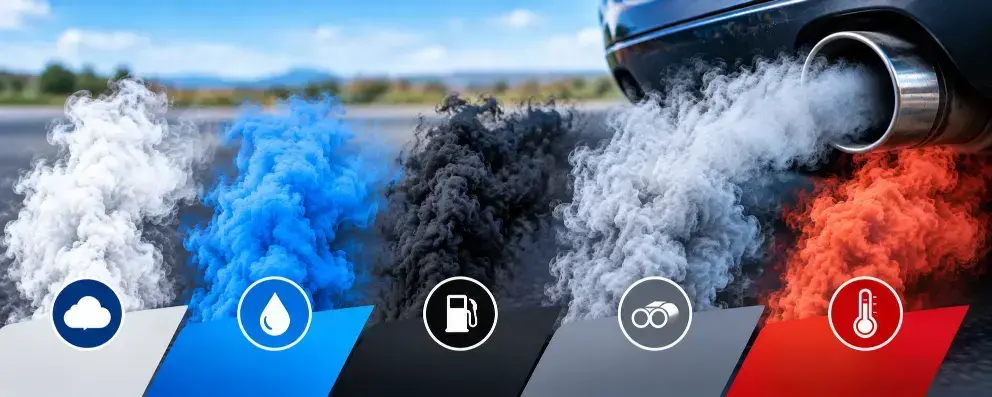
Exhaust smoke is one of the most reliable visual indicators of your engine’s internal health. While a small amount of thin white vapor on a cold morning is completely normal, persistent thick white, black, blue, or gray smoke indicates underlying mechanical issues that require prompt attention.
Quick Diagnostic Guide: Exhaust Smoke Colors
| Smoke Color | Most Likely Cause | Primary Severity | Common Symptoms |
|---|---|---|---|
| Thin White / Vapor | Condensation in exhaust system | Normal / None | Disappears quickly after engine warms up |
| Thick Heavy White | Burning engine coolant | High | Engine overheating, sweet odor, dropping coolant level |
| Black Smoke | Excessive fuel / Rich mixture | Moderate | Reduced MPG, rough idle, soot on tailpipe |
| Blue / Bluish-Gray | Burning engine oil | High | Dropping oil level, burning smell, fouled spark plugs |
| Dense Gray | Burning transmission fluid, PCV valve, or turbo | Moderate to High | Slipping gears, elevated oil consumption |
Exhaust Smoke Color Breakdown: Causes and Solutions
1. White Exhaust Smoke
Thin White Smoke or Vapor (Normal)
When you start your car on a cold day, moisture trapped inside the exhaust pipe turns into steam. This creates a light, wispy white vapor that dissipates within a few minutes once the exhaust system reaches normal operating temperature.
Thick, Continuous White Smoke (Blown Head Gasket / Coolant Leak)
If heavy white smoke streams continuously from the tailpipe even after the engine is fully warm, coolant is leaking into the engine combustion chambers and burning alongside the fuel.
- Common Causes: Blown head gasket, cracked cylinder head, or warped engine block.
- Secondary Signs: Engine overheating, sweet maple-syrup-like smell from exhaust, milky white oil under the oil cap (“milkshake” oil).
- Action Required: Stop driving immediately to prevent complete engine seizure.
2. Black Exhaust Smoke
Black smoke indicates that the engine is burning too much fuel (running an overly “rich” air-fuel mixture). Unburned carbon exits through the tailpipe as dark black soot.
- Common Causes:Clogged or dirty engine air filter.Leaking or stuck-open fuel injector.Faulty oxygen ($O_2$) sensor or Mass Air Flow (MAF) sensor.Malfunctioning fuel pressure regulator.
- Clogged or dirty engine air filter.
- Leaking or stuck-open fuel injector.
- Faulty oxygen ($O_2$) sensor or Mass Air Flow (MAF) sensor.
- Malfunctioning fuel pressure regulator.
- Secondary Signs: Drastic drop in fuel economy (MPG), sluggish engine response, strong gasoline smell.
- Action Required: Inspect air filters, run diagnostic OBD-II scans, and check fuel delivery components.
3. Blue or Bluish-Gray Exhaust Smoke
Blue smoke clearly signals that motor oil is entering the combustion chambers and burning alongside gasoline or diesel fuel.
- Common Causes:Worn or damaged piston rings allowing crankcase oil to slip past the pistons.Worn valve stem seals allowing oil to seep down from the cylinder head.Stuck or clogged PCV (Positive Crankcase Ventilation) valve creating excess pressure.Damaged turbocharger oil seals leaking oil into the air intake.
- Worn or damaged piston rings allowing crankcase oil to slip past the pistons.
- Worn valve stem seals allowing oil to seep down from the cylinder head.
- Stuck or clogged PCV (Positive Crankcase Ventilation) valve creating excess pressure.
- Damaged turbocharger oil seals leaking oil into the air intake.
- Secondary Signs: Rapid oil consumption, burning oil odor, oily tailpipe residue, misfires due to oil-fouled spark plugs.
- Action Required: Check oil level frequently, inspect the PCV valve, and perform a cylinder compression or leak-down test.
4. Dense Gray Exhaust Smoke
Gray smoke can be tricky to diagnose because its causes overlap with both blue and black smoke, but it often stems from specific auxiliary components:
- Common Causes:Failed PCV Valve: Keeps crankcase pressure from venting, forcing oil into the combustion chamber.Transmission Fluid Leak: On older vehicles with vacuum-operated transmission modulators, a failed diaphragm can draw transmission fluid into the engine intake manifold.Failing Turbocharger: Leaking internal bearings force oil directly into the hot exhaust stream.
- Failed PCV Valve: Keeps crankcase pressure from venting, forcing oil into the combustion chamber.
- Transmission Fluid Leak: On older vehicles with vacuum-operated transmission modulators, a failed diaphragm can draw transmission fluid into the engine intake manifold.
- Failing Turbocharger: Leaking internal bearings force oil directly into the hot exhaust stream.
- Action Required: Check both engine oil and transmission fluid levels, and inspect turbocharger piping for oil accumulation.
Frequently Asked Questions: exhaust smoke from car meaning
Is it safe to drive with white exhaust smoke?
If the smoke is thin and dissipates quickly, it is completely safe. However, if it is thick white smoke accompanied by a sweet smell or overheating, do not drive. Running an engine with a head gasket leak can cause severe engine block destruction.
Why does my car smoke when accelerating hard?
Smoking under heavy acceleration usually points to worn piston rings or valve seals (blue smoke) or a rich fuel mixture caused by a faulty sensor or sticking fuel injector (black smoke).
How much does it cost to fix an exhaust smoke issue?
Costs vary significantly based on the root cause:
- PCV Valve / Air Filter: $20 – $150
- Fuel Injector / Sensor Replacement: $150 – $500
- Head Gasket Replacement: $1,200 – $2,500+
- Piston Rings / Engine Rebuild: $2,000 – $4,500+
Can a dirty air filter cause black exhaust smoke?
Yes. A severely clogged air filter restricts airflow into the engine cylinders. Since less air is available for combustion, the computer’s fixed fuel spray creates an overly rich mixture, resulting in black soot and smoke.
What does exhaust smoke smell like?
- Burning Coolant: Sweet, maple syrup smell.
- Burning Oil: Harsh, burnt toast or acrid petroleum odor.
- Rich Fuel Mixture: Heavy raw gasoline odor.
Will exhaust smoke cause my car to fail an emissions test?
Yes. Any visible exhaust smoke (black, blue, or thick white) indicates unburned hydrocarbons, oil, or coolant exiting the system, which will trigger diagnostic trouble codes and cause an immediate emissions test failure.
Key Takeaways: exhaust smoke from car meaning
- Thin White Smoke/Vapor: Usually harmless condensation evaporating on cold mornings.
- Thick White Smoke: A sign of burning engine coolant, typically caused by a blown head gasket, cracked engine block, or damaged cylinder head.
- Black Smoke: Indicates an overly rich fuel mixture (burning too much fuel due to clogged air filters, leaking fuel injectors, or a faulty sensor).
- Blue/Bluish-Gray Smoke: Indicates the engine is burning oil due to worn valve seals, leaking piston rings, or a failed PCV valve.
- Gray Smoke: Can indicate burning transmission fluid (in older automatics), a stuck PCV valve, or turbocharger seal failure.