As a standard industry rule for vehicle preventive maintenance, you should have your wheel alignment checked once a year or every 15,000 to 25,000 kilometers (10,000 to 15,000 miles)—whichever milestone occurs first. Think of an alignment check as a routine wellness assessment for your car’s suspension system. Rather than waiting for a mechanical part to fail completely, checking your alignment parameters annually ensures your steering link geometries are correct, stopping premature tire wear and maximizing rolling fuel efficiency.
The Suspension Framework Roads Dictate the Timeline
Your vehicle’s suspension system is constructed from precisely machined steering links, control arms, and ball joints. Over thousands of kilometers, everyday driving forces gradually cause these links to slip out of their original positions. How quickly your alignment drifts depends entirely on your driving environment:
Standard Commuting
If your daily route consists of smooth asphalt highways and standard suburban roads, an annual check is perfectly sufficient to correct minor structural drift caused by normal wear-and-tear.
Severe Roads and Heavy Hauling
If you regularly commute over frost-heaved roads, hit deep potholes, travel down unpaved gravel trails, or use your truck for heavy commercial towing, your suspension handles immense stress. You should have your tracking checked every 6 months to prevent your tires from scrubbing away their rubber prematurely.
Tell-Tale Warning Signs You Need an Alignment Right Away
You should completely bypass your service calendar and book an appointment at an independent workshop floor immediately if your vehicle exhibits any of these classic alignment red flags:
- The Steering Wheel Tug: When driving down a flat, straight road, your vehicle noticeably veers or drifts toward the left or right shoulder the moment you relax your grip on the steering wheel.
- An Off-Center Steering Wheel: When your vehicle is traveling completely straight forward, the steering wheel’s center spoke or logo is visibly crooked, tilted, or off-center.
- Abnormal Tire Wear Patterns: The inner or outer rubber shoulders of your tires are wearing down significantly faster than the center tread. This is often visible as diagonal shaving (feathering) or wavy dips across the rubber (cupping).
- Squealing Tires on Gentle Turns: Your front tires emit a sharp scrubbing or squealing sound when making standard turns at low speeds through parking garages or intersections.
The Geometry Specs — Camber, Caster, and Toe
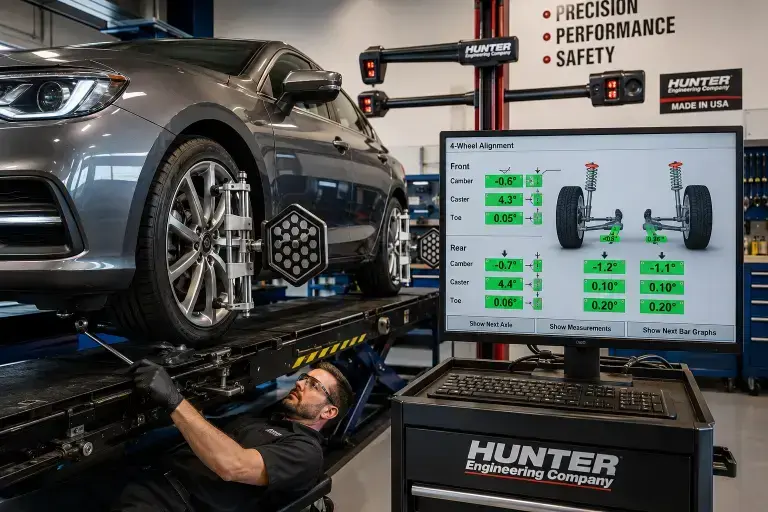
When a licensed mechanic places your vehicle onto a computerized laser alignment rack, they are measuring three highly distinct angles built into your steering links:
Toe ($Toe\text{-}In$ / $Toe\text{-}Out$)
This measures the exact direction the tires are pointing relative to the centerline of the vehicle when viewed from directly above. If your tires point inward toward each other ($Toe\text{-}In$) or outward away from each other ($Toe\text{-}Out$), they will slide down the road sideways, wiping out your tire tread within weeks.
Camber (Positive / Negative)
This is the inward or outward tilt of the wheel when viewed from directly in front of the vehicle. Excessive negative camber (top of the tire tilting inward) strains your internal wheel bearings and strips away the inner tire shoulders.
Caster
The forward or backward tilt of the steering axis when viewed from the side. Proper caster ensures your steering wheel naturally returns to the center position automatically after completing a turn and maintains high-speed highway stability.
Situations That Mandate an Immediate Alignment
Beyond your annual milestone check, there are two specific mechanical events that require resetting your steering links back to factory blueprints:
1. When Installing Fresh Tires
Whenever you invest in a brand-new set of matching tires, getting a computerized alignment is highly recommended. If your vehicle’s underlying angles are skewed, a misaligned suspension will permanently scrub away the tread of expensive new rubber within a few thousand kilometers, completely voiding your tire wear warranties.
2. Following Steering or Suspension Repairs
If a technician replaces a worn-out tie rod end, lower control arm, ball joint, or stabilizer link, the structural geometry of your steering system is completely disturbed. An alignment is mandatory immediately following these repairs to calibrate the new parts back to original factory parameters.
The Oil Service and Fluid Maintenance Connection
Because performing a proper wheel alignment requires raising your vehicle on a specialized drive-on rack and removing the wheel tracking assemblies, it pairs beautifully with other routine preventative milestones.
When you bring your vehicle into an independent garage for a routine engine oil change or automatic transmission fluid service, the technician will raise the car and scan your tire tread profiles. Catching a skewed toe angle early during an oil change lets you combine your services, keeping your car tracking straight without requiring multiple shop visits.
Full-Service Automotive Excellence
Maintaining your automobile requires viewing the vehicle as a fully integrated ecosystem. Bringing your vehicle to a full-service facility ensures that any underlying suspension issues found during an alignment check can be addressed on the spot.
A premier repair workshop floor handles everything required to keep your automobile dependable and safe. If your brakes are squealing or displaying a soft pedal feel, a comprehensive brake repair service will fully restore your stopping confidence. If your vehicle is exhibiting complex running issues, licensed technicians can pinpoint the exact wheel sensor or wiring issue triggering an ABS light or check engine alert.
From restoring crisp, icy airflow with an expert air conditioning service to tracking down complex mechanical faults, comprehensive care saves time. If your manual gearbox is fighting your inputs up steep hills, a specialized clutch repair balances your power delivery. Furthermore, for high-mileage engines, booking a preemptive timing belt repair provides absolute insurance against catastrophic internal engine valve damage.
Restoring Steering Precision and Total Peace of Mind
Allowing your suspension to operate out of factory spec leaves your vehicle highly vulnerable to accelerated tire wear, decreased fuel tracking efficiency, and compromised steering control during sudden emergency lane changes. Opting for a professional, computerized wheel alignment completely restores your steering precision, extends the life of your tires, and ensures your daily commutes remain safe and worry-free.
Frequently Asked Questions: how often should i do wheel alignment
What is the main difference between a wheel alignment and tire balancing?
A wheel alignment corrects the underlying mechanical angles of your steering links and suspension components so that your tires roll parallel to each other and track straight. A professional tire repair service incorporates wheel balancing, which places small weights along the rim flange to correct natural heavy spots within the spinning rubber assembly itself, entirely removing high-speed steering vibrations.
What is the difference between a two-wheel and a four-wheel alignment?
A two-wheel (front-end) alignment only measures and adjusts the steering components on the front axle. A four-wheel alignment calibrates all four wheels back to the vehicle’s centerline. Most modern front-wheel-drive cars, crossovers, and independent suspension SUVs require a full four-wheel alignment to handle properly.
Can bad alignment cause my steering wheel to shake at high speeds?
Usually, no. High-speed steering wheel shaking or vibration is almost always caused by an unbalanced tire or an out-of-round wheel rim. A bad alignment causes your vehicle to pull hard to one side or causes your steering wheel to sit crooked, but it does not create a rhythmic physical shake.
Can I do a wheel alignment myself at home?
While you can perform rough alignment checks using strings and tape measures, modern vehicle suspension systems require tolerances measured in fractions of a millimeter. A professional computerized alignment rack uses specialized laser sensors and camera arrays to calibrate your steering links back to exact factory specs, which cannot be duplicated at home.
How long does a standard wheel alignment service take?
Under normal conditions, a standard two-wheel or four-wheel alignment service takes between 45 to 60 minutes. The process can take a bit longer if your suspension bolts are heavily rusted, or if components like tie rods are completely seized and require heating with a torch to break them loose.
Why is my car still pulling after getting a fresh alignment?
If your alignment specs match factory parameters but the car still pulls, you may be experiencing a “radial pull” caused by an uneven tire wear pattern that developed before the alignment was fixed. It could also indicate a sticking brake caliper or a worn internal steering gear valve body.
Key Takeaways: how often should i do wheel alignment
- The Baseline Blueprint: Schedule a computerized wheel alignment check once a year or every 15,000 to 25,000 kilometers to maintain total safety.
- Watch for Red Flags: Book an appointment immediately if your car pulls to one side, has a crooked steering wheel, or displays rapid, uneven tire wear.
- Mandatory Replacements: Always pair a wheel alignment with the installation of fresh tires or the replacement of steering wear components like tie rods.
- Know Your Specs: Computerized racks calibrate three critical geometric specifications: Camber, Caster, and Toe angles.
- The Maintenance Connection: Checking your alignment during a routine oil change or transmission service is the most efficient way to maximize tire longevity.
- Independent Shop Accuracy: Booking your service with an established local independent facility guarantees laser-accurate calibration, certified technicians, and completely transparent turnaround times.