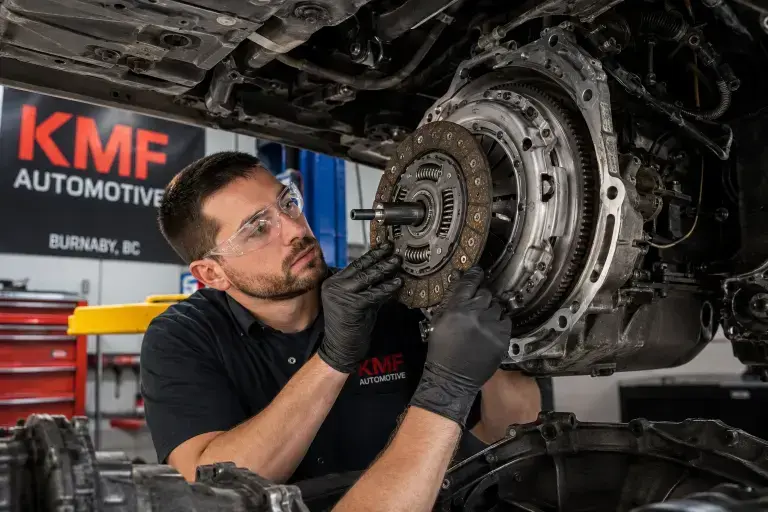
If your manual transmission is slipping out of gear, revving wildly without accelerating, or fighting you when you try to shift, your clutch assembly is worn out. At KMF Automotive, adjusting a hydraulic clutch fluid line or replacing a faulty master cylinder typically takes 1 to 2 hours. A complete clutch kit replacement (clutch disc, pressure plate, throw-out bearing, and flywheel resurfacing) requires dropping the transmission, which takes between 4 and 8 hours of dedicated shop bench time. Continuing to drive with a slipping clutch will permanently warp your flywheel and leave you completely stranded. Contact us directly or visit our Burnaby facility today for an honest, upfront quote.
The Core Architecture of Your Vehicle’s Clutch System
When local drivers look for reliable clutch repair in Burnaby, BC, they are dealing with the mechanical bridge that connects their engine’s raw spinning power to their transmission. Unlike an automatic vehicle that uses fluid dynamics to shift gears, a manual transmission relies on direct mechanical friction. The clutch assembly allows you to temporarily disconnect a spinning engine from a stationary or moving transmission so you can shift gears smoothly without grinding the gear teeth.
Understanding how these core parts mesh together makes it clear why a failure in just one piece compromises your entire drivetrain:
- The Flywheel: A heavy metal disc bolted directly to the engine’s crankshaft. It acts as a smooth momentum balancer and provides the primary friction surface for the clutch to lock onto.
- The Clutch Disc: A steel plate coated on both sides with high-friction material (similar to brake pads). Splined directly to the transmission’s input shaft, it sits sandwiched tightly between the flywheel and pressure plate.
- The Pressure Plate: A spring-loaded steel cover bolted to the flywheel. It exerts a massive clamping force to squeeze the clutch disc tightly against the flywheel, locking the engine and transmission together at the same speed.
- The Release (Throw-out) Bearing & Fork: When you step on the clutch pedal, mechanical or hydraulic force pushes this bearing against the pressure plate’s diaphragm springs, releasing the clamping force so the disc can spin independently.
- The Hydraulic System (Master & Slave Cylinders): Modern vehicles use fluid pressure to operate the clutch. Pressing the pedal pushes fluid out of the master cylinder, down a high-pressure line, and into the slave cylinder, which physically moves the release fork.
Why Do Automotive Clutches Wear Out?
Clutch components are friction wear items, much like your vehicle’s brake pads. Under normal driving conditions, a high-quality factory clutch assembly can last anywhere from 100,000 to 150,000 kilometers. However, driving habits and local environment dictate how quickly that friction material degrades.
The primary enemy of a clutch disc is excessive heat caused by prolonged slippage. When a driver “rides the clutch”—keeping the pedal partially depressed while driving—or constantly holds the vehicle on steep Burnaby hills using the clutch instead of the brakes, the disc slips continuously against the spinning flywheel.
This friction generates extreme thermal energy that can rapidly heat the assembly past 300°C. This extreme heat glazes over the friction material, making it brittle and smooth, which robs the pressure plate of its ability to bite and hold power.
Diagnostic Insights: Warning Signs You Cannot Ignore
Catching a clutch issue early can prevent a minor component problem from snowballing into a massive repair bill that includes a ruined flywheel or a damaged transmission housing. Pay close attention to these distinct mechanical red flags:
The Slipping Clutch (Loss of Power)
The most common symptom of a failing clutch disc. You step on the gas pedal to accelerate up a steep hill or merge onto the highway; your engine revs up quickly, and your tachometer needle climbs, but your vehicle’s road speed does not increase, matching the roar of the engine. This means the pressure plate can no longer hold the worn disc tightly against the flywheel, letting the engine spin right past it.
Shifting Difficulties and Auditory Clues
- Hard Gear Engagement: If you push the clutch pedal completely to the floor but find yourself physically forcing the shift lever into gear, or if you hear a violent grinding sound when shifting, the clutch is not disengaging fully. This is usually caused by air trapped in the hydraulic fluid line or a failing master cylinder.
- A Soft, Spongy, or Dropped Pedal: If the clutch pedal feels completely soft underfoot, offers zero resistance, or sinks directly to the floorboards and stays there, you are dealing with a severe hydraulic pressure failure or a blown slave cylinder seal.
- High-Pitched Whining or Chirping: If you hear a distinct whirring or chirping noise whenever you lightly press your foot down on the clutch pedal, your throw-out bearing is worn out and dry of lubricant.
Professional Repair Protocols vs. Backyard Inaccuracy
Some independent tutorials suggest adjusting the clutch pedal linkage or adding stop-leak additives to hydraulic reservoirs to eliminate gear grinding. These are temporary band-aids. If a clutch disc’s friction lining is worn down to its metal rivets, no amount of adjustment will restore its holding capacity, and forcing it to drive will deeply score and ruin your expensive flywheel.
When you bring your manual vehicle to KMF Automotive, we perform a thorough, professional teardown. We raise the vehicle on our shop lifts and safely extract the transmission housing. We measure the flywheel with precision micrometers for warping or heat-checking.
If the flywheel is healthy, we resurface it on a precision lathe to create a perfectly flat, fresh mating surface; if it is deeply cracked from extreme heat, we replace it entirely. We then install a complete, balanced clutch kit, including a fresh disc, a brand-new pressure plate, and a crisp throw-out bearing, before refilling and bleeding the hydraulic lines with premium fluid to guarantee sharp pedal feedback.
The Mechanical Connection Between Your Drivetrain and Your Tires
Your clutch assembly handles the direct transfer of kinetic energy from your engine straight through the wheels to your tires. When a clutch is dropping its clamping force or grabbing violently due to a warped pressure plate, it creates severe mechanical shockwaves throughout your entire drivetrain. This violent shaking and chattering at launch places sudden stress on your constant-velocity (CV) axle joints, transmission mounts, and differential gears.
Over time, this drivetrain vibration can alter your suspension alignment or wear down your steering links. If your vehicle suffered severe mechanical chattering or took a hard driveline impact during a clutch failure, it is highly wise to pair your repair with a precise computerized wheel alignment in Burnaby. Ensuring your suspension angles match factory settings prevents your tires from scrubbing away their tread unevenly and guarantees your car tracks straight and true.
Comprehensive Automotive Care at KMF Automotive
At KMF Automotive, we operate a full-service, owner-operated mechanical workshop designed to manage your vehicle’s entire maintenance needs. While our licensed technicians have your transmission dropped to secure your clutch assembly, it provides a highly convenient window to address other critical maintenance items, saving you an extra trip to the mechanic later.
Our shop floor is fully equipped to handle any diagnostic or mechanical challenge with complete dealership accuracy. If your engine is due for a regular service interval, we provide warranty-approved, premium oil changes using top-tier lubricants to keep your motor running clean. If your dashboard check engine light is illuminated, or if you notice an unusual squealing noise under braking, our comprehensive brake repair service in Burnaby will completely restore your vehicle’s safety.
We provide extensive service specializations across all major automotive systems. From resolving poor cabin airflow with an expert air conditioning service in Burnaby to tracking down complex mechanical issues, we handle it all. If your manual transmission suffers from a slipping clutch pedal, our specialized clutch repair service will restore smooth, efficient power delivery. Furthermore, if you are approaching a major manufacturer mileage milestone, booking a preemptive timing belt repair in Burnaby protects your engine from catastrophic, irreversible valve damage. From minor fixes to major overhauls, we treat your car with the exact level of precision we would give our very own vehicles.
Restoring Performance and Total Peace of Mind
Allowing a slipping or chattering clutch to linger might seem like something you can manage by driving gently, but it continuously threatens your driving safety and places undue stress on your entire drivetrain. Choosing a professional-grade clutch kit replacement, flywheel resurfacing, and complete hydraulic system bleeding eliminates the risk of getting stranded on the roadside and restores your manual transmission to crisp, effortless shifting. Trusting our experienced team ensures your daily commute stays smooth, reliable, and exceptionally efficient.
Schedule Your Clutch Inspection in Burnaby Today
Don’t struggle with hard gear changes, an embarrassing engine slip, or a spongy clutch pedal that saps your vehicle’s performance. Our certified mechanics at KMF Automotive are fully prepared to accurately test, diagnose, and resolve your transmission issues with transparent communication and upfront pricing.
Conveniently located at 7080 Macpherson Ave in Burnaby, BC (V5J 4N3), just a brief walk from the Royal Oak SkyTrain Station, we proudly serve local car owners across the Lower Mainland with honest, dependable automotive craftsmanship. Call our friendly team today at 604-438-0222 or contact us online to schedule your service appointment or drop by for an expert driveline inspection.
Frequently Asked Questions: clutch repair Burnaby BC
What is the main difference between a wheel alignment and tire balancing?
A wheel alignment corrects the underlying mechanical angles of your vehicle’s steering and suspension links so that the tires roll perfectly parallel to each other and track straight down the road. Our professional tire repair service in Burnaby incorporates wheel balancing, which uses small weights on the rim flange to counteract natural heavy spots within the spinning rubber assembly itself, eliminating high-speed steering wheel vibrations.
How long does a standard professional clutch replacement service take?
Because a full clutch replacement requires completely unbolting and dropping your vehicle’s transmission to access the engine flywheel, it is a labor-intensive project. On most standard front-wheel or rear-wheel-drive vehicles, the entire process takes between 4 and 8 hours of focused shop floor bench time.
Can I replace just the worn clutch disc and reuse the old pressure plate?
We strongly discourage this. A clutch pressure plate undergoes intense thermal cycles and loses its spring tension over time. If you install a brand-new friction disc against a worn, fatigued pressure plate, the clutch will likely slip prematurely. Replacing the disc, pressure plate, and throw-out bearing together as a matched kit ensures uniform wear and optimal longevity.
4. Why does my car’s clutch pedal stay stuck flat on the floorboard?
A clutch pedal that drops to the floor and fails to return means there is a complete loss of hydraulic pressure within the shifting line. This is caused by a low fluid reservoir, a severely leaking master cylinder piston seal, or a ruptured slave cylinder boot that is letting brake fluid escape and allowing atmospheric air to fill the system.
What does “chattering” mean when talking about a vehicle’s clutch?
Clutch chattering is a violent shudder or vibration that ripples through the car when you first release the pedal to launch from a complete stop. It occurs when the clutch disc grips and slips unevenly against the flywheel rather than engaging smoothly. This is usually caused by oil or grease contamination on the friction material or a deeply warped flywheel face.
Is clutch fluid different from standard vehicle brake fluid?
No, the vast majority of modern hydraulic clutch systems utilize standard automotive brake fluid (typically DOT 3 or DOT 4) directly from the vehicle’s brake reservoir or a dedicated matching clutch reservoir. Over time, this fluid absorbs ambient moisture and turns dark, which can corrode internal rubber pistons and require a complete system flush.
Key Takeaways: clutch repair Burnaby BC
- Mechanical Power Transmission: The clutch assembly acts as a critical friction interface, allowing temporary disconnection between a spinning engine and a manual transmission.
- Thermal Abuse Consequences: Riding the clutch pedal or slipping it on steep inclines creates intense heat that glazes over friction linings, permanently destroying their biting capability.
- Prompt Warning Signs: Slipping RPMs under load, grinding gear transitions, and spongy pedal feedback point directly to an immediate need for clutch or hydraulic system service.
- The Component Kit Reality: Longevity requires replacing the friction disc, pressure plate, and throw-out bearing as a fully matched unit alongside a professionally resurfaced flywheel.
- Secondary Stress Impacts: Severe launch chatter sends destructive vibrations through CV axles and engine mounts, making an undercarriage suspension check essential.
- Trusted Local Automotive Care: Choosing an established, independent shop provides access to precision transmission toolsets, clear communication, and honest, competitive pricing.