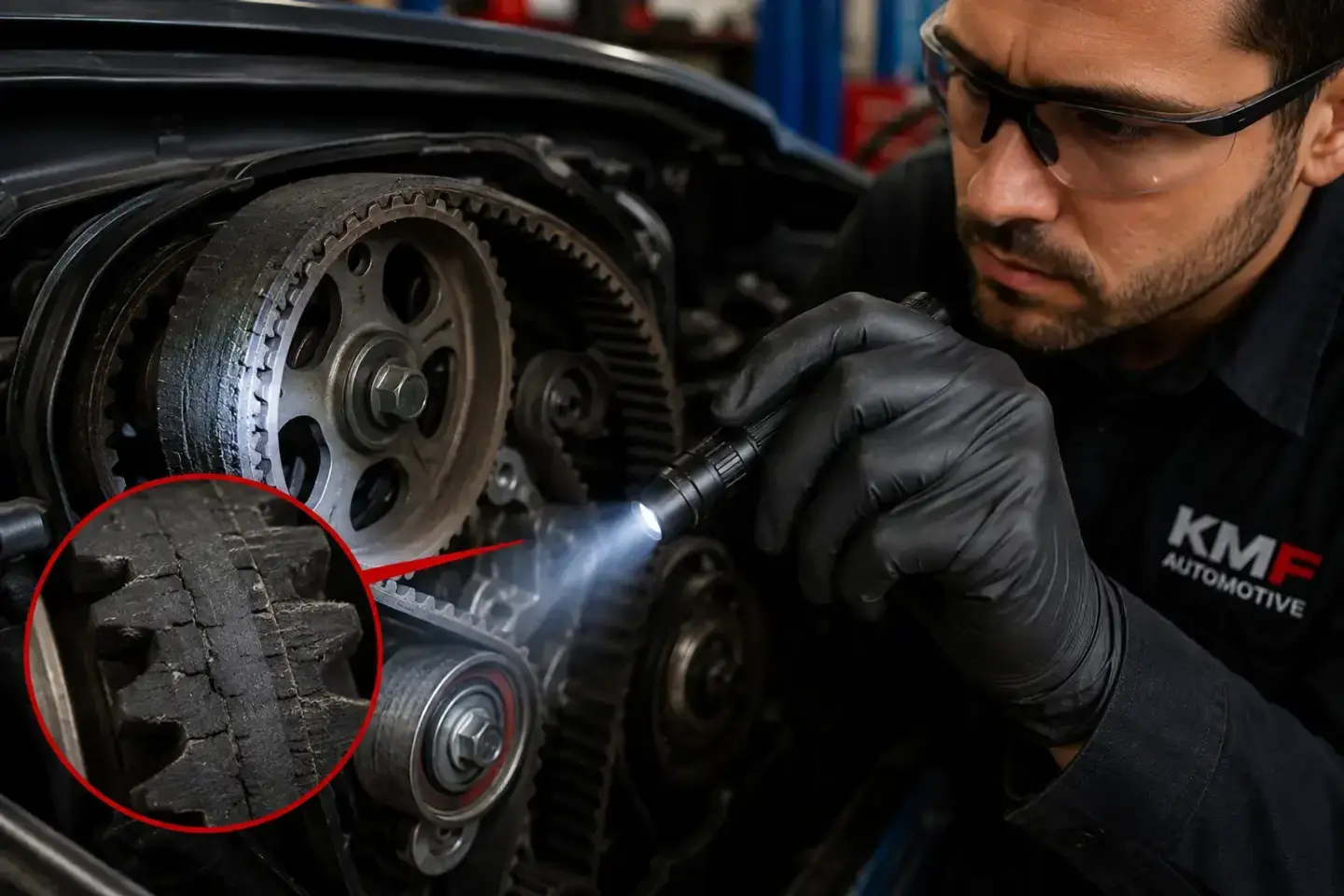
A timing belt is a critical preventative maintenance item that synchronizes your engine’s internal cylinders and valves. Unlike brakes or belts that screech loudly, a timing belt often fails silently with zero warning signs. However, subtle red flags like a rhythmic ticking noise from the engine, frequent engine misfires, oil leaks near the front covers, or an engine that refuses to start can point to a failing belt track. At KMF Automotive, a full timing kit and water pump overhaul takes 3 to 5 hours of specialized shop time. Ignoring these signs on an interference engine risks total piston-to-valve destruction. Contact us or stop by our Burnaby facility today if you suspect engine timing trouble.
The Silent Orchestrator: What Does a Timing Belt Do?
To understand the warning signs of a failing timing belt, you first need to understand its high-stakes job under your vehicle’s hood. Your engine is split into two primary mechanical areas: the bottom half (the crankshaft and pistons) and the top half (the camshaft and intake/exhaust valves).
The timing belt is a heavy-duty, reinforced rubber band lined with thick, molded teeth along its inner surface. It wraps around the camshaft and crankshaft gears, acting as a strict structural coordinator.
Its sole purpose is to ensure that the engine’s valves open and close at the exact millisecond required relative to the rapid up-and-down movement of the pistons. If this timing slips by even a fraction of an inch, your engine’s internal balance is broken, and combustion ceases instantly.
Rhythmic Ticking Noise from the Engine
While a timing belt will rarely make a traditional slipping screech, an aging or loosening belt can produce a distinct, rhythmic ticking or clicking sound coming from behind the front plastic engine covers.
This ticking noise usually happens when the belt has stretched past its structural limits or when the hydraulic timing belt tensioner has begun to lose its pressure. When the belt loses its factory tautness, it whips slightly along its track, creating a fast, repetitive clicking sound that increases in speed as your engine’s RPMs. If you hear a clear ticking noise that sounds like a clock echoing from the front of your motor, it demands immediate professional inspection.
Engine Misfires and Rough Idling
Because the timing belt keeps your engine’s internal valves operating down to the millisecond, any physical stretching or missing teeth along the rubber track will throw off your vehicle’s combustion cycle.
If the belt stretches excessively, it can skip a tooth on the camshaft or crankshaft sprocket. This minor slip causes the valves to open or close slightly too early or too late. The result is an immediate engine misfire, a rough, violently shaking idle, a severe drop in highway acceleration power, and an illuminated dashboard Check Engine Light.
Front Engine Oil Leaks
Many timing belt failures are not caused by simple old age, but rather by secondary fluid contamination. During a routine oil check, look closely at the front center sections of your engine block and the edges of the plastic timing belt covers.
If you notice active engine oil weeping or puddling near the front of the motor, your front camshaft seals or crankshaft seals have likely degraded and cracked. Pressurized engine oil will slowly seep past these failing rubber O-rings and coat the dry timing belt chamber. Because petroleum products chemically dissolve and break down rubber compounds, oil contamination will rapidly soften the belt, causing its molded teeth to slide off and strip away prematurely.
The Engine Cranks but Won’t Start
If your vehicle was running fine a moment ago, but now refuses to turn over when you turn the key, your timing belt may have snapped completely while the car was turned off or right when you parked.
When you turn the ignition key, you will hear the starter motor engage and hum at an unusually fast, high-pitched whirring speed. This distinct sound happens because the broken belt means the camshaft is no longer turning to open the valves. Without closed valves, the engine has zero internal compression resistance, allowing the starter motor to spin the crankshaft freely and effortlessly without ever catching or starting the car.
Structural Disassembly and the Wheel Alignment Connection
Replacing a timing belt is a highly complex task that involves major engine disassembly. To clear a path to the lower crankshaft pulleys, our licensed technicians must support your engine block with specialized cranes so they can safely unbolt major passenger-side engine mounts. In many modern vehicle configurations, sections of the steering linkages and the front suspension subframe must also be moved out of the way.
Because these heavy structural foundations are shifted and re-torqued during reassembly, your front wheel tracking parameters will change slightly. To protect your mechanical investment, we strongly advise pairing your engine repairs with a precise computerized wheel alignment in Burnaby. Restoring your factory steering alignment avoids unexpected highway pulling, optimizes your rolling fuel economy, and protects your tires from scrubbing down their tread unevenly on the pavement.
Full-Service Mechanical Excellence at KMF Automotive
At KMF Automotive, we operate a full-service, independent mechanical workshop equipped to handle your vehicle’s entire maintenance ecosystem. Because a full timing belt overhaul requires our licensed technicians to open up the front architecture of your motor, it opens up a highly efficient window to address other pending maintenance tasks without paying for overlapping disassembly labor.
Our workshop floor handles everything required to keep your automobile dependable, safe, and efficient. If your vehicle is approaching its next routine service window, we provide factory-approved, premium oil changes using top-tier synthetic lubricants to preserve engine longevity. If your dashboard check engine light is glowing, or if you notice an unusual squealing sound under hard braking, our comprehensive brake repair service in Burnaby will fully restore your stopping confidence.
We provide deep technical expertise across all major automotive platforms and comfort systems. From restoring crisp, icy airflow with an expert air conditioning service in Burnaby to tracking down complex mechanical faults, we handle it all. If your manual gearbox is fighting your inputs, our specialized clutch repair service in Burnaby balances your power delivery. Furthermore, for high-mileage engines, booking a preemptive timing belt repair in Burnaby provides absolute insurance against catastrophic internal engine valve damage. We treat your vehicle with the exact level of precision and honesty we would give our own.
Schedule Your Timing Belt Inspection in Burnaby Today
Don’t wait for a ticking noise or an engine misfire to turn into a total engine breakdown on a busy highway. Our certified mechanics at KMF Automotive are fully prepared to accurately test, diagnose, and resolve your vehicle’s timing issues with upfront transparency and honest pricing.
Conveniently located at 7080 Macpherson Ave in Burnaby, BC (V5J 4N3), just a brief walk from the Royal Oak SkyTrain Station, we proudly serve local car owners across the Lower Mainland with exceptional automotive craftsmanship. Call our friendly local shop today at 604-438-0222 or contact us online to schedule your service appointment or drop by for an expert powertrain consultation.
Frequently Asked Questions: signs timing belt is going bad
What is the main difference between a wheel alignment and tire balancing?
A wheel alignment corrects the underlying physical angles of your steering links and suspension components so that the tires roll perfectly parallel to each other and track straight. Our professional tire repair service in Burnaby incorporates wheel balancing, which uses small weights on the rim flange to counteract natural heavy spots within the spinning tire rubber itself, completely removing high-speed steering wheel vibrations.
Why doesn’t a bad timing belt squeal like an alternator accessory belt?
External accessory belts feature smooth or multi-grooved V-shaped channels that run on friction. If they are loose or wet, they slip across the spinning pulleys, producing a high-pitched rubber squeal. A timing belt is structurally lined with thick, hard teeth that interlock directly into matching gear notches; it cannot slip without tearing or snapping entirely, keeping it quiet until it fails.
What is an interference engine, and why does a bad belt threaten it?
In an interference engine layout, the mechanical clearance paths of the valves and pistons overlap within the cylinder chamber. They are kept from striking one another solely by the timing belt’s synchronization. If a worn belt snaps at speed, the valves instantly freeze open while the pistons continue to slam upward at thousands of RPMs, instantly shattering internal engine components.
Should I replace my water pump if my timing belt appears to be wearing out?
Yes, absolutely. On the vast majority of modern consumer cars, the water pump is driven directly by the timing belt and lives behind the same protective shields. Because accessing this area requires hours of intensive teardown labor, replacing your water pump, idler pulleys, and belt tensioners simultaneously as a complete kit ensures uniform longevity and saves you from paying double labor fees later.
How many kilometers does a factory rubber timing belt normally last?
While driving environments vary, most automotive manufacturers recommend a hard preventative replacement interval between 90,000 and 160,000 kilometers, or every 7 to 10 years, whichever metric hits first. Because rubber naturally dries out and undergoes material breakdown over time, regardless of total use, age is just as dangerous as high mileage.
Can driving on a bad timing belt trigger a Check Engine Light?
Yes, it frequently does. If a stretched or failing timing belt skips a single tooth on the camshaft gear, the engine’s internal sensors will instantly detect a mismatch between the rotation angles of the cam and crankshaft. This timing deviation triggers an immediate dashboard Check Engine Light, usually accompanied by error codes indicating camshaft position correlation issues or engine misfires.
Key Takeaways: signs timing belt is going bad
- The Silent Threat Reality: Timing belts do not squeal when failing and often break with zero warning, making odometer tracking your best line of defense.
- Auditory Red Flags: A fast, rhythmic clicking or ticking sound echoing from behind the front plastic engine shrouds points to a loose, failing belt track.
- Combustion Disruptions: Frequent engine misfires, rough idling vibrations, and sudden power drops can mean the belt has stretched and skipped a gear tooth.
- Chemical Degradation Risks: Active oil leaks from front camshaft and crankshaft seals will coat the rubber loop, rapidly melting and dissolving its molded teeth.
- Chassis Reassembly Realities: Deep front-engine work requires unbolting structural mounts and shifting suspension elements, making a follow-up wheel alignment highly recommended.
- Dependable Local Repair Value: Trusting your vehicle to an established independent automotive workshop ensures access to certified technicians, advanced diagnostics, and upfront pricing.