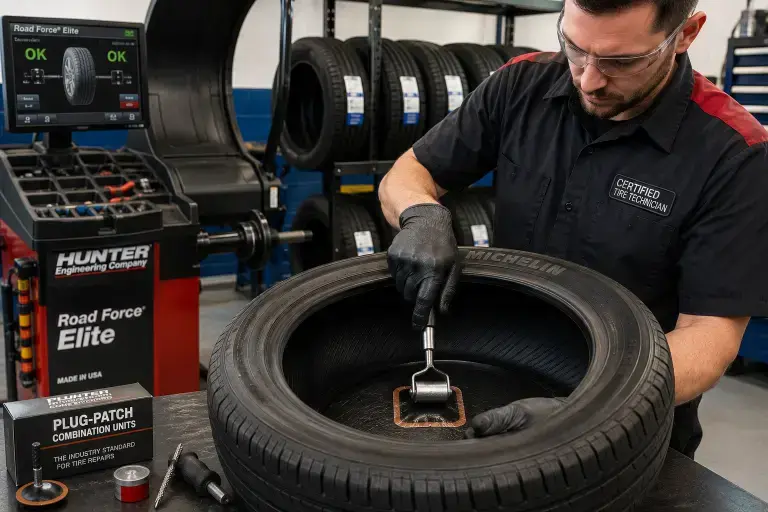
A permanent, safe tire repair cannot be done from the outside with a simple roadside rope plug. According to strict industry safety standards, a tire must be completely dismounted from the wheel rim so a technician can inspect the internal rubber liner for structural damage. The only approved method to fix a flat is a combination tire patch-and-plug unit inserted from the inside out. This dual-action repair physically fills the injury path through the tread to keep moisture away from the internal steel belts while vulcanizing a structural patch over the inner liner to hold pressurized air safely.
The Anatomy of a Repairable Tire Injury
Before attempting a repair, a technician must evaluate the location and severity of the puncture. Not every flat tire can be salvaged safely:
The Safe Repair Zone
A puncture is only eligible for repair if it is located entirely within the center crown tread area—roughly 1/2 inch (13 mm) away from the inner and outer shoulder edges.
The Non-Repairable Zone
The sidewalls and shoulders of a tire flex aggressively under the weight of your vehicle when cornering. If a patch is applied to a sidewall or shoulder puncture, this constant structural bending will cause the patch to loosen and fail, risking a high-speed blowout.
The Structural Rejection Criteria: A tire must be discarded if the puncture hole is larger than 1/4 inch (6 mm) in diameter, if the tire has been repaired in the same spot previously, or if it was driven on while completely deflated (which shreds the internal sidewall support cords).
Step-by-Step Professional Patch-and-Plug Repair
Dismount and Internal Inspection
The tire is placed on a pneumatic tire-changing machine to break the bead and pull the rubber completely off the metal rim. The technician inspects the inner liner for fine black rubber powder or a creased crease ring—classic signs that the tire was run flat and is structurally compromised.
Reaming the Injury Path
The technician locates the offending nail or screw, removes it with pliers, and inspects the entry angle. They run a specialized low-speed pneumatic drill equipped with a carbide reamer bit through the hole three times from the inside out. This clears out jagged wires, rust, and debris, shaping a uniform channel for the plug stem.
Buffing the Inner Liner
Using a specialized pre-buff cleaner solution and a mechanical scraper, the technician removes mold lubricants from a 2-inch circle around the puncture on the inner liner. They use a high-speed buffer tool with a textured stone attachment to gently roughen the smooth inner rubber to a velvet-like texture (RMA buff texture #1 or #2), providing an ideal bonding surface.
Applying Fast-Dry Vulcanizing Cement
The technician brushes a layer of specialized fast-dry vulcanizing fluid into the drilled channel and across the freshly buffed inner rubber patch zone, letting it air-dry until it feels slightly tacky.
Inserting the Combination Patch-Plug
The technician peels the protective backing off an integrated patch-plug unit. They push the pointed metal quill tip of the rubber stem through the hole from the inside out. Using pliers on the outside of the tread, they pull the stem firmly until the circular patch base seats flat and flush against the interior lining of the tire.
Stitching and Sealing
A mechanical stitching wheel tool is rolled firmly over the patch from the center outward to roll out trapped air pockets and complete the vulcanizing chemical bond. The technician covers the exposed edges of the patch with a layer of liquid inner-liner sealant to replace any factory coating worn away during buffing.
Final Mounting and Balancing
The tire is re-mounted onto the wheel rim and inflated back to standard door-jamb PSI parameters. The technician trims the remaining outer stem completely flush with the surrounding tread blocks. The assembly is placed onto a computer wheel balancing machine to correct any heavy spots before the wheel is bolted back onto the vehicle.
The Preventive Fluids and Oil Maintenance Connection
Because executing a proper tire repair requires dismounting the wheel assembly entirely, it provides an excellent diagnostic window to check your car’s underlying mechanical health during a scheduled oil service or transmission fluid change.
When you bring your vehicle into an independent garage to locate a slow air leak, the technician will elevate the chassis. Removing the wheel gives them open access to inspect your brake pad thickness, look for leaking strut fluid, and check the inner shoulders of your remaining tires for uneven wear. Catching a skewed toe alignment profile during a routine tire repair allows you to combine your service milestones, maximizing your overall tire investment in a single visit.
Comprehensive Full-Service Automotive Reliability
Your tires function as your vehicle’s sole point of contact with the road. If you ran over road debris that punctured your tread, the severe jolt or subsequent flat may have placed structural stress on other underbody tracking assemblies.
A premier, full-service independent garage handles everything required to keep your automobile dependable and safe. If the flat tire was caused by hitting a jagged pothole that also warped your suspension alignment or a wheel rim, a computerized wheel alignment service will fully restore your tracking accuracy. If that same impact damaged a caliper pin or cracked a sensor, comprehensive brake repair services and electrical diagnostics can quickly pinpoint the exact root cause triggering an ABS light or check engine alert.
From restoring crisp, icy airflow with an expert air conditioning service to tracking down complex mechanical faults, comprehensive care saves time. If your manual transmission or torque delivery feels loose following an underbody impact, a specialized clutch repair balances your power delivery. Furthermore, for high-mileage engines, booking a preemptive timing belt repair provides absolute insurance against catastrophic internal engine valve damage.
Precision Repairs and Total Highway Confidence
Slowing down a slow air leak with a cheap, external roadside rope plug leaves your tire exposed to structural rust along its internal steel belts and runs a high risk of pressure failure on the highway. Entrusting your flat to a professional tire service bay using an interior patch-plug combination completely restores the structural integrity of your rubber, seals out moisture, and ensures your daily commutes remain smooth and completely worry-free.
Frequently Asked Questions: How much to repair a tire
What is the main difference between a wheel alignment and tire balancing?
A wheel alignment corrects the underlying mechanical angles of your steering links and suspension components so that your tires roll parallel to each other and track straight. A professional tire repair service incorporates wheel balancing, which places small weights along the rim flange to correct natural heavy spots within the spinning rubber assembly itself, entirely removing high-speed steering vibrations.
Are temporary emergency tire strings or rope plugs safe to leave in a tire permanently?
No, temporary external string plugs are strictly designed as an emergency roadside measure to help you drive safely to the nearest repair shop. Because the tire is not dismounted, an external plug cannot seal the internal lining and fails to protect the hidden internal steel cords from moisture, rot, and rust separation over time.
Can you repair a tire that has a puncture in the sidewall?
No, sidewall punctures can never be repaired safely under any circumstances. The sidewall undergoes immense load flexing and structural stress every time the vehicle accelerates, brakes, or turns. This bending forces patches to peel loose within a few miles, which can result in an instant high-speed blowout.
Is aerosol tire sealant (like Fix-a-Flat) bad for my tires?
Emergency pressurized tire sealants are designed to get you out of a dangerous roadside situation, but they are highly toxic, messy temporary fixes. The liquid chemical coating coats the inside of the tire unevenly, throwing off wheel balancing, and it can gum up or permanently destroy your electronic Tire Pressure Monitoring System (TPMS) sensors.
How long does a professional tire patch-and-plug repair last?
When executed correctly by a certified technician using an approved combination patch-plug unit on an eligible center-tread puncture, the repair is permanent and rated to last for the remaining legal tread lifespan of the tire.
Can a tire be patched if it has two different punctures?
Yes, a tire can receive multiple patches, provided the punctures are not too close together. Tire safety regulations require that separate repair locations be spaced at least 16 inches (40 cm) apart from one another, and a single tire should never receive more than a maximum of two permanent patches over its lifespan.
Key Takeaways: How much to repair a tire
- The Crown Zone Rule: Tires can only be repaired if the puncture path is located squarely within the center crown tread area, away from the shoulders and sidewalls.
- Insist on Dismounting: Never rely on a roadside rope plug; a safe repair demands removing the tire from the rim to scan for hidden internal structural tears.
- The Patch-Plug Standard: Always request a combination stem-plug and patch unit to seal the internal liner while blocking moisture from the internal steel belts.
- Watch the Puncture Size: Any injury channel larger than 1/4 inch (6 mm) cannot be plugged or patched safely and mandates a fresh tire replacement.
- The Preventive Maintenance Link: Inspecting your steering links and brakes during a routine tire repair or engine oil change is the most efficient way to maximize vehicle safety.
- Independent Facility Excellence: Trusting your tire to an established local independent shop guarantees access to certified tire technicians, proper computerized balancing equipment, and clear turnaround times.