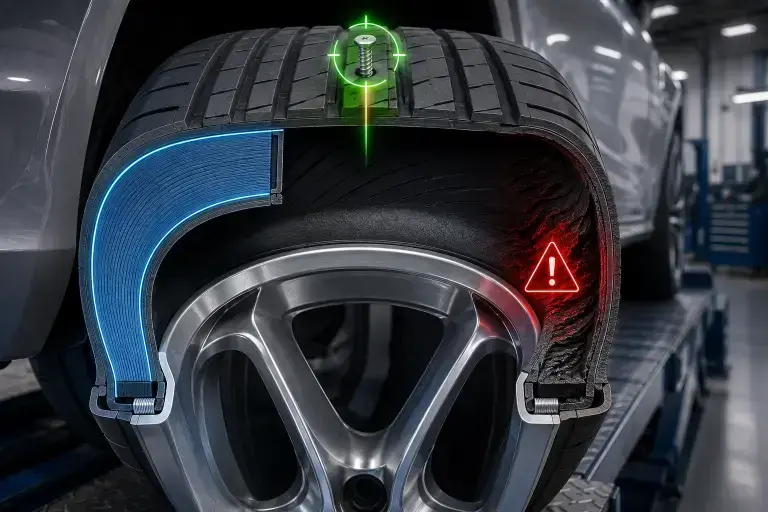
Technically, a run-flat tire can only be repaired if the puncture is a small nail or screw located squarely within the center tread area, and most importantly, if the tire never lost air pressure completely or was never driven on while deflated. However, in the vast majority of real-world scenarios, the answer is no. Because it is nearly impossible to visually confirm whether the reinforced internal sidewall structures suffered catastrophic heat degradation while driving without air, major tire manufacturers like Bridgestone, Michelin, and Pirelli strictly mandate replacing a run-flat tire rather than patching it.
The Engineering Secret Behind Run-Flat Technology
To understand why repairing a run-flat tire is a massive safety gamble, you have to look at how they are engineered compared to standard radial tires.
Run-flat tires feature exceptionally thick, heavy-duty rubber reinforcements embedded directly inside the sidewalls. When a puncture occurs and all air pressure escapes, these rigid internal inserts structurally support the entire weight of your vehicle. This allows you to maintain steering control and continue driving safely at a reduced speed (usually up to 80 km/h for roughly 80 kilometers) to reach a service bay, completely bypassing the danger of changing a tire on a chaotic highway shoulder.
Why Most Repair Requests Get Rejected
When you bring a punctured run-flat tire to a professional service center, the service advisor will likely tell you it needs to be replaced. This strict stance is due to three distinct mechanical limitations:
1. Hidden Internal Sidewall Shredding
When a run-flat tire is driven with zero air pressure, the massive friction and weight load generate extreme internal heat. The reinforced rubber sidewall begins to break down, dry rot, and self-shred from the inside out. Even if the outside of the tire looks perfect, removing it from the rim often reveals a heap of fine black rubber powder and structural creases inside—meaning the tire’s structural core is permanently compromised and cannot safely hold air again.
2. Strict Manufacturer Policies
Tire brands maintain uncompromising safety guidelines regarding run-flat structural repairs:
- Zero Tolerance: Brands like BMW-approved Bridgestone and Pirelli explicitly state that their run-flat tires must never be repaired once they have operated in a deflated or low-pressure condition.
- Conditional Exceptions: Brands like Michelin allow a single patch-and-plug repair only if a certified technician completely dismounts the tire and verifies that no internal heat wrinkling, creasing, or structural separation has occurred.
3. The Puncture Size Limit
Just like a standard tire, a run-flat can never be repaired if the puncture is wider than 1/4 inch (6 mm), or if the injury lands on the outer shoulder blocks or the flexible sidewall face.
The Routine Oil Service and Fluid Maintenance Connection
Because diagnosing structural run-flat tire damage requires utilizing heavy-duty pneumatic bead breakers to pull the stiff rubber assembly completely off your alloy wheel, it shares an exceptionally efficient timeline with your scheduled vehicle fluid services.
When you book your vehicle into an independent garage to evaluate a low-pressure warning, pairing that diagnostic check with a scheduled engine oil change or an automatic transmission fluid change saves hours of shop time. While your vehicle is raised on the lift to drain old engine oil, the technician can use advanced diagnostic tooling to inspect your suspension linkages and run an interior liner scan on your run-flat tire, checking your vehicle’s safety parameters in a single visit.
Full-Service Premium Automotive Care
Run-flat tires are standard equipment on luxury European imports and performance vehicles. These vehicles feature intricate, highly sensitive electronic chassis systems. If you hit a road obstacle severe enough to puncture a thick run-flat tire tread, the sudden impact can easily throw off other sensitive steering links.
A premier, independent repair facility covers everything required to keep your high-end automobile dependable and safe. If that road impact jarred your steering tracking or threw your steering wheel off-center, a computerized wheel alignment service will fully calibrate your suspension back to factory green specifications. If the impact damaged an active electronic brake caliper or wheel speed sensor, specialized brake repair services and computer diagnostics can quickly clear any illuminated ABS or check engine alerts.
From restoring crisp, icy cabin cooling with an expert air conditioning service to tracking down complex mechanical faults, comprehensive care saves time. If your manual gearbox link or torque delivery feels loose following an underbody scrape, a specialized clutch repair balances your power transfer. Furthermore, for high-mileage engines, booking a preemptive timing belt repair provides complete security against catastrophic internal engine valve damage.
Uncompromising Repairs for Total Daily Security
Saving a few pesos by trying to force an external roadside string plug into a compromised run-flat tire is an extreme safety hazard that risks a sudden, catastrophic high-speed blowout on the highway. Entrusting your luxury vehicle to a professional tire service center using advanced dismounting machines guarantees that your internal tire structure is inspected with absolute precision, protecting your expensive alloy rims and keeping your daily driving smooth, efficient, and fully secure.
Frequently Asked Questions: can run flat tires be repaired
What is the main difference between a wheel alignment and tire balancing?
A wheel alignment corrects the underlying mechanical angles of your steering links and suspension components so that your tires roll parallel to each other and track straight. A professional tire repair service incorporates wheel balancing, which places small weights along the rim flange to correct natural heavy spots within the spinning rubber assembly itself, entirely removing high-speed steering vibrations.
Why do shops charge more labor to mount and dismount run-flat tires?
Run-flat tires feature exceptionally stiff, reinforced rubber beads that are incredibly difficult to stretch over a metal wheel rim. Technicians must use specialized high-pressure pneumatic tire-changing machines equipped with plastic-coated helper arms and extra care to prevent scratching or cracking your vehicle’s expensive aluminum alloy rims.
Can I replace just one damaged run-flat tire with a standard regular tire?
No, this is highly dangerous and strongly discouraged by automotive engineers. Standard radial tires flex and compress far more than rigid run-flat tires. Mixing different tire constructions on the same axle will create a major imbalance in cornering stability, completely disrupt your vehicle’s anti-lock braking system (ABS), and compromise your wet-weather handling.
How far can I actually drive on a run-flat tire after a complete puncture?
Most premium run-flat tires are engineered to travel for up to 80 kilometers (50 miles) at a maximum speed of 80 km/h (50 mph) after losing all air pressure. Pushing the tire past these limits will cause the reinforced sidewall to disintegrate completely, causing the tire to break apart from the wheel rim.
Why is my dashboard low tire light still on after fixing a run-flat leak?
Modern run-flat vehicles utilize electronic Tire Pressure Monitoring System (TPMS) sensors inside the wheels. If a run-flat tire is deflated, the technician must use a digital scan tool to input a TPMS manual recalibration or reset code into the onboard computer, allowing the car to recognize that correct air pressures have been restored.
Key Takeaways: can run flat tires be repaired
- The Replacement Default: Assume your run-flat tire needs to be replaced if it was driven on for more than a few kilometers while completely flat.
- The Inspection Mandate: A run-flat can never be patched without first dismounting it from the rim to search for hidden internal rubber breakdown.
- The Center Zone Rule Only: Punctures landing on the inner shoulder blocks or outer sidewall faces can never be repaired safely under any circumstances.
- Follow the Brand Guidelines: Respect the strict safety policies of your specific tire brand (e.g., Bridgestone, Pirelli) regarding structural patches.
- The Fleet Maintenance Connection: Checking your suspension tracking parameters during a tire diagnostic check or fluid service is the smartest way to maximize tire lifespan.
- Independent Workshop Accuracy: Relying on an established local independent facility ensures access to run-flat dismounting machines, computerized balancing bays, and completely upfront flat-rate service pricing.