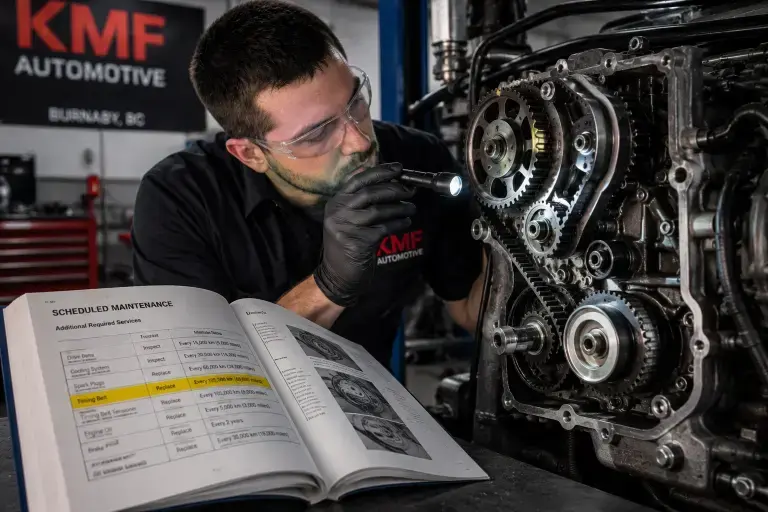
As a strict rule of thumb, most vehicle manufacturers recommend replacing your timing belt every 90,000 to 160,000 kilometers (roughly 60,000 to 100,000 miles), or every 7 to 10 years, whichever threshold arrives first. Unlike your vehicle’s brakes or suspension, a timing belt operates completely silently and will rarely give you audible warning signs before it snaps. At KMF Automotive, a complete timing belt and water pump kit replacement requires between 3 and 5 hours of specialized shop floor time. Because a broken belt on an interference engine causes instant, catastrophic valve damage, following your odometer is critical. Contact our friendly team or visit our Burnaby facility today for an honest, upfront inspection.
The Odometer Baseline Mileage and Time Thresholds
When it comes to automotive longevity, few questions are as critical as asking how often to replace a timing belt. Because this heavy-duty, toothed rubber band coordinates the high-speed synchronization of your engine’s internal pistons and valves, it is subjected to continuous mechanical stress and intense thermal cycles every single time your engine runs.
Because rubber naturally degrades, hardens, and loses its structural elasticity over time, vehicle manufacturers establish strict preventative replacement boundaries based on two distinct metrics:
The Mileage Limit
For the vast majority of modern consumer vehicles driven across North America, the standard replacement window opens at 90,000 kilometers and caps out firmly at 160,000 kilometers. Pushing past your vehicle’s specific mileage milestone significantly increases the statistical probability of a sudden rubber structural failure.
The Chronological Age Limit
A common trap for casual drivers is assuming their timing belt is perfectly safe because their car has low overall mileage. Even if a vehicle has only been driven 40,000 kilometers, if that rubber belt has been sitting inside the dark, hot engine bay for 7 to 10 years, it must be replaced. Environmental moisture, atmospheric ozone, and localized engine heat chemically dry out the rubber compound, creating microscopic cracks that can cause the molded teeth to shear off without warning under acceleration.
Why You Cannot Wait for the Belt to Fail
With routine wear items like brake pads or serpentine belts, your vehicle will naturally alert you to an upcoming failure by producing loud squeals, deep metallic grinding noises, or noticeable pedal vibrations. The timing belt is completely different; it gives zero warning signs before it breaks. It operates silently beneath heavy plastic dust shrouds, performing its high-speed synchronous dance until the exact millisecond it snaps.
Waiting for a timing belt to break before replacing it is an incredibly high financial gamble due to how modern automotive internal combustion chambers are structurally engineered. Most high-efficiency passenger cars utilize an interference engine design.
In an interference layout, the mechanical paths of the intake/exhaust valves and the heavy steel pistons overlap within the same physical cylinder space; they are simply kept from hitting each other by the flawless timing synchronization of the belt.
If the belt snaps at highway speeds, the camshaft instantly stops spinning, freezing the delicate engine valves wide open. However, the heavy crankshaft continues to spin due to vehicle momentum, forcing the massive pistons to slam upward into the stationary valves at thousands of revolutions per minute. The resulting impact causes instant, catastrophic engine destruction:
- Bent, shattered, or broken valve stems
- Punctured or cracked aluminum piston faces
- Warped connecting rods and scored cylinder walls
- A ruined engine block requiring a complete multi-thousand-dollar replacement
Variables That Accelerate Timing Belt Degradation
While your vehicle’s factory owner’s manual provides an excellent baseline schedule, several real-world operational environments can cause a timing belt to degrade prematurely, requiring an earlier mechanical intervention:
- Extreme Local Climates: Operating a vehicle in geographic regions that experience severe temperature swings, such as freezing winter conditions paired with intense summer heat waves, accelerates structural stress on rubber compounds.
- Aggressive Driving and Severe Duty Cycles: Frequent stop-and-go city idling, delivery courier routes, heavy vehicle towing, or continuous high-RPM sports driving subjects the belt track to rapid tension fluctuations, increasing material stretching.
- Hidden Fluid Contamination: If your engine’s internal front camshaft seals or crankshaft oil seals develop a minor leak, pressurized engine oil will slowly seep past the plastic dust covers. Petroleum products chemically dissolve rubber. Once oil coats the timing belt track, the rubber softens, glazes, and strips its inner teeth within a fraction of its normal lifespan.
Maximizing the Value of Your Timing Belt Service
When you book a professional timing belt service at a licensed repair facility like KMF Automotive, our mechanics will always recommend replacing the belt as part of a complete system bundle rather than swapping the rubber band alone. Because accessing the deep timing circuit requires hours of intensive disassembly, including removing engine mounts, accessory belt pulleys, and protective shrouds, the labor represents a major portion of the final bill.
Once the front of your engine is fully open, it is incredibly practical to replace the adjacent wear items that share the same lifespan. This includes the spring-loaded tensioner assembly (which keeps the belt perfectly taut) and the idler pulleys (which route the belt path safely).
Most importantly, it includes your vehicle’s water pump. On most modern overhead-cam engines, the water pump is driven directly by the smooth backside of the timing belt. If you opt to skip the water pump, and its internal bearings seize or leak six months down the road, you will have to pay for the same intensive shop labor fee all over again to replace a minor component.
The Crucial Connection Between Your Engine and Your Tires
Performing a thorough timing belt kit replacement requires our technicians to temporarily support your engine block with specialized cranes so they can safely unbolt major structural passenger-side engine mounts. Additionally, sections of your vehicle’s front suspension subframe and steering linkages must be loosened or removed to give our tools physical access to the lower crankshaft pulley.
Because these critical chassis foundations are moved and re-torqued during reassembly, your vehicle’s front-end geometry will shift slightly. To safeguard your new mechanical components, pairing this powertrain service with a computerized wheel alignment in Burnaby is highly recommended. Realigning your steering angles eliminates tracking pulls, maximizes highway fuel efficiency, and prevents your front tires from scrubbing away their tread unevenly across the pavement.
Comprehensive Automotive Care at KMF Automotive
At KMF Automotive, we operate a full-service, independent mechanical workshop equipped to handle your vehicle’s entire maintenance ecosystem. Because a full timing belt overhaul requires our licensed technicians to open up the front architecture of your motor, it opens up a highly efficient window to address other pending maintenance tasks without paying for overlapping disassembly labor.
Our shop floor handles everything required to keep your automobile dependable, safe, and efficient. If your vehicle is approaching its next routine service window, we provide factory-approved, premium oil changes using top-tier synthetic lubricants to preserve engine longevity. If your dashboard check engine light is glowing, or if you notice an unusual squealing sound under hard braking, our comprehensive brake repair service in Burnaby will fully restore your stopping confidence.
We provide deep technical expertise across all major automotive platforms and comfort systems. From restoring crisp, icy airflow with an expert air conditioning service in Burnaby to tracking down complex mechanical faults, we handle it all. If your manual gearbox is fighting your inputs, our specialized clutch repair service in Burnaby balances your power delivery. Furthermore, for high-mileage engines, booking a preemptive timing belt repair in Burnaby provides absolute insurance against catastrophic internal engine valve damage. We treat your vehicle with the exact level of precision and honesty we would give our own.
Restoring Performance and Total Peace of Mind
Allowing an internal timing belt to operate past its manufacturer-recommended lifespan is an incredibly high gamble that often results in total engine destruction. Choosing a comprehensive, premium timing belt kit replacement, complete with a fresh water pump, tensioners, and idler rollers, fully protects your powertrain and ensures your vehicle remains completely reliable. Trusting our experienced mechanics keeps your daily driving completely predictable, efficient, and stress-free.
Schedule Your Preventive Engine Service in Burnaby Today
Don’t let your vehicle run on borrowed time or leave your engine’s health to complete guesswork. Our certified mechanics at KMF Automotive are fully prepared to accurately evaluate your vehicle’s mileage history, inspect your engine configuration, and execute a flawless, factory-grade timing belt service with upfront transparency and clear pricing.
Conveniently located at 7080 Macpherson Ave in Burnaby, BC (V5J 4N3), just a brief walk from the Royal Oak SkyTrain Station, we proudly serve local car owners across the Lower Mainland with exceptional craftsmanship. Call our friendly local shop today at 604-438-0222 or contact us online to schedule your service appointment or drop by for an expert consultation.
Frequently Asked Questions: How often replace timing belt
What is the main difference between a wheel alignment and tire balancing?
A wheel alignment adjusts your vehicle’s underlying suspension and steering links so that the tires roll perfectly parallel to one another and track straight down the road. Our professional tire repair service in Burnaby incorporates wheel balancing, which uses small, calibrated weights on the rim flange to counteract natural heavy spots within the spinning rubber assembly itself, eliminating high-speed steering wheel vibrations.
Does my vehicle have a timing belt or a metal timing chain?
It depends entirely on your specific engine model. Generally speaking, timing belts are made of rubber compounds, feature grooved teeth, run outside the engine’s oil passages beneath plastic shields, and require routine preventative replacements. Timing chains are constructed from heavy steel links, operate inside the oily core of the engine block, and are typically designed to last the entire lifespan of the vehicle if regular oil changes are performed.
Are there any subtle symptoms that my timing belt is wearing out?
While a timing belt will not squeal or make noise before it snaps, a belt that has stretched excessively or skipped a tooth on the gears will cause immediate engine misfires, a rough and shaking idle, a severe loss of acceleration power, an illuminated check engine light on your dashboard, or a rhythmic ticking sound coming from behind the front plastic covers.
What should I do if my engine suddenly cuts out while driving and won’t restart?
If your car dies suddenly at speed, safely coast to the shoulder and do not attempt to continuously crank the starter motor. If a timing belt has snapped on an interference engine, repeatedly turning the key forces the starter motor to smash the pistons into the stationary valves over and over again, massively compounding the internal structural damage.
Can cold weather speed up the cracking of a vehicle’s timing belt?
Yes, prolonged exposure to extreme cold weather combined with rapid engine warming cycles causes rubber compounds to contract and expand intensely. Over time, this thermal fluctuation stiffens the rubber, making it brittle and more susceptible to developing micro-cracks along the outer backing and track edges.
I bought a used car with 110,000 kilometers and no service history. Should I replace the belt?
Yes, absolutely. If a used vehicle has reached its standard factory timing belt interval boundary and contains zero verifiable maintenance receipts or shop stickers proving the service was done, you should always assume it is operating on the original factory belt and schedule a replacement immediately to eliminate the risk of sudden engine failure.
Key Takeaways: How often replace timing belt
- The Golden Mileage Range: Plan for a preventative timing belt replacement between 90,000 and 160,000 kilometers to stay ahead of material fatigue.
- The Time Limit Rule: Even with minimal driving, a timing belt must be swapped every 7 to 10 years due to natural rubber degradation.
- The Silent Peril: Timing belts give zero auditory warnings or squeals prior to breaking, making calendar and odometer tracking your only line of defense.
- The Total Kit Protocol: Always replace the rubber belt alongside brand-new tensioners, idler pulleys, and a fresh water pump to prevent overlapping labor bills later.
- Interference Engine Consequences: A snapped belt on an interference layout results in a catastrophic piston-to-valve collision, leading to total internal engine destruction.
- Trusted Professional Care: Entrusting your vehicle to an established, independent repair facility guarantees factory-spec tool usage, accurate torque settings, and upfront pricing.