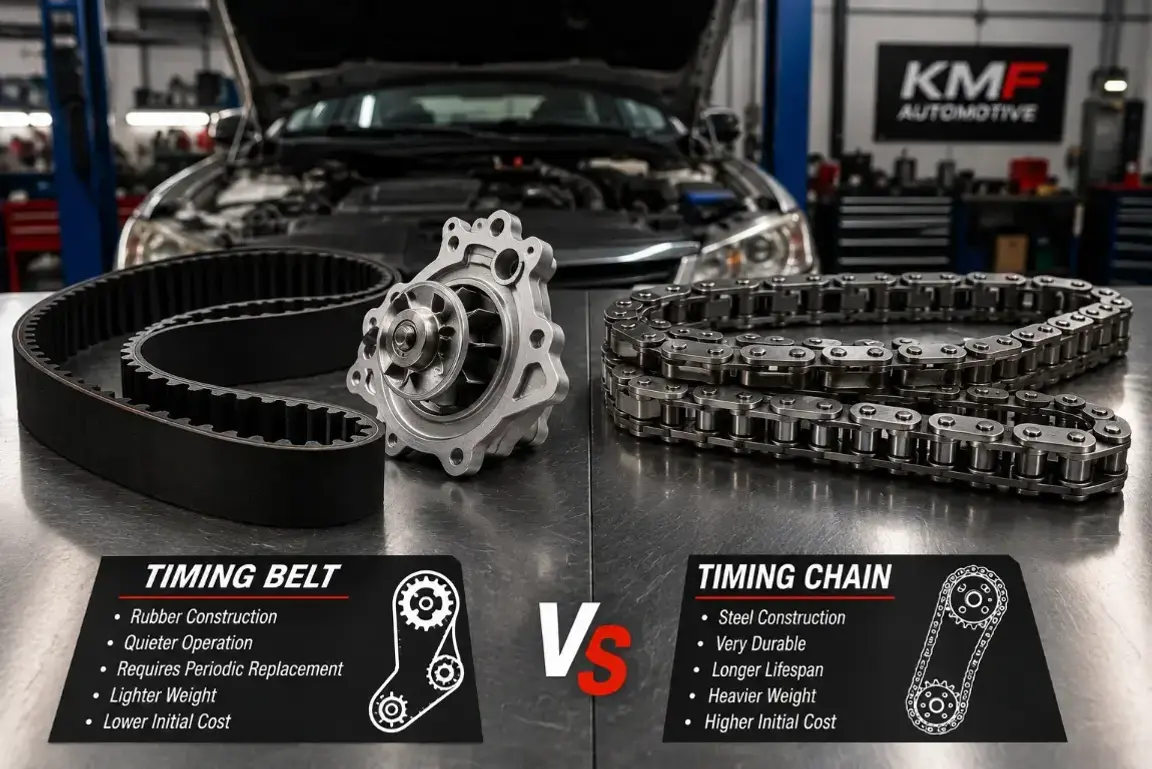
The primary difference comes down to materials, location, and maintenance. Timing belts are made of reinforced rubber, run outside the oily sections of the engine, and must be replaced preemptively every 90,000 to 160,000 kilometers to prevent catastrophic breakage. Timing chains are constructed from heavy-duty steel links, run completely inside the engine block, and are lubricated by engine oil. A timing chain can theoretically last the entire lifespan of the vehicle, provided you never skip your scheduled oil changes. If your timing system is overdue for an inspection in the Lower Mainland, contact KMF Automotive or visit our Burnaby service center today.
The High-Speed Synchronization Circuit
Open up your car’s hood, and you are looking at a masterclass in high-speed mechanical engineering. Deep within the core of your internal combustion engine, two major shafts must rotate in perfect harmony. The crankshaft (at the bottom) moves your pistons up and down, while the camshaft (at the top) opens and closes the intake and exhaust valves to let air in and fuel out.
The link that keeps these two halves moving in perfect harmony is either a timing belt or a timing chain. If this synchronization fails by even a fraction of a second, your engine will instantly stop running, or worse, smash its internal components together at violent speeds. While their functional goals are identical, how they achieve this synchronization involves two completely different styles of engineering.
The Timing Belt: Quiet, Efficient, and Temporarily Borrowed Time
Introduced heavily in the 1960s as auto manufacturers looked for ways to build lighter and quieter engines, the timing belt is a thick, reinforced rubber band lined with molded teeth along its inner track. Because it is made of rubber and sits outside the oily inner core of the motor beneath dry plastic covers, it creates very little structural friction. This makes it incredibly quiet and fuel-efficient. However, because rubber degrades naturally when exposed to rapid temperature swings and atmospheric conditions, it operates on strictly borrowed time.
A timing belt will give you zero auditory warnings before it snaps. It doesn’t stretch gradually or squeak like an accessory belt; it simply breaks. If your vehicle features an interference engine layout, that sudden snap will cause the pistons to instantly collide with the wide-open valves, resulting in total engine destruction.
The Timing Chain Rugged Metal and Oil-Dependent Longevity
If a timing belt is a heavy-duty rubber band, a timing chain is essentially a heavy, hardened steel bicycle chain. It wraps around metal sprockets and lives completely inside the engine block, completely isolated from the outside air.
Because it is made of interlocking steel links, it is incredibly durable. Instead of running dry, it is constantly showered in pressurized engine oil to reduce friction and keep wear to an absolute minimum. Under ideal driving conditions, a premium timing chain is designed to last the entire operational life of the vehicle.
The Hidden Catch: A timing chain is only as healthy as the engine oil lubricating it. It relies on hydraulic oil pressure to operate its automatic chain tensioners and plastic guide tracks. If a driver routinely ignores scheduled maintenance or drives with low, dirty oil, that abrasive, contaminated oil will rapidly wear down the chain links and guide rails. This causes the chain to “stretch” out of spec, which throws off engine performance and causes a loose, metallic rattling sound.
Head-to-Head Structural Breakdown
When comparing the long-term ownership costs of a vehicle, understanding which system you have under the hood helps you plan your maintenance budget accurately:
si Real-World Stress Factors for Burnaby Drivers
Whether your vehicle utilizes a belt or a chain, navigating the unique geography of the Lower Mainland places extra physical stress on your vehicle’s timing circuit. Driving in Burnaby isn’t just a flat highway commute; it involves distinct environmental challenges:
- The Hill Climb Factor: Regularly driving up steep inclines, such as commuting up to the SFU campus on Burnaby Mountain or navigating the heavy slopes of Royal Oak Avenue, places a higher structural load on your engine. This load forces the timing system to work harder under higher torque conditions.
- Stop-and-Go City Traffic: Heavy, daily gridlock traffic along Kingsway or Hastings Street means prolonged engine idling. Your odometer might not be clicking forward rapidly, but your engine is still spinning and racking up structural wear hours that degrade rubber compounds and break down engine oil.
- The Maritime Climate: Our damp, rain-heavy winters create persistent moisture and high ambient humidity. For dry timing belt layouts, aging plastic covers can let micro-condensation seep in, accelerating the cracking of older rubber compounds.
Mechanical Disassembly and the Need for Precision Tracking
Servicing an engine’s internal timing network requires extensive physical disassembly. Whether a technician is executing a preventative belt service or swapping out worn plastic timing chain guides, they must temporarily support the engine with specialized cranes to safely unbolt major structural passenger-side engine mounts. In many modern vehicle layouts, sections of the front suspension subframe and steering links must also be loosened to gain clearance to the lower crankshaft pulley.
Because major structural chassis components are moved and re-torqued during this deep mechanical process, your vehicle’s front-end tracking angles will shift slightly upon reassembly. To fully protect your mechanical investment, pairing this internal engine care with a precise computerized wheel alignment in Burnaby is a smart decision. Realigning your steering geometry ensures your vehicle handles perfectly straight, eliminates rolling resistance, and keeps your tires from scrubbing down their tread unevenly on the highway.
Full-Service Automotive Excellence at KMF Automotive
At KMF Automotive, we operate a full-service, owner-operated mechanical workshop designed to manage your vehicle’s entire maintenance ecosystem. While our licensed mechanics have your engine opened up to secure your powertrain timing circuit, it provides a highly convenient window to address other critical maintenance items, saving you an extra trip to the mechanic later.
Our shop floor is fully updated to handle any diagnostic or mechanical challenge with complete dealership accuracy. If your vehicle uses a timing chain, keeping your oil fresh is non-negotiable; we provide warranty-approved, premium oil changes using top-tier synthetic lubricants to protect your chain guides. If your dashboard check engine light is illuminated due to a performance code, or if you notice an unusual squealing sound under hard braking, our comprehensive brake repair service in Burnaby will completely restore your vehicle’s safety.
We offer extensive service specializations across all major automotive systems. From restoring ice-cold dashboard airflow with an expert air conditioning service in Burnaby to tracking down complex drivetrain faults, we handle it all. If your manual vehicle is slipping out of gear or fighting your inputs up steep hills, our specialized clutch repair service in Burnaby will restore smooth, efficient power delivery. Furthermore, if you are driving a vehicle that utilizes a rubber belt and you are approaching a major manufacturer mileage milestone, booking a preemptive timing belt repair in Burnaby protects your engine from catastrophic, irreversible valve damage. From minor maintenance to major overhauls, we treat your car with the exact level of precision we would give our very own vehicles.
Schedule Your Professional Inspection in Burnaby Today
Stop guessing about your vehicle’s internal timing setup or ignoring an unusual, metallic rattling sound coming from your engine bay. Our certified mechanics at KMF Automotive are fully prepared to accurately evaluate your vehicle’s service history, identify your specific engine layout, and perform precision repairs with complete transparency and upfront pricing.
Conveniently located at 7080 Macpherson Ave in Burnaby, BC (V5J 4N3), just a brief walk from the Royal Oak SkyTrain Station, we proudly serve local car owners across the Lower Mainland with exceptional craftsmanship. Call our friendly local shop today at 604-438-0222 or contact us online to schedule your service appointment or drop by for an expert consultation.
Frequently Asked Questions: Timing Belt vs. Timing Chain
What is the main difference between a wheel alignment and tire balancing?
A wheel alignment corrects the underlying mechanical angles of your vehicle’s steering and suspension links so that the tires roll perfectly parallel to each other and track straight down the road. Our professional tire repair service in Burnaby incorporates wheel balancing, which uses small weights on the rim flange to counteract natural heavy spots within the spinning rubber assembly itself, eliminating high-speed steering wheel vibrations.
How can I find out if my specific car uses a belt or a chain?
The quickest and most accurate way is to check your vehicle’s official factory owner’s manual under the scheduled maintenance section. Alternatively, you can look closely at the front of your engine block. If the front covers protecting the gears are made of black plastic held on by clips, you have a dry timing belt. If the front of the engine features a solid aluminum cover sealed tightly with silicone sealant and bolted directly to the block, you have an oiled timing chain.
What does a failing timing chain sound like compared to a loose belt?
A loose or worn accessory belt produces a loud, high-pitched rubber squeal that changes pitch when you accelerate. A worn or stretched timing chain produces a distinct, heavy metallic rattling or clattering sound—similar to a marbles-in-a-blender noise—that is loudest right when you start the engine cold or when the engine is idling at low RPMs.
Can a timing chain break suddenly like a rubber timing belt?
While it is technically possible for a timing chain to snap, it is exceptionally rare. Instead of snapping without warning, a timing chain degrades gradually. As the metal links wear down, the chain stretches out of spec, causing the engine’s camshaft sensors to instantly detect mismatched timing angles. This will trigger a distinct check engine code on your dashboard long before the chain physically fails.
Why is changing my engine oil so critical if my car has a timing chain?
Modern timing chains rely on a constant supply of pressurized engine oil to lubricate the moving metal links and extend the hydraulic tensioner arm. If you skip oil changes, dirty, sludgy oil acts like liquid sandpaper, rapidly wearing down the chain links and chewing through the soft plastic guide rails that keep the chain from whipping around.
Is it cheaper to maintain an engine with a timing chain or a timing belt?
In the short term, a timing chain is cheaper because it requires zero routine replacement costs if you maintain clean oil. However, if a timing chain does wear out due to poor maintenance, replacing it is significantly more expensive than a timing belt service. A chain replacement requires extensive labor hours to scrape off old sealants, pull the oil pan, and reset intricate hydraulic timing gears deep inside the motor.
Key Takeaways: Timing Belt vs. Timing Chain
- Material and Environment: Timing belts are quite like rubber bands that run completely dry outside the engine block, while timing chains are durable metal links that run lubricated inside the motor.
- The Lifespan Divide: Timing belts have a hard preventative replacement boundary (90,000 to 160,000 km), whereas a timing chain can last the life of the vehicle if properly maintained.
- Oil Quality Dependence: The longevity of a timing chain relies entirely on clean engine oil to preserve its hydraulic tensioners and protect its plastic guide rails from premature wear.
- Warning Sign Visibility: A failing timing chain will alert you ahead of time by producing a loud metallic rattle and triggering a dashboard check engine code, while an aging timing belt fails silently without warning.
- Chassis Reassembly Realities: Deep engine repairs require moving structural engine mounts and subframe linkages, making a subsequent computerized steering alignment highly recommended.
- Honest Local Mechanical Service: Choosing an established, independent repair center guarantees access to certified technicians, advanced diagnostics, and clear upfront pricing.