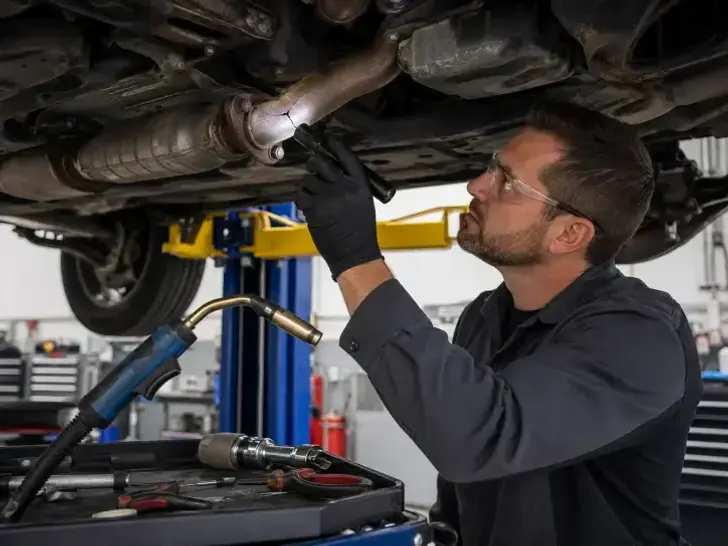
A sudden loud exhaust noise from your car means a breach has formed somewhere along your exhaust system. At KMF Automotive, diagnosing the exact leak or performing a minor weld takes roughly 30 to 60 minutes, while replacing a rotted muffler or catalytic converter takes 1 to 2 hours. Driving a loud car in British Columbia isn’t just an annoying distraction—it can result in steep traffic fines and allow toxic carbon monoxide gas to seep into your passenger cabin. If your vehicle is roaring or rattling in the Lower Mainland, contact us or visit our Burnaby shop today for an honest, upfront solution.
Identifying the Source of Your Loud Exhaust Noise
When your vehicle suddenly starts roaring like a race car down the street, it is easy to assume you just need a new muffler. However, a loud exhaust noise from a car in Burnaby can stem from a variety of distinct breakdown points along your vehicle’s undercarriage corridor. Your exhaust system is a continuous pipeline, and the specific sound your car makes can tell our technicians exactly where the breach is hiding:
- A Deep, Booming Roar: If your car sounds incredibly loud, especially when you step on the gas pedal, the issue is almost always a structural hole rusted through the muffler shell or a pipe that has broken completely in half.
- A Sharp, Rapid Ticking or Hissing: A loud ticking noise that speeds up perfectly as your engine RPMs rise usually points to a leaking exhaust manifold gasket or a cracked manifold runner right up against the engine block.
- A Loud Metallic Rattle or Buzzing: A harsh rattling sound at idle or when accelerating often signifies that an internal ceramic component inside your catalytic converter has shattered, or that a metal heat shield has broken its mounts and is vibrating against the spinning drivetrain.
Why Do Lower Mainland Cars Develop Loud Exhaust Leaks?
Vehicles operating in the Pacific Northwest face a unique set of driving conditions that accelerate undercarriage wear. The primary catalyst behind a loud exhaust leak is severe rust and oxidation. While exhaust systems are made of treated steel, winter road maintenance across the Lower Mainland relies on road salt and chemical de-icers. When these corrosive chemicals mix with winter rain and splash against an exhaust pipe running at temperatures over 400°C, it triggers rapid chemical degradation.
Furthermore, short-trip driving patterns compound this issue from the inside out. When you only drive your car for 10 or 15 minutes at a time, your exhaust pipeline never reaches its full operational temperature. Water vapor, a natural byproduct of fuel combustion, condenses and pools inside the cool muffler. This trapped moisture combines with exhaust soot to form an acidic liquid that slowly eats through the metal walls, creating the classic “blown muffler” look and a very loud exhaust note.
The Hidden Performance and Safety Risks of a Loud Exhaust
Postponing a visit to an auto shop to fix a loud exhaust noise can cause significant damage to your vehicle and your health. Many drivers are surprised to learn that an exhaust leak can heavily damage their fuel economy. When a hole forms ahead of your primary oxygen sensor, the rushing gas pulses pull outside ambient air into the pipe. This tricks your car’s computer into believing the engine is running dangerously lean, causing it to inject excess fuel and tank your fuel efficiency by 10% to 15%.
More importantly, a broken exhaust system is a major safety hazard. When exhaust gases escape underneath the vehicle instead of exiting through the tailpipe, toxic, odorless carbon monoxide ($CO$) can seep directly up into the passenger cabin through floor panel seals and climate control vents. Prolonged exposure to low levels of carbon monoxide causes headaches, dizziness, and nausea while driving, presenting an immediate threat to you and your passengers.
Why DIY Exhaust Tapes and Pastes Fail Under Pressure
When an unexpected exhaust noise occurs, it is highly tempting to purchase an emergency repair kit containing metallic putty or exhaust wrapping tape. While these quick-fix patches are useful for crawling your car to a nearby repair shop, they are never permanent solutions. The extreme heat expansions and high gas pressures running through an exhaust line will easily crack or blow out temporary adhesive patches within a matter of days.
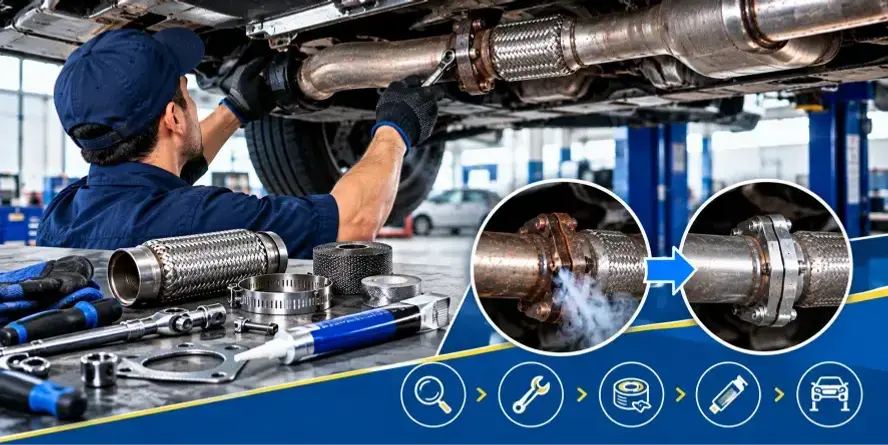
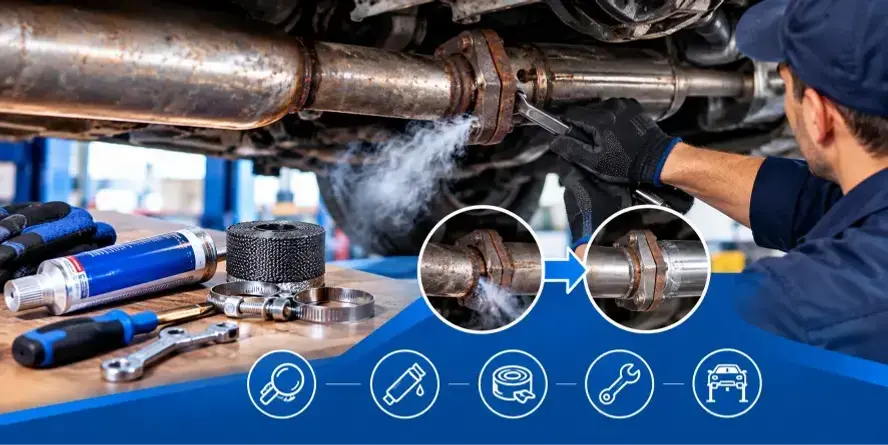
At KMF Automotive, we resolve loud exhaust noises using professional, structural techniques. We raise your vehicle on a commercial lift to visually inspect the entire line and perform an advanced pressure check. If a pipe section or muffler neck is cracked but the surrounding metal remains thick and healthy, our licensed technicians use specialized MIG or TIG welding torches to fuse a fresh steel sleeve over the breach. If rust has fully structurally compromised the component, we cut away the rotted pipe cleanly and weld an exact factory-spec replacement unit in place for a long-lasting, leak-free seal.
The Mechanical Connection Between Your Exhaust and Your Tires
Your vehicle’s exhaust pipeline handles a massive amount of physical weight and requires secure mounting to stay clear of other undercarriage parts. When your exhaust system develops broken metal hangers or stretched rubber isolation loops, the heavy pipes begin to sag and shift out of place. During sharp cornering or when navigating speed bumps, this loose piping can slam into your rear suspension links or press tightly against your inner tire sidewalls.
A hot exhaust pipe resting near a tire transfers extreme thermal energy directly into the rubber casing. This can degrade the tire compound or damage delicate suspension bushings.
If you ran over road debris or struck a deep pothole that damaged your exhaust layout, it is highly recommended to pair your exhaust fix with a precise computerized wheel alignment in Burnaby. Aligning your steering and suspension geometry ensures your newly repaired vehicle tracks straight down the road and prevents your tires from scrubbing raw against the asphalt.
Full-Service Automotive Repairs at KMF Automotive
At KMF Automotive, we operate as a full-service, owner-operated mechanical facility equipped to handle all aspects of vehicle maintenance and complex repair. While your car is raised on our shop hoists for a loud exhaust assessment, it is often the most practical time to address other pending maintenance needs to save you a separate trip to the shop floor later.
Our facility handles everything required to keep your automobile safe, dependable, and highly efficient. If your vehicle is approaching its next oil service interval, we provide warranty-approved, premium oil changes using top-tier lubricants to keep internal engine components pristine. If your dashboard check engine light is illuminated due to an emissions fault, or if you notice an unusual squealing noise under braking, our comprehensive brake repair service in Burnaby will completely restore your vehicle’s stopping confidence.
We also focus heavily on critical powertrain systems to preserve your car’s long-term reliability. From resolving hot cabin temperatures with an expert air conditioning service in Burnaby to tracking down complex mechanical issues, our team handles it all. If your manual transmission suffers from a loose or slipping clutch pedal, our specialized clutch repair service in Burnaby restores sharp, mechanical power delivery. Furthermore, for high-mileage engines, securing a timely timing belt repair in Burnaby acts as a crucial shield against catastrophic, irreversible internal engine damage.
Restoring Peace of Mind to Your Daily Drive
Leaving a loud exhaust noise unaddressed compromises your driving safety, ruins fuel efficiency, and can easily lead to a costly traffic fine under the BC Motor Vehicle Act for excessive noise pollution. Trusting professional welding repairs, thorough pressure testing, and premium replacement components eliminates the risk of exhaust fumes entering your cabin and restores your vehicle to its factory-quiet operation. Our dedicated local team ensures your car runs smoothly and safely on every commute.
Schedule Your Exhaust Inspection in Burnaby Today
Don’t ride around with an embarrassing exhaust roar, an irritating undercar rattle, or a sudden drop in fuel efficiency. Our certified mechanics at KMF Automotive are ready to provide an honest, thorough, and completely transparent evaluation of your vehicle’s exhaust system.
Conveniently located at 7080 Macpherson Ave in Burnaby, BC (V5J 4N3)—just a quick walk from the Royal Oak SkyTrain Station—we serve local drivers with exceptional craftsmanship and upfront, competitive pricing. Call our friendly local shop today at 604-438-0222 or contact us online to book your appointment or drop by for a professional inspection.
Frequently Asked Questions: loud exhaust noise car Burnaby
What is the main difference between a wheel alignment and tire balancing?
A wheel alignment adjusts your vehicle’s underlying suspension and steering links so that the tires roll perfectly parallel to one another and track straight down the road. Our professional tire repair service in Burnaby includes wheel balancing, which uses small, calibrated weights on the rim flange to counteract natural heavy spots within the spinning rubber assembly itself, completely eliminating high-speed steering wheel vibrations.
How long does it typically take to fix a loud exhaust noise in the shop?
For standard issues like an isolated crack on an exhaust pipe or a loose heat shield, a professional patch weld or adjustments take between 30 and 60 minutes. If your car requires a completely new catalytic converter assembly, a replacement exhaust manifold, or if our team has to torch away heavily rusted bolts, the repair can take 1 to 2 hours of shop floor bench time.
Can a loud exhaust leak cause my dashboard check engine light to turn on?
Yes, absolutely. If your exhaust system develops a hole or crack anywhere near your primary or secondary oxygen sensors, outside air will be drawn into the gas stream. The sensors will flag this elevated oxygen content and trigger an emissions or fuel trim code on your dashboard, illuminating your check engine light.
Is it legal to drive a vehicle with a loud exhaust leak in British Columbia?
No. Under the British Columbia Motor Vehicle Act Regulations, it is a traffic offense to operate a motor vehicle that produces disruptive or excessive noise pollution caused by a damaged, missing, or modified muffler system. Driving a vehicle with a severely blowing exhaust can result in a fine and an order forcing a mandatory mechanical inspection.
What happens if an internal part of my catalytic converter breaks loose?
If the internal ceramic honeycomb structure inside your catalytic converter shatters due to thermal shock or a harsh road impact, it will create a loud, metallic rattling sound that shifts with your engine speed. Over time, these broken ceramic pieces can rotate and completely block the exhaust flow, causing your engine to stall, lose power, or overheat.
Can an exhaust leak cause my vehicle’s cabin air to smell like rotten eggs?
A sulfur or “rotten egg” smell usually indicates that your catalytic converter is overloaded, failing chemically, or running too hot due to an improper fuel mixture. If an exhaust leak is present near the converter, these toxic, unrefined fumes can easily drift upward into your vehicle’s passenger cabin, requiring prompt professional inspection.
Key Takeaways: loud exhaust noise car Burnaby
- Acoustic Diagnostics: The specific pitch and tone of your loud car exhaust noise—whether a roar, click, or rattle—points directly to the broken component under the chassis.
- The Atmospheric Enemy: Local winter road salting practices and damp weather accelerate oxidation, rotting exhaust pipes from the outside in.
- Hidden Performance Loss: Exhaust breaches trick internal oxygen sensors into running the engine too rich, dropping your fuel economy by up to 15%.
- Severe Health Hazards: Driving a vehicle with an exhaust leak exposes the passenger cabin to toxic, odorless carbon monoxide gas.
- Permanent Welding Repairs: Temporary hardware store exhaust wraps and pastes cannot withstand highway operational temperatures and high gas pressures.
- Suspending Secondary Damage: Sagging exhaust systems can rub against suspension linkages or inner tire sidewalls, requiring a comprehensive undercar assessment.