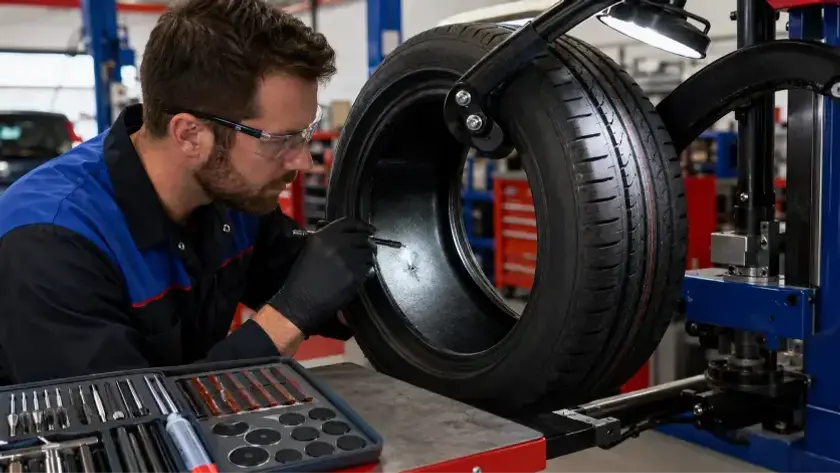
If you want to know how to repair a car tire properly, the process requires much more than shoving a temporary plug into the tread from the outside. A safe, permanent, and industry-compliant tire repair takes about 30 to 45 minutes and involves demounting the tire from the wheel to install an internal vulcanized plug-and-patch combo. To qualify for a repair, the puncture must be smaller than 1/4 inch in diameter and located strictly within the tire’s central tread area. If you have a tire leaking air in the Lower Mainland, contact KMF Automotive or visit our service bay for an honest, professional repair.
The Safety Check: Can Your Car Tire Be Legally Repaired?
Before learning how to repair a car tire, you must determine whether the tire can be saved safely. According to strict safety guidelines established by the Tire Industry Association, a puncture can only be repaired if it is located within the central crown of the tire’s tread. The structural “shoulder” zones and the absolute sidewall are completely off-limits for patches.
We enforce these boundaries rigorously on the shop floor because the sidewall experiences extreme bending, flexing, and high thermal strain while traveling at highway speeds. A patch applied to this area will inevitably peel away, posing a massive risk of a sudden, catastrophic tire blowout. Additionally, if the puncture path is wider than 1/4 inch ($6\text{ mm}$), or if the tire has been slashed, it is structurally compromised and must be replaced to protect your safety on the road.
Step-by-Step: How to Repair a Car Tire the Right Way
A true, long-lasting repair requires specialized commercial tools and a sterile environment. Here is the exact mechanical process our licensed technicians follow to ensure your tire holds factory air pressure indefinitely:
- Step 1: Complete Demounting and Inspection: We remove the wheel from the vehicle and use a pneumatic tire changer to separate the rubber from the rim. This allows us to look inside the tire and check for internal structural crushing or shredded rubber powder—common signs that a tire was driven on while flat.
- Step 2: Preparing the Puncture Path: Once the casing is verified as healthy, we locate the foreign object and extract it. We use a high-speed carbide reamer tool to clear the puncture channel, removing jagged metal wires from the steel belts and creating a clean, uniform pathway.
- Step 3: Buffing the Inner Liner: We use a specialized texture brush to buff the inner rubber lining around the puncture site, removing the smooth factory mold-release lubricants to create a rough, clean surface area for adhesion.
- Step 4: Vulcanizing Cement Application: A thin layer of chemical vulcanizing fluid is applied to the prepared inner rubber and left to cure briefly. This fluid initiates a cold-chemical reaction that permanently bonds the repair material to the tire itself.
- Step 5: Pulling the Combo Patch-Plug: We insert a professional combined rubber plug-and-patch unit from the inside out. The plug stem fills the physical entry hole to keep moisture away from the internal steel belts, while the flat patch base seals the inner liner. We roll the patch flat with a high-pressure stitching tool to eliminate trapped air bubbles.
- Step 6: Sealing and Balancing: The stem of the plug is trimmed flush with the outer tread blocks. We seal the exposed edge of the inner patch with a specialized rubber compound, remount the tire onto the rim, and place the assembly on a digital wheel balancer to ensure perfectly smooth highway rolling.
Why Temporary Exterior Rope Plugs Are a Driving Hazard
When dealing with an unexpected puncture, many drivers turn to cheap emergency kits that use sticky “rope plugs” forced into the tread from the outside without separating the tire from the metal wheel. While these kits are excellent emergency tools to help you crawl out of a dangerous situation or reach a nearby service station, they are never considered a permanent or legal fix.
Relying on an exterior plug leaves your vehicle highly vulnerable. Without an internal visual inspection, it is impossible to see if the inner rubber liner has started delaminating or if the steel belt wires have snapped. Furthermore, exterior plugs do not seal the inner lining correctly, allowing air to slowly migrate into the tire’s structural layers over time, which can cause the tread to separate entirely while driving.
What Hidden Issues Can Sabotage Your Tire Repair?
Beyond the location of a nail or screw, several underlying mechanical factors can prevent us from safely executing a repair. If your remaining tire tread depth has worn down to or below $2/32\text{ of an inch}$ ($1.6\text{ mm}$), the tire is legally bald. Safety regulations strictly forbid patching a bald tire because the thin remaining casing cannot adequately grip the vulcanizing patch or provide sufficient wet-weather traction.
Regional driving environments can also degrade your tire rubber prematurely. If a tire is older and exhibits severe weather cracking or deep dry rot along the exterior casing, the rubber compounds have lost their core elasticity and strength. Bringing your car into our independent, owner-operated shop ensures that an expert evaluates these subtle, hidden structural details honestly, keeping you from operating an unstable vehicle.
Pairing a Professional Tire Fix with Suspension Alignment
The road debris, potholes, or concrete curbs that puncture your tire are often severe enough to jar your vehicle’s delicate suspension linkages completely out of specification. If your tire sustained a harsh impact, it is highly recommended to pair your puncture fix with a precise computerized wheel alignment in Burnaby.
During our alignment process, we mount high-precision optical targets to your wheels to measure your current chassis geometry against a massive manufacturer database. Adjusting your camber, caster, and toe angles back to original factory specifications ensures that your newly repaired tire rolls perfectly parallel to the road. This prevents the rubber from scrubbing raw against the asphalt, maximizing your tire life and eliminating any annoying steering wheel pulls.
Beyond Tire Service: Comprehensive Mechanical Care
At KMF Automotive, we believe in keeping your entire vehicle in pristine mechanical shape. While your car is already raised on our hoists for a tire assessment, it provides the perfect opportunity to address other routine maintenance needs to save you a separate trip to the mechanic later. Our licensed technicians treat every vehicle with meticulous attention to detail.
Our facility operates as a full-service workshop equipped to handle any automotive challenge. If your engine is approaching its next milestone, we provide warranty-approved oil changes to maintain clean internal lubrication. If you are noticing a soft pedal or squealing noises, our comprehensive brake repair service in Burnaby will restore complete confidence to your stops. From correcting hot cabin temperatures with an expert air conditioning service in Burnaby to resolving loud rumbling with an exhaust and muffler repair in Burnaby, we handle it all.
We also focus heavily on core powertrain systems to guarantee your long-term reliability. If your transmission shifting feels loose or slips under load, our precision clutch repair service in Burnaby will restore smooth, mechanical power delivery. Furthermore, for high-mileage engines, securing a preemptive timing belt repair in Burnaby protects your internal engine components from catastrophic, irreversible structural failure.
Trust Professional Accuracy for Total Peace of Mind
Allowing an amateur to patch your tire or ignoring a slow, leaking puncture compromises your safety and places unnecessary strain on your vehicle’s drivetrain. Your tires are the single point of contact between your car and the road surface, making their integrity paramount during wet-weather braking and sudden evasive maneuvers. Trusting professional-grade equipment, detailed internal inspections, and factory-approved vulcanized patches ensures total peace of mind every time you get behind the wheel.
Visit KMF Automotive in Burnaby for Reliable Tire Service
Don’t risk your family’s safety by driving on a leaking tire or relying on a temporary plug that could fail unexpectedly at highway speeds. Our certified technicians at KMF Automotive are ready to provide an honest, thorough, and highly reliable internal patch-and-plug repair to get you moving safely again. Conveniently located at 7080 Macpherson Ave in Burnaby, BC (V5J 4N3), just steps away from the Royal Oak SkyTrain Station, we proudly serve local drivers with transparent pricing, clear communication, and exceptional craftsmanship. Call our friendly team today at 604-438-0222 or contact us online to book an appointment or drop by for an expert inspection.
Frequently Asked Questions: how to repair a car tire
What is the main difference between a wheel alignment and tire balancing?
A wheel alignment corrects the underlying angles of your vehicle’s steering and suspension links so that the tires roll perfectly parallel to each other. Our professional tire repair service in Burnaby includes wheel balancing, which uses small weights on the rim to counteract natural heavy spots within the spinning rubber tire assembly itself, completely eliminating high-speed steering wheel vibrations.
How long does a standard in-shop professional tire repair take?
On a typical passenger vehicle, a complete, safety-compliant tire repair takes between 30 and 45 minutes. This timeframe allows our technicians to safely lift the vehicle, demount the rubber from the wheel rim, perform a comprehensive internal inspection, apply the vulcanized plug-and-patch unit, remount the tire, and balance the assembly perfectly.
.3. Is it safe to drive to your shop if I have a nail in my tire?
If the tire is maintaining proper air pressure and you can pump it up to its recommended PSI, you can safely drive a short distance directly to our shop floor. However, if the tire is completely flat or losing air rapidly, driving on it will cause the heavy rim to cut through the inner liner, destroying the tire. In that case, mount your spare tire first.
Can a puncture located on the absolute edge or sidewall of a tire be patched?
No, punctures located on the tire shoulder or sidewall cannot be repaired under any circumstances. The sidewall undergoes massive structural flexing and heat generation while you drive, which prevents an internal patch from remaining securely bonded and introduces a severe risk of a sudden high-speed blowout. Sidewall damage always requires replacement.
Why does my tire keep losing air even though I cannot find an embedded nail?
Air can escape from several areas other than a classic tread puncture. Slow leaks are frequently caused by a corroded or degraded valve stem, a leaking inner valve core, or road debris trapped between the rubber tire bead and the metal rim flange. Our technicians use specialized leak-detection solutions to check the entire wheel assembly.
Do I need to replace my tire immediately if the TPMS light turns on?
Not necessarily. The tire pressure monitoring system light simply indicates that the inflation pressure in at least one tire has dropped below a safe threshold, which can be caused by a minor puncture or a seasonal drop in temperature. You should have us inspect the tire right away to see if it can be safely saved with a simple patch before investing in a replacement.
Key Takeaways: how to repair a car tire
- Knowing how to repair a car tire correctly requires shifting past external temporary solutions and committing to a full internal plug-and-patch repair.
- Punctures must be located strictly within the central tread area and measure under 1/4 inch in size to be safely repaired.
- Temporary exterior rope plugs are not safety-compliant for permanent highway use and do not address hidden internal cord damage.
- Tires worn down to 2/32 of an inch or showing extensive weather cracking cannot be legally repaired and must be replaced.
- Separating a tire from its rim requires a digital wheel balance afterward to guarantee smooth rolling and eliminate highway vibrations.
- Choosing an established local repair facility guarantees an honest, transparent assessment of your suspension and tire safety.