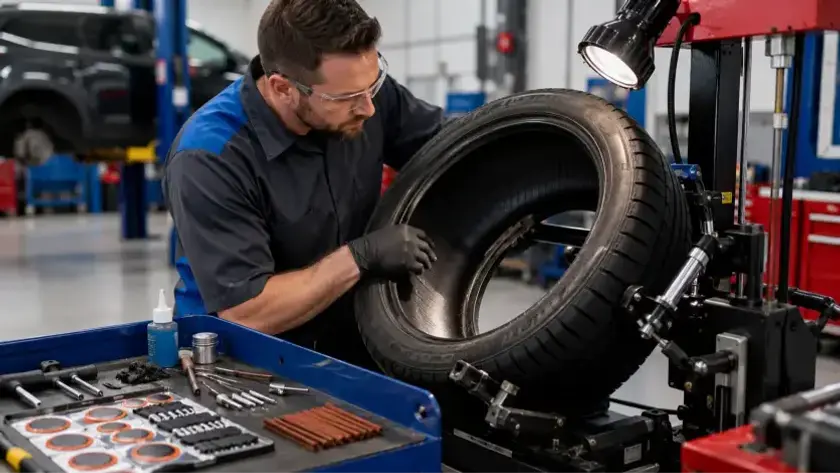
When you are stuck with a flat tire, calling a mobile tire repair truck to your driveway or a parking lot might seem like the ultimate convenience. However, a permanent, safety-compliant tire repair takes about 30 to 45 minutes and requires heavy, stationary shop machinery to demount the rubber, inspect the inner lining for structural crushing, and spin-balance the assembly afterward. While mobile operators can get you out of a temporary jam, visiting KMF Automotive ensures your puncture is fixed to the highest safety standards using a commercial plug-and-patch combo. Contact us or visit our shop today to get your flat tire handled properly.
Mobile Tire Repair: The Real Differences in Safety and Equipment
Discovering a sharp object embedded in your tread leaves you with a critical decision on how to handle the repair. While a mobile tire repair service offers roadside assistance, the physical constraints of the service can limit the level of precision a technician can provide. A true, permanent tire repair requires a meticulous multi-step process that is best executed within a controlled, fully equipped shop environment.
From our perspective on the shop floor, a safety-compliant tire fix can only occur if the puncture is located within the central crown of the tread, at least one inch away from the sidewall shoulders. To execute this correctly, we place your vehicle on a heavy-duty hydraulic hoist and use a stationary pneumatic tire changer to split the rubber from the rim. This allows our certified technicians to inspect the interior carcass under high-intensity lighting, a critical step that mobile roadside jacks and basic hand tools cannot replicate with the same level of accuracy.
The Danger of Quick Roadside Plugs vs. Professional Shop Patches
A major drawback of relying solely on rapid mobile tire repair solutions is the frequent use of temporary exterior “rope plugs.” These temporary fixes are simply pushed into the puncture hole from the outside without separating the tire from the wheel. While this might stop air from escaping for a short drive, it leaves your vehicle highly vulnerable to hidden internal damage that can trigger a dangerous blowout on the highway.
If your tire was driven even a few hundred meters while severely underinflated, the weight of your vehicle’s metal rim can crush and shred the internal rubber cords. This structural breakdown is completely invisible from the outside of the tire. At KMF Automotive, we buff away the inner liner of the demounted tire, apply specialized vulcanizing cement, and pull a combined rubber plug-and-patch unit through from the inside. This dual-action method blocks moisture from rusting the internal steel belts while sealing the inner liner to hold correct factory air pressure permanently.
What Hidden Factors Determine If Your Tire Can Be Fixed?
Beyond the physical location of a nail or screw, several underlying technical criteria dictate whether a tire can be legally saved. If your tire tread depth has worn down to or below $2/32\text{ of an inch}$ ($1.6\text{ mm}$), the tire is legally bald. Safety regulations strictly forbid patching a tire in this condition because the thin remaining rubber cannot adequately grip a patch or provide sufficient traction in wet driving conditions, meaning a replacement is mandatory.
The age and general condition of the rubber compounds also play a massive role. Tires operating in the Lower Mainland are exposed to seasonal temperature shifts that can accelerate dry rot and weather cracking along the exterior sidewalls over time. If the rubber carcass exhibits these signs of degradation, it loses its structural flexibility, making a patch highly unreliable. Bringing your vehicle directly to an owner-operated local shop guarantees an honest, transparent evaluation of whether your tire is safe to salvage or if a replacement is required.
Diagnostic Insights: Catching a Slow Puncture Early
While some flat tires happen instantly, most drivers deal with slow, creeping leaks that gradually reduce tire pressure over several days. The most prominent early indicator of an embedded object is a subtle, rhythmic ticking or clicking sound that increases in speed as you accelerate down the road. This noise is almost always the sound of a metal bolt or nail head making contact with the pavement on every turn of the wheel.
Here is a pro-level diagnostic tip you can use at home if your dashboard tire pressure light keeps illuminating: mix liquid dish soap with water in a clean spray bottle and douse the tire tread, valve stem, and rim bead thoroughly. Watch the tire closely for a minute or two. If you notice a cluster of tiny, growing bubbles continually forming in a specific spot, you have found the exact path of the air leak. Catching a slow leak early allows you to drive safely into our facility before the tire goes completely flat and ruins the wheel rim.
Why Wheel Balancing Is Essential After Any Tire Repair
Every time a tire is separated from its wheel rim to install an internal patch, the physical weight distribution of the assembly changes slightly. To prevent annoying steering vibrations at highway speeds, the repaired assembly must be placed onto a computerized wheel balancer. This machine spins the tire at high speeds to detect microscopic heavy spots down to the fraction of an ounce, instructing the technician where to apply small, calibrated counterweights to the rim.
Furthermore, hitting a road hazard or a concrete curb that caused your flat tire can easily knock your delicate suspension linkages out of specification. If your vehicle suffered a harsh impact, it is incredibly wise to pair your puncture fix with a precise computerized wheel alignment in Burnaby. Adjusting your camber, caster, and toe angles back to factory specifications ensures your newly repaired tire rolls perfectly straight, maximizing your tread life and protecting your suspension.
Beyond Tire Service: Comprehensive Care for Your Vehicle
At KMF Automotive, we operate a full-service mechanical workshop equipped to handle all aspects of automotive maintenance and repair. While our team is addressing your tire needs, it provides the perfect opportunity to take care of other routine service items to save you an extra trip to the mechanic later. Our licensed technicians treat every vehicle with meticulous care, whether performing basic upkeep or complex mechanical tasks.
Our modern facility handles everything required to keep your automobile safe and dependable. If your engine is due for a regular service interval, we offer factory-approved premium oil changes to maintain clean internal lubrication. If you are experiencing squealing noises or a soft pedal, our comprehensive brake repair service in Burnaby will restore your stopping power completely. From diagnosing hot cabin airflow with our specialized air conditioning service in Burnaby to resolving loud exhaust notes with an exhaust and muffler repair in Burnaby, we have the computerized tools to handle it efficiently.
We also focus heavily on critical powertrain components to protect your vehicle’s longevity. If your transmission shifting feels sloppy or slips under load, our precision clutch repair service in Burnaby will restore smooth, mechanical power delivery. Additionally, for high-mileage engines, securing a timely timing belt repair in Burnaby prevents catastrophic, irreversible internal engine damage. From top to bottom, our shop offers the advanced expertise of a dealership combined with the personal care of a local business.
Relying on Professional Precision for Long-Term Road Safety
Your tires are the single point of contact between your vehicle and the road surface, making their mechanical integrity absolutely vital to your safety during sudden braking or evasive maneuvers. Choosing a proper, in-shop repair with a thorough internal inspection and a vulcanized patch eliminates the guesswork of roadside fixes. Investing in professional-grade service ensures complete peace of mind for you and your family on every journey.
Visit KMF Automotive in Burnaby for Reliable Tire Solutions
Don’t gamble with your driving safety by relying on a temporary roadside plug or driving on a tire that is continuously losing air pressure. Our certified mechanics at KMF Automotive are ready to provide an honest, highly reliable internal patch repair to get your vehicle tracking perfectly again. Conveniently located at 7080 Macpherson Ave in Burnaby, BC (V5J 4N3), we proudly serve drivers from all across the surrounding communities with transparent service and clear communication. Give our friendly local team a call today at 604-438-0222 or contact us online to schedule your appointment or drop by for a prompt tire assessment.
Frequently Asked Questions: mobile tire repair near me
What is the main difference between a wheel alignment and tire balancing?
A wheel alignment corrects the underlying angles of your vehicle’s steering and suspension links so that the tires roll perfectly parallel to one another. Our tire repair service in Burnaby incorporates wheel balancing, which uses small weights on the rim flange to counteract natural heavy spots within the spinning tire rubber itself, entirely eliminating high-speed steering wheel vibrations.
How long does a standard in-shop professional flat tire repair take?
On a typical passenger vehicle, a complete safety-compliant flat tire repair takes between 30 and 45 minutes. This timeframe allows our technicians to safely lift the vehicle, demount the rubber from the wheel rim, perform a comprehensive internal inspection, install the vulcanized plug-and-patch unit, remount the tire, and balance the assembly perfectly.
Can a tire puncture located on the sidewall or shoulder be fixed?
No, punctures located on the tire shoulder or the sidewall cannot be repaired under any circumstances. The sidewall undergoes massive structural flexing and heat generation while you drive, which prevents an internal patch from remaining securely bonded and introduces a severe risk of a sudden high-speed blowout. Sidewall damage always requires replacement.
Is it safe to drive to your shop if I have a nail in my tire?
If the tire is maintaining proper air pressure and you can pump it up to its recommended PSI, you can safely drive a short distance directly to our shop floor. However, if the tire is completely flat or losing air rapidly, driving on it will cause the heavy rim to cut through the inner liner, destroying the tire. In that case, mount your spare tire first.
Why does my tire pressure continue to drop when there is no nail visible?
Air can escape from several areas other than a classic tread puncture. Slow leaks are frequently caused by a corroded or degraded valve stem, a leaking inner valve core, or road debris trapped between the rubber tire bead and the metal rim flange. Our technicians use specialized leak-detection solutions to check the entire wheel assembly.
Do I need to replace my tire immediately if the TPMS light turns on?
Not necessarily. The tire pressure monitoring system light simply indicates that the inflation pressure in at least one tire has dropped below a safe threshold, which can be caused by a minor puncture or a seasonal drop in temperature. You should have us inspect the tire right away to see if it can be safely saved with a simple patch before investing in a replacement.
Key Takeaways: mobile tire repair near me
- Evaluating mobile tire repair options highlights the importance of using heavy shop machinery to demount the rubber for a proper internal safety check.
- Permanent, safety-compliant tire fixes require using a combined plug-and-patch unit pulled from the inside, rather than temporary exterior rope plugs.
- Punctures must be located strictly within the central tread area and measure under 1/4 inch in size to be safely repaired.
- Tires worn down to 2/32 of an inch or showing extensive weather cracking cannot be legally repaired and must be replaced.
- Separating a tire from its rim requires a digital wheel balance afterward to guarantee smooth rolling and eliminate highway vibrations.
- Relying on an established local repair facility guarantees an honest, transparent assessment of your suspension and tire safety.
rolling and eliminating highway vibrations.
* Relying on an established local repair facility guarantees an honest, transparent assessment of your suspension and tire safety.