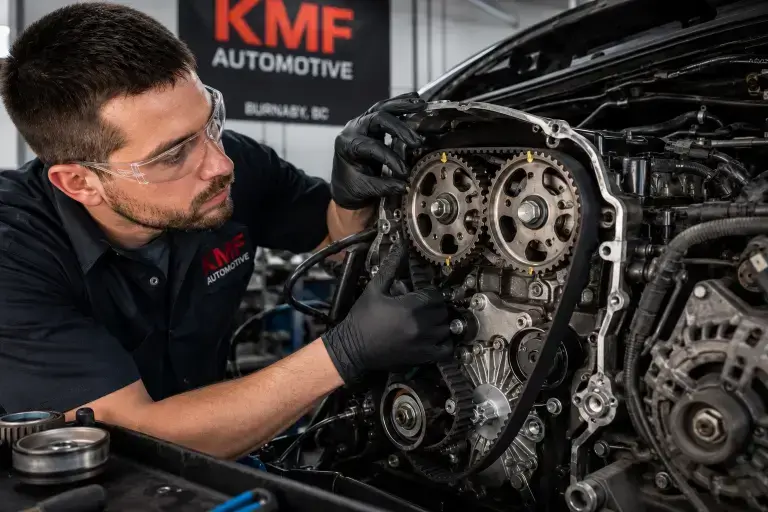
A timing belt is a critical preventative maintenance item that must be replaced according to your manufacturer’s mileage schedule, typically every 90,000 to 160,000 kilometers. Unlike other components, a timing belt will rarely give you audible warning signs before it snaps. At KMF Automotive, a complete timing belt service (including installing a new belt, idler pulleys, tensioners, and a fresh water pump) takes between 3 and 5 hours of highly specialized shop floor time. Because a snapped belt on an interference engine causes instant, catastrophic valve destruction, delaying this service is an incredibly high financial risk. Contact our Burnaby shop today for an upfront, transparent quote.
The Core Architecture of Your Engine’s Timing Circuit
When local drivers look up reliable timing belt replacement in Burnaby, BC, they are dealing with the single most important rubber component under their vehicle’s hood. Your engine is split into two primary operational halves: the top half (the cylinder head housing the intake and exhaust valves) and the bottom half (the engine block housing the pistons and crankshaft).
The timing belt is a heavy-duty, reinforced rubber band featuring molded teeth on its inner surface. It wraps precisely around the crankshaft and camshaft sprockets, acting as a strict mechanical orchestrator.
Its sole job is to keep the rotation of the camshaft and crankshaft locked in perfect synchronization. This synchronization ensures that your engine’s valves open and close at the exact millisecond required relative to the up-and-down movement of the pistons. If this synchronization slips by even a few degrees, the engine will instantly lose combustion efficiency or cease running altogether.
The Interference Engine Peril: Why Delaying is a Total Gamble
Automotive engines are designed using one of two internal structural layouts: Non-Interference or Interference. Understanding which design powers your vehicle dictates the true urgency of your timing belt maintenance:
Non-Interference Engines
In a non-interference layout, there is enough physical clearance inside the combustion chamber between a fully opened valve and a piston at the top of its stroke. If the timing belt snaps at highway speeds, the camshaft stops spinning, and the engine dies instantly, but the components will never physically collide. You will need a tow truck, but your engine will survive intact.
Interference Engines
The vast majority of modern, high-efficiency import and domestic vehicles utilize an interference engine layout. In these tight designs, the valves and pistons occupy the same physical space inside the cylinder, just at completely different times.
If a neglected timing belt stretches, strips its teeth, or snaps while the engine is running, the pistons will continue to slam upward at thousands of revolutions per minute while the valves freeze wide open. The results are instantaneous and catastrophic:
- Bent or shattered intake and exhaust valves
- Deeply punctured or cracked aluminum piston heads
- Scored cylinder walls and warped connecting rods
- Total internal engine destruction requires a multi-thousand-dollar engine replacement
Diagnostic Realities — The Component That Gives No Warning
One of the most dangerous traits of an aging timing belt is that it does not make noise when it is about to fail. Unlike a loose accessory serpentine belt that produces a loud, high-pitched squeal when slipping, a timing belt is heavily grooved and cannot slip without breaking. It operates completely silently beneath a solid plastic protective shield.
Because you cannot easily see or hear the wear, you must rely strictly on your vehicle’s odometer and factory maintenance intervals. Most vehicle manufacturers dictate a hard replacement boundary between 90,000 and 160,000 kilometers, or every 7 to 10 years, regardless of total mileage. If you bought a used vehicle with missing service records and the odometer is creeping past this threshold, booking an inspection is paramount.
Splicing Value — Sourcing the Complete Timing Belt Kit
When you bring your vehicle into KMF Automotive for a timing belt service, our licensed technicians will always recommend replacing the belt as part of a complete system kit rather than changing the rubber band alone. The physical labor required to access the timing loop is intensive, requiring the removal of engine mounts, accessory pulleys, and protective shrouds.
Once our team has fully opened up the front of your engine, it is highly practical to replace the adjacent wear components that share the same lifespan:
- The Timing Belt Tensioner: A spring-loaded or hydraulic pulley designed to apply constant, precise pressure to the belt. If the tensioner fails, a brand-new belt will slacken and skip teeth, causing the same engine damage as a snapped belt.
- Idler Pulleys: Smooth rolling wheels that route the belt path safely through the engine block. Their internal bearings dry out over time, leading to heat buildup and physical seizure.
- The Water Pump: On many modern overhead-cam engines, the water pump is driven directly by the smooth backside of the timing belt. Because a water pump bearing can seize or begin leaking coolant directly onto the rubber belt (which chemically dissolves rubber), replacing it “while we are in there” saves you from paying for the same labor fee all over again down the road.
The Crucial Structural Connection to Your Tires
Executing a professional timing belt replacement requires our technicians to temporarily unbolt structural passenger-side engine mounts and lower sections of your vehicle’s front suspension subframe to gain physical clearance for our specialized toolsets. Because major structural chassis foundations are moved and re-torqued during this deep mechanical process, your vehicle’s front-end geometry will shift slightly upon reassembly.
To fully protect your mechanical investment, we highly recommend pairing your engine service with a precise computerized wheel alignment in Burnaby. Readjusting your steering linkages back to original factory parameters eliminates unexpected highway steering pulls, minimizes rolling resistance, and prevents your front tires from scrubbing away their tread unevenly across the asphalt.
Full-Service Automotive Excellence at KMF Automotive
At KMF Automotive, we operate a full-service, owner-operated mechanical workshop designed to manage your vehicle’s entire maintenance needs. While our licensed technicians have your engine opened up to secure your powertrain timing, it provides an ideal window to address other critical maintenance items, saving you an extra trip to the mechanic later.
Our shop floor is fully equipped to handle any diagnostic or mechanical challenge with complete dealership accuracy. If your engine is approaching a minor service window, we provide warranty-approved, premium oil changes using top-tier synthetic lubricants to keep your engine running clean. If your dashboard check engine light is illuminated due to an emissions code, or if you feel a soft pedal underfoot, our comprehensive brake repair service in Burnaby will completely restore your vehicle’s safety.
We provide extensive service specializations across all major automotive systems. From resolving poor cabin cooling with an expert air conditioning service in Burnaby to executing advanced mechanical fixes, we handle it all. If your manual transmission suffers from a slipping clutch pedal, our specialized clutch repair service in Burnaby will completely restore smooth power delivery. From minor fixes to major overhauls, we treat your car with the exact level of precision we would give our very own vehicles.
Restoring Performance and Total Peace of Mind
Allowing a timing belt to exceed its recommended service life is one of the most dangerous risks a vehicle owner can take. Choosing professional-grade component replacement, a fresh water pump installation, and a strict adherence to factory mileage protocols eliminates the threat of sudden engine failure and protects your wallet from catastrophic replacement bills. Trusting our experienced team ensures your daily commute stays entirely safe, reliable, and stress-free.
Schedule Your Timing Belt Service in Burnaby Today
Don’t let your engine operate on borrowed time. Our certified mechanics at KMF Automotive are fully prepared to accurately evaluate your vehicle’s service history, inspect your belt conditions, and perform a factory-grade replacement with transparent communication and honest, upfront pricing.
Conveniently located at 7080 Macpherson Ave in Burnaby, BC (V5J 4N3), just a brief walk from the Royal Oak SkyTrain Station, we proudly serve local car owners across the Lower Mainland with exceptional automotive craftsmanship. Call our friendly local shop today at 604-438-0222 or contact us online to schedule your service appointment or drop by for a professional consultation.
Frequently Asked Questions: Timing Belt Replacement Burnaby
What is the main difference between a wheel alignment and tire balancing?
A wheel alignment corrects the underlying mechanical angles of your vehicle’s steering and suspension links so that the tires roll perfectly parallel to each other and track straight down the road. Our professional tire repair service in Burnaby incorporates wheel balancing, which uses small weights on the rim flange to counteract natural heavy spots within the spinning rubber assembly itself, eliminating high-speed steering wheel vibrations.
Does my vehicle have an internal timing belt or a timing chain?
It depends entirely on your specific engine make and model. Generally speaking, timing belts are made of rubber and ride outside the oily sections of the engine beneath plastic covers, requiring regular scheduled replacement. Timing chains are made of heavy steel links, run inside the engine block, lubricated by engine oil, and are typically designed to last the entire lifespan of the vehicle if regular oil changes are performed.
What are the common symptoms of a timing belt that has skipped a tooth?
If a worn timing belt stretches or loses teeth, it can slip out of place by one or two notches on the gears. This knocks the engine out of synchronization, causing sudden engine misfires, rough idling, a severe loss of acceleration power, a loud ticking noise coming from beneath the plastic shields, and an immediate check engine light on your dashboard.
Is it an absolute policy to replace the water pump during a timing belt service?
While it is not mechanically mandatory, it is an industry-standard best practice that saves you a massive amount of money. On most modern engines, accessing the water pump requires removing the timing belt entirely. If you choose not to replace a high-mileage water pump, and it begins to leak or fail six months later, you will have to pay for the entire 3-to-5-hour timing belt labor charge all over again.
Can an active engine oil leak speed up timing belt failure?
Yes, absolutely. If your engine’s front camshaft seals or crankshaft seals are leaking oil, that engine oil will slowly seep past the protective plastic covers and coat the timing belt. Petroleum-based lubricants chemically break down rubber compounds rapidly, causing the belt material to soften, glaze, and strip its teeth prematurely.
What should I do immediately if my engine cuts out while driving and won’t restart?
If your vehicle cuts out suddenly at speed, especially accompanied by a light mechanical popping sound, pull over safely and do not attempt to continuously crank the starter motor. If a timing belt has snapped on an interference engine, repeatedly turning the key forces the starter motor to smash the pistons into the stationary valves over and over again, magnifying internal structural damage.
Key Takeaways: Timing Belt Replacement Burnaby
- Mechanical Orchestration: The timing belt serves as a critical synchronous link locking your engine’s valves and pistons in a flawless, high-speed operational dance.
- The Interference Danger: A broken belt on an interference layout results in instant piston-to-valve collision, leading to catastrophic internal engine destruction.
- The Silent Factor: Timing belts give zero auditory warnings or squeals prior to snapping, making odometer tracking the only safe way to gauge lifespan.
- The Shared Kit Policy: Longevity requires replacing the rubber belt alongside fresh tensioners, idler pulleys, and a brand-new water pump.
- Chassis Disassembly Impact: Accessing front-engine timing setups requires unbolting major engine mounts and suspension parts, making a subsequent wheel alignment highly recommended.
- Trusted Independent Quality: Entrusting your powertrain to an established independent repair center ensures factory-spec installation tools, strict torque verification, and honest pricing.