When drivers ask what wheel alignment is, they are often surprised to learn it does not actually involve adjusting your tires. Instead, a wheel alignment is a mechanical calibration of your vehicle’s suspension system to ensure your wheels point in the exact direction the manufacturer intended. Standard computerized adjustments fine tune three primary structural angles, camber, caster, and toe. Routine alignment checks prevent rapid tire destruction, eliminate annoying steering wheel pull, and keep you safe on the road.
What Is Wheel Alignment and How Does It Affect Your Vehicle?
To fully understand what wheel alignment is, you have to look past the rubber tires and focus entirely on the intricate network of control arms, tie rods, ball joints, and springs that connect your vehicle to its wheels. Over time, everyday driving forces, hitting potholes, striking curbs, or traveling over rough gravel roads slowly jar these components out of place. When your suspension shifts even a fraction of a degree out of specification, your tires stop rolling parallel to each other and perpendicular to the road surface.
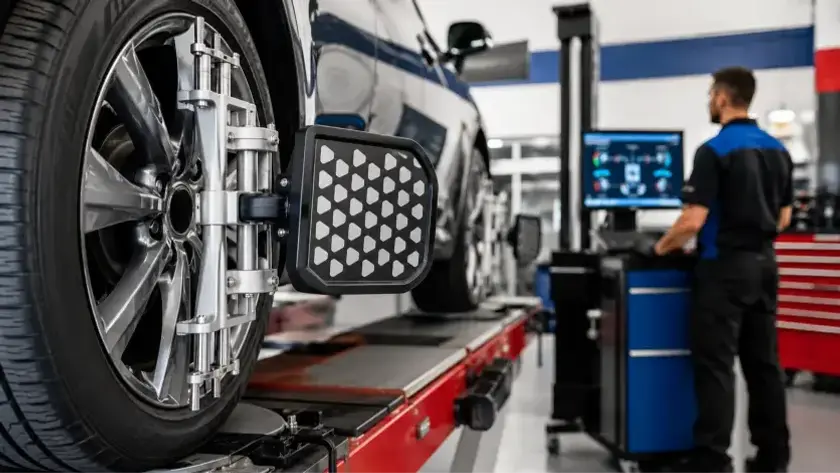
From our perspective on the shop floor, the calibration process requires mounting high precision optical tracking targets to your wheels and utilizing our advanced computerized 3D imaging machine. This electronic sensor array measures your current chassis geometry against a massive database of original equipment manufacturer specifications. If your geometry is distorted, your car is essentially dragging its own tires down the street sideways, which creates immense friction, destroys your tread, and forces your engine to work harder.
The Three Crucial Angles of Suspension Geometry Explained
When evaluating what is wheel alignment, our certified technicians focus on three primary mechanical angles. Each angle serves a distinct purpose in balancing tire wear, steering stability, and cornering performance:
- Toe: This is the most common adjustment we perform. Imagine looking straight down at your vehicle from a bird’s eye view. If the front edges of your tires point slightly inward toward each other, you have to toe in. If they point outward, you have to toe out. Incorrect toe settings will scrub your tread smooth in a matter of weeks.
- Camber: This represents the inward or outward tilt of the tire when viewed directly from the front of the vehicle. Tilt pointing inward toward the engine is negative camber, while tilt leaning away from the vehicle is positive camber. Misaligned camber causes extreme accelerated wear on either the absolute inside or outside edge of your tire.
- Caster: This angle describes the steering axis tilt when viewed from the side of your vehicle. Caster plays a massive role in your steering wheel’s ability to automatically snap back to the center position after you complete a turn, and it ensures your vehicle tracks straight at highway speeds.
Why Do Luxury, Performance, and Modified Cars Require Specialized Care?
If you pull into our service bay driving a premium luxury vehicle, an intricate sports car, or a heavily modified ride, the answer to what wheel alignment involves a much higher level of technical complexity. High end manufacturers design vehicles with incredibly complex multi link independent front and rear suspensions, adaptive air ride systems, or electronic active steering components. Calibrating these premium setups frequently requires us to use specialized diagnostic scan tools alongside physical mechanical adjustments to reset your steering angle sensor within the vehicle’s computer system.
For drivers who love modified vehicles around the Lower Mainland, our task becomes even more meticulous. When you install an aftermarket lift kit on your truck or drop your sports compact on performance coilovers, the factory specification sheet is no longer applicable. Our technicians must spend significant hands-on shop time manually calculating custom camber, caster, and toe curves to ensure your vehicle remains stable at high speeds and handles predictably. This level of expert customization requires advanced specialized training and extra shop floor time compared to a standard factory reset.
What Hidden Suspension Issues Sabotage an Alignment?
A common scenario we encounter in our automotive repair world involves a car that simply refuses to hold its adjustments on our alignment rack. When learning about wheel alignment, you might be unaware that underlying mechanical wear can completely stall our process. If our safety inspection uncovers a loose tie rod end, a blown ball joint, or dry rotted control arm bushings, performing an alignment is practically useless because your wheels will just shift right back out of spec the moment your tires experience real world driving forces.
Our industry safety standards and mechanical integrity dictate that these worn steering and suspension components must be completely replaced before your final alignment can be locked into place. Furthermore, regional driving conditions introduce elements like road salt, moisture, and debris, which cause heavy corrosion on your threaded adjusting sleeves and eccentric adjustment bolts. Breaking free a seized toe adjustment link often requires meticulous torch work, induction heaters, specialized penetrants, and extra labor time from our team.
Diagnostic Insights: Signs Your Vehicle Needs Immediate Attention
While our professional alignment machinery provides the final digital proof, you can perform some troubleshooting right from your driver’s seat to catch issues before they result in a dangerous component failure. The most frequent symptom of your vehicle fighting its own steering geometry is a constant, exhausting pull to one side on a flat, level road. You might also notice your steering wheel spoke sits visibly crooked or off center while you are traveling straight as an arrow down the highway.
Here is a pro level diagnostic tip we use daily during our in the shop inspections: run your hand flat across the tread of your front tires from the inside edge to the outside edge. If the rubber blocks feel smooth moving one way but sharp, jagged, and raspy moving the opposite direction, you are feeling feathering. This is a definitive mechanical sign of severe toe in or toe out misalignment scrubbing your tires raw. If you catch this pattern early, you can schedule a professional wheel alignment in Burnaby with us before your expensive tire carcass is completely ruined and requires total replacement.
Beyond Alignments: Comprehensive Care for Your Vehicle
At KMF Automotive, we believe in keeping your entire vehicle in pristine mechanical shape. Often, a severe alignment problem is discovered during other routine checkups, or it can place secondary strain on systems like your brakes and axles. If your car is already in our service bay getting its suspension squared away, it might be the perfect opportunity to address your automobile’s comprehensive maintenance needs to save you a separate trip later.
Our facility operates as a full service workshop equipped to handle any diagnostic or mechanical challenge. Beyond resetting your steering geometry, our licensed technicians specialize in everything from quick, routine upkeep to major hardware overhauls. Whether your engine is due for a warranty approved oil change, your climate system needs an air conditioning service in Burnaby, or you are hearing an unsettling rumble that requires an exhaust and muffler repair in Burnaby, we have the computerized tools to resolve the problem efficiently.
Taking care of your vehicle’s fundamental components guarantees that your daily drive stays smooth, predictable, and remarkably safe. If your transmission shifting feels sloppy or slipping, our precision clutch repair service in Burnaby will restore your vehicle’s mechanical power delivery. Furthermore, if you are approaching a major mileage milestone, securing a preemptive timing belt repair in Burnaby protects your internal engine components from catastrophic, irreversible failure. From a quick fluid refresh to a critical brake repair service in Burnaby, we treat your car with the exact level of precision and care we would give our very own vehicles.
Relying on Professional Precision for Long Term Driving Safety
Allowing your vehicle to drift out of factory specification might seem like a minor inconvenience, but it places immense, continuous stress on your entire drivetrain and chassis. When your front and rear wheels fight each other for direction, your engine works harder, your fuel efficiency drops, and your tires wear out prematurely. Our routine alignment checks are the absolute best way to ensure maximum tire life and maintain predictable, safe handling during sudden braking or emergency maneuvers. Trusting our factory specifications and professional diagnostic tools ensures complete peace of mind every time you and your family hit the road.
Restore Your Steering Performance at KMF Automotive in Burnaby
Don’t let a crooked steering wheel, sloppy handling, or uneven tire wear ruin your daily commute or compromise your safety on local roads. Our certified technicians at KMF Automotive are ready to utilize our state of the art computerized alignment equipment to restore your vehicle’s factory spec handling instantly. Conveniently located at 7080 Macpherson Ave in Burnaby, BC (V5J 4N3), we serve drivers from all across the surrounding areas with precision care. Whether you need a quick inspection after hitting a nasty pothole or a complete steering system overhaul, we provide the honest, high quality service you deserve without any hidden fees or high pressure upselling. Give our friendly local team a call today or contact us online to get your vehicle driving straight and true again.
Frequently Asked Questions
What is the main difference between a wheel alignment and tire balancing?
A wheel alignment adjusts the angles of your vehicle’s steering and suspension links so that the tires roll perfectly parallel to each other and perpendicular to the road surface. Our tire repair service in Burnaby and wheel balancing, conversely, uses small calibrated weights to correct uneven weight distribution within the spinning rubber tire and wheel assembly itself, eliminating high speed steering wheel vibrations.
How long does it take for your team to complete a standard alignment?
On an average vehicle with no severely rusted or seized components, our professional two wheel or four wheel alignment generally takes between 45 and 60 minutes. If we discover worn ball joints, bent tie rods, or need to apply heat to frozen adjusting sleeves, the process will take us longer to complete safely.
Is it safe to postpone a wheel alignment if my car pulls slightly?
Driving a short distance is mechanically possible, but putting off an alignment is highly discouraged for daily use. Prolonged misalignment causes rapid, irreversible tire destruction, degrades your overall fuel economy, and compromises your vehicle’s stability during sudden braking or emergency evasive maneuvers.
Do I absolutely need an alignment every time I install new tires?
Yes, we highly recommend pairing a new tire installation with our professional alignment service to safeguard your financial investment. Mounting brand new rubber onto a vehicle with distorted suspension geometry will cause immediate, uneven tread wear, significantly shortening the lifespan of your fresh tires.
Can a misaligned suspension cause my steering wheel to shake at high speeds?
While high speed steering wheel vibrations are typically caused by out of balance wheels, severe alignment issues can contribute to a rough or erratic steering feel. If your alignment angles are drastically incorrect, your front tires will continuously fight each other for traction, telegraphing a distinct feedback sensation up through the steering column.
Can hitting a single bad pothole knock my vehicle out of alignment?
Yes, hitting a deep pothole, striking a concrete curb, or driving over debris with significant force can instantly bend a control arm or shift an adjustment bolt out of position. If you experience a harsh impact and notice an immediate change in your steering wheel’s center position, you should have us inspect it right away.
Key Takeaways: What Is Wheel Alignment?
- Understanding what wheel alignment requires shifting focus away from the rubber tires and focusing entirely on correcting your underlying steering and suspension links.
- Front end and four wheel alignments require different tiers of service based on whether your car features a solid or independent rear suspension design.
- Technicians calibrate three primary structural angles during an inspection, toe, camber, and caster.
- Worn out tie rods, failing ball joints, or seized adjustments must be repaired before we can successfully lock in a precise alignment.
- Running your hand across the tread can reveal feathering, a distinct diagnostic sign of severe tire wear that we look for to catch poor alignment early.
- DIY alignment methods cannot achieve the fractional degree precision we provide with our digital shop equipment to protect your tires and preserve vehicle fuel economy.