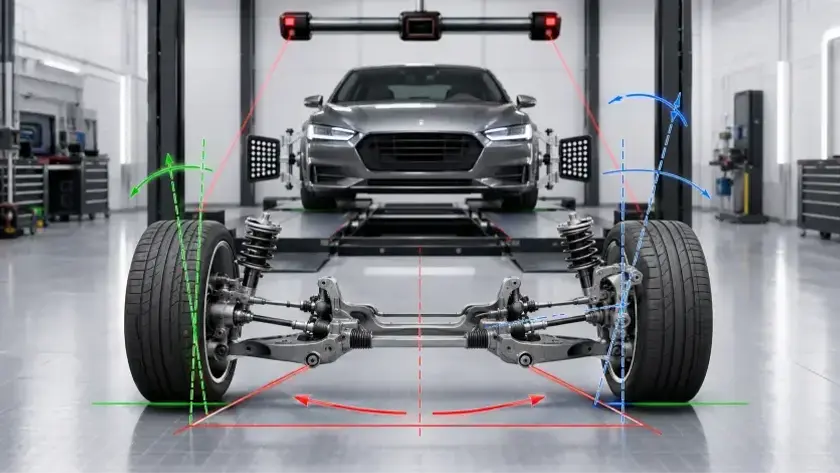
A wheel alignment is not an adjustment of the physical wheels or tires themselves. Instead, it is a mechanical service that tunes your vehicle’s underlying suspension and steering components back to the manufacturer’s precise factory specifications. Using a specialized drive-on rack equipped with digital laser cameras, a technician calibrates the structural links so your tires sit perfectly flat on the pavement and roll precisely parallel to one another. Keeping these angles balanced prevents your tires from scrubbing away their rubber prematurely, centers your steering wheel, and eliminates highway tracking drift.
The Three Pillars of Alignment Geometry
When your car rolls out of the factory, its steering links are dialed into three highly specific geometric angles: Camber, Caster, and Toe. Over thousands of kilometers, driving over speed bumps, hitting curbs, or dropping into deep potholes gradually forces these parameters out of spec.
1. Toe Angle ($Toe\text{-}In$ / $Toe\text{-}Out$)
This is the most critical angle for tire longevity. Toe describes the exact direction the tires point relative to the vehicle’s centerline when viewed from directly above.
- Toe-In: The fronts of the tires lean inward toward each other (like being pigeon-toed).
- Toe-Out: The fronts of the tires flare outward away from each other (like duck feet).
- The Result: If your toe angle is incorrect even by a fraction of a millimeter, your tires will literally drag sideways down the highway, wiping out your tread within a matter of weeks.
2. Camber Angle (Positive / Negative)
Camber is the inward or outward vertical tilt of the wheel assembly when viewed from the direct front of the vehicle.
- Negative Camber: The top of the tire tilts inward toward the engine.
- Positive Camber: The top of the tire tilts outward away from the car.
- The Result: While a tiny bit of negative camber aids cornering grip, excessive camber forces the vehicle’s weight onto only one edge of the tire, stripping away either the inner or outer rubber shoulder.
3. Caster Angle (Positive / Negative)
Caster is the angle of your steering pivot axis when viewed from the side of the vehicle. It is easiest to picture as the rake of a bicycle’s front fork.
- Positive Caster: The steering axis tilts backward toward the driver.
- Negative Caster: The steering axis tilts forward toward the front bumper.
- The Result: Caster does not cause tire wear. Instead, it dictates steering wheel behavior. Proper positive caster gives your vehicle high-speed directional stability and provides the self-centering force that automatically straightens your steering wheel after completing a turn.
Why Do Wheels Drift Out of Alignment?
Suspension drift is an inevitable reality of vehicle ownership. The mechanical connections under your chassis alter their positioning due to two distinct factors:
- Sudden Kinetic Impacts: Striking a deep frost heave, slamming into an unexpected pothole at highway speeds, or clipping a concrete curb while parking can instantly bend or forcefully shift solid metal tie rods and control arms out of place.
- Normal Component Aging: Your suspension utilizes internal rubber bushings and ball joints to absorb road vibrations. As these rubber components naturally degrade, dry-rot, and squash over time, they develop mechanical slack, allowing the wheel assemblies to sag away from their original factory blueprints.
The Massive Financial and Performance Benefits
Investing an hour on a workshop alignment rack pays for itself almost immediately across several key areas of vehicle operation:
- Extends Tire Life Expectancy: Tires are a significant financial investment. Keeping your suspension balanced ensures your vehicle’s weight is distributed perfectly across the entire flat face of the tread, maximizing your tire life.
- Boosts Fuel Tracking Efficiency: When your tires are misaligned (especially with bad toe specs), they continuously fight each other and drag across the road surface. This drag increases rolling resistance, forcing your engine to burn significantly more fuel just to maintain speed.
- Enhances Driving Safety: A properly aligned vehicle handles predictably. It will track perfectly straight on the highway without requiring constant steering wheel corrections, and it will respond sharply during emergency swerves or heavy braking events.
The Oil Change and Preventative Fluid Connection
Because analyzing alignment geometry requires raising your vehicle on an open hoist or a drive-on lift, it forms a natural partnership with routine fluid milestones.
When you book your vehicle into an independent garage for a routine engine oil change or an automatic transmission fluid change, the technician will elevate the chassis. This gives them a clear path to run a quick tire tread scan. Spotting a skewed toe tracking profile early during a routine fluid check lets you resolve the issue on the spot, keeping your vehicle safe without making you book a completely separate service appointment later.
Comprehensive Automotive Mastery
An automobile is a complex network of interconnected systems. If an impact with a pothole was severe enough to alter your steering geometry, it is highly likely that other components underneath your chassis sustained structural stress or damage.
A premier, independent repair facility handles everything required to keep your automobile dependable and safe. If that pothole impact damaged a wheel bearing or warped a rotor, a comprehensive brake repair service will fully restore your stopping confidence. If the jolt disturbed delicate electronic sensors, licensed mechanics can quickly pinpoint the exact error code triggering an ABS light or check engine alert.
From restoring crisp, icy airflow with an expert air conditioning service to tracking down complex mechanical faults, comprehensive care saves time. If your manual transmission link or clutch assembly feels loose following a heavy underbody hit, a specialized clutch repair balances your power delivery. Furthermore, for high-mileage engines, booking a preemptive timing belt repair provides absolute insurance against catastrophic internal engine valve damage.
Precision Alignment and Complete Daily Confidence
Driving a vehicle with a severely misaligned suspension forces you to constantly fight a pulling steering wheel while actively scrubbing away your tire rubber. Entrusting your car to a professional alignment bay entirely removes underbody mechanical stress, ensures your vehicle tracks straight, and guarantees your daily commutes remain smooth and completely worry-free.
Frequently Asked Questions: what is the wheel alignment
What is the main difference between a wheel alignment and tire balancing?
A wheel alignment corrects the underlying mechanical angles of your steering links and suspension components so that your tires roll parallel to each other and track straight. A professional tire repair service incorporates wheel balancing, which places small weights along the rim flange to correct natural heavy spots within the spinning rubber assembly itself, entirely removing high-speed steering vibrations.
How can I tell if my car needs an alignment right now?
The most common symptoms include your vehicle pulling hard to the left or right when you momentarily relax your grip on the steering wheel, your steering wheel sitting crooked or off-center while driving straight, or your front tires making a loud squealing or scrubbing noise during normal low-speed turns.
Does a wheel alignment include checking my car’s tire pressure?
Yes, absolutely. A correct tire pressure check is the mandatory first step of any professional alignment. If the tire on the left side is heavily deflated compared to the tire on the right side, the vehicle’s ride height will tilt slightly, which will completely distort the computer’s laser alignment measurements.
Can a bad alignment cause an active suspension noise?
An alignment setting being out of spec will not make noise, but the worn-out suspension parts causing the bad alignment certainly will. If your vehicle clunks, pops, or groans when you drive over bumps, it typically means your control arm bushings or ball joints are completely shot and must be replaced before an alignment can be done.
What is a steering angle sensor (SAS) recalibration?
Many modern vehicles feature advanced driver-assist systems (ADAS) like lane-keep assist and automated cruise control. When a technician alters your physical steering geometry during an alignment, they must use a digital scan tool to reset the electronic Steering Angle Sensor to zero, ensuring the vehicle’s onboard computers know exactly when the wheels are pointing straight.
Should I get an alignment if I only buy two new tires instead of four?
Yes. Whenever fresh rubber is introduced to your vehicle, checking the suspension tracking is highly recommended. The shop will typically mount the two fresh tires onto your rear axle for optimal wet-weather traction and perform a full alignment to ensure they roll perfectly straight without wearing out prematurely.
Key Takeaways: what is the wheel alignment
- Suspension, Not Wheels: An alignment tunes the steering links and suspension angles beneath the chassis, not the physical wheels or tires.
- The Big Three Specs: Technicians use advanced lasers to calibrate three distinct geometric parameters: Camber, Caster, and Toe.
- Prevent Tread Scrubbing: Even a tiny alignment error forces your tires to drag sideways, ruining expensive tire tread in a matter of weeks.
- Schedule an Annual Check: Aim to test your suspension tracking once a year or every 15,000 to 25,000 kilometers to maintain total safety.
- The Maintenance Connection: Checking your alignment during a routine oil change or transmission service is the most effective way to optimize tire longevity.
- Independent Facility Accuracy: Trusting your vehicle to an established independent facility guarantees access to digital laser alignment racks, certified technicians, and completely upfront service rates.