A proper wheel alignment is a highly precise mechanical service that cannot be accurately duplicated with standard hand tools in a home driveway. Because modern vehicles are built with suspension tolerances measured in fractions of a millimeter, performing an alignment requires a specialized computerized drive-on alignment rack and high-definition laser target cameras.
Here is exactly how a certified automotive technician performs a professional four-wheel alignment from start to finish.
The Alignment Prep Work The Diagnostic Inspection
Before any geometric adjustments are made, a technician must verify that the vehicle’s underlying hardware is structurally capable of holding an alignment.
1. Correcting Tire Pressure
The technician connects a digital pressure gauge to all four tires, inflating or deflating them to the exact manufacturer specifications listed on the driver’s door jamb. If one tire is significantly lower than the others, it tilts the vehicle’s ride height, which completely distorts the laser calculations.
2. The Steering and Suspension Component Shake-Down
With the vehicle raised slightly on the alignment lift, the technician uses a pry bar and physical force to rigorously shake down the front and rear wheels. They are checking for structural play or mechanical slack in the:
- Inner and outer steering tie rod ends.
- Lower and upper ball joints.
- Control arm rubber bushings.
- Wheel bearings and strut mounts.
The Red Light Rule: If any of these steering components are worn out, cracked, or loose, the alignment service must be stopped immediately. Adjusting steering links attached to a loose component is completely pointless; the moment the vehicle hits a bump on the road, the wheel will shift right back out of specification. The worn components must be replaced first.
Step-by-Step Computerized Laser Execution
Once the chassis passes the physical inspection, the vehicle is prepared for digital laser measurement and mechanical calibration.
Mounting the Digital Laser Targets
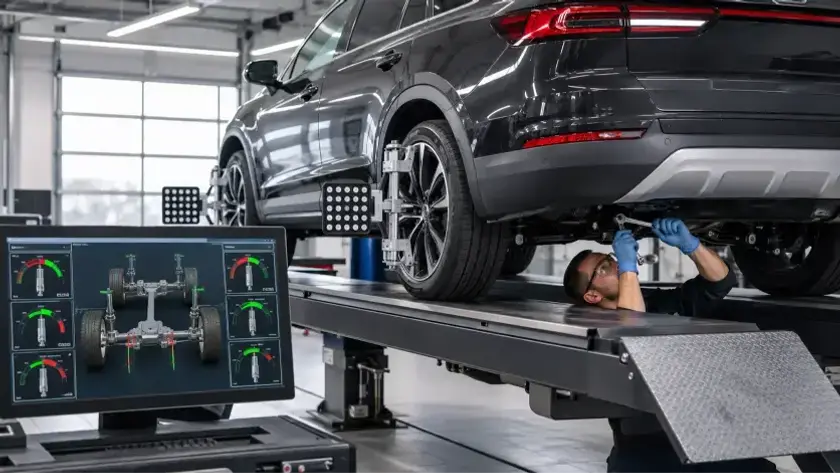
The technician clamps advanced electronic reflection targets or laser sensors securely onto the outer lip of all four wheel rims. These targets feature precise geometric patterns that reflect infrared light back to a master camera tower positioned in front of the alignment rack.
The Rolling Compensation Phase
The technician unlocks the alignment rack’s integrated slip plates (which allow the vehicle’s
wheels to slide freely sideways without tire resistance) and rolls the car backward and forward a few inches. This process maps any slight bends or manufacturing variations in the wheel rims, calibrating the computer to read the true centerline of the wheel bearings.
The Steering Caster Sweep
The technician sits in the driver’s seat and turns the steering wheel fully to the left, then fully to the right. This “caster sweep” allows the computer tower’s optical sensors to track the vertical pivot arc of the front struts, calculating the exact Caster angle of the front steering knuckles.
Centering and Locking the Steering Wheel
The technician centers the steering wheel perfectly straight forward, verifies that the dashboard steering angle sensor (SAS) reads zero degrees, and installs a physical spring-loaded steering wheel holder to lock it in place. A brake pedal depressor tool is also wedged between the driver’s seat and the brake pedal to lock all four wheels, preventing the car from rolling while adjustments are made.
Mechanical Component Calibration
With real-time measurements displayed on a workshop monitor, the technician slides underneath the vehicle with specialized wrenches to physically alter the suspension links. They always adjust the rear axle first, followed by the front axle:
- Rear Alignment: The technician turns eccentric cam bolts along the rear control arms to center the rear Camber and rear Toe angles. This establishes the vehicle’s “thrust line”—the direction the rear wheels are pushing the car.
- Front Camber & Caster: Moving to the front, the technician adjusts strut mount plates or subframe bolts (if applicable) to align the front camber tilt.
- Front Toe Adjustment: Finally, the technician loosens the lock nuts on the front steering tie rods. By physically rotating the threaded tie rod adjustment sleeves, they lengthen or shorten the steering links until the front Toe angle is brought perfectly to zero degrees on the monitor screen.
The Final Printout and Road Test
Once all measurements turn from red (out-of-spec) to green (in-spec) on the computer screen, the technician tightens and torques all lock nuts back to factory specifications. The computer generates a detailed, color-coded before-and-after data sheet for the customer. The laser targets are removed, and the technician takes the car on a brief road test to verify that the steering wheel sits completely straight and the vehicle tracks straight on flat asphalt.
The Oil Change and Routine Fluid Connection
Because setting up a computerized wheel alignment requires placing your vehicle onto a dedicated mechanical hoist, it pairs beautifully with other routine preventative maintenance milestones.
When you bring your vehicle into an independent garage for a routine engine oil change or an automatic transmission fluid change, the technician will elevate the chassis. This open view allows them to easily run a quick tire tread check. Spotting an uneven toe wear pattern or feathering early during a routine oil service lets you seamlessly transition the car over to the alignment rack, correcting the underlying geometry issue without requiring multiple separate shop visits.
Full-Service Automotive Mastery
Your vehicle operates as an intricately connected network of mechanical systems. If an impact with a heavy curb or a deep pothole was severe enough to throw your suspension links completely out of alignment, other underbody components often sustain collateral stress.
A premier, full-service independent garage handles everything required to keep your automobile dependable and safe. If that pothole impact damaged an internal wheel bearing assembly or bent a brake rotor, a complete brake repair service will fully restore your stopping confidence. If the harsh jolt disturbed delicate wheel speed electronics, licensed mechanics can use advanced scan tools to pinpoint the exact sensor fault triggering an ABS light or check engine alert.
From restoring crisp, icy airflow with an expert air conditioning service to tracking down complex mechanical faults, comprehensive care saves time. If your manual transmission link or torque delivery feels loose following an underbody hit, a specialized clutch repair balances your power delivery. Furthermore, for high-mileage engines, booking a preemptive timing belt repair provides absolute insurance against catastrophic internal engine valve damage.
Precision Tracking and Complete Daily Confidence
Attempting to drive a vehicle with a severely misaligned suspension means you are actively scrubbing away your expensive tire tread while constantly fighting a pulling steering wheel. Entrusting your car to a professional, laser-calibrated alignment bay completely removes mechanical stress from your chassis, centers your steering tracking, and guarantees your daily commutes remain smooth, highly fuel-efficient, and perfectly safe.
Frequently Asked Questions: how do you do a wheel alignment
What is the main difference between a wheel alignment and tire balancing?
A wheel alignment corrects the underlying mechanical angles of your steering links and suspension components so that your tires roll parallel to each other and track straight. A professional tire repair service incorporates wheel balancing, which places small weights along the rim flange to correct natural heavy spots within the spinning rubber assembly itself, entirely removing high-speed steering vibrations.
Why do some cars only get a front-end alignment instead of a four-wheel alignment?
Older trucks, cargo vans, and select vintage cars feature a solid rear axle that has zero mechanical provisions for adjustment. These vehicles can only receive a two-wheel (front-end) alignment. However, almost all modern front-wheel-drive sedans, crossovers, and SUVs feature independent rear suspensions that require a full four-wheel alignment to handle safely.
What does “thrust angle” mean on an alignment sheet?
The thrust angle is an imaginary line that points directly down the path the rear wheels are pointing. If your rear axle is misaligned, the rear wheels will push the back of the car sideways, causing the vehicle to “dog-track” or drive down the road at a slight angle. A four-wheel alignment centers this thrust line perfectly parallel to the front wheels.
Can a shop perform an alignment if my car has modified suspension?
Standard alignment computer databases carry factory specifications for stock ride heights. If your car has aftermarket lowering springs or adjustable coilovers, you will need to seek out a specialized performance or tuning shop that specializes in custom suspension setups to manually dial in your tracking parameters safely.
What happens if a technician cannot turn the tie rod adjustment sleeves?
In geographic regions that experience heavy winter road salt or moisture, underbody steel components rust quickly. If a tie rod sleeve is rusted solid, the technician will use a specialized oxy-acetylene heating torch to break the rust bond. If the part is completely seized or structurally compromised by rust, the tie rod end must be replaced before the alignment can be finished.
How often should I get my alignment checked if I don’t feel a pulling sensation?
As an optimal preventive standard, you should have your wheel alignment verified once a year or every 15,000 to 25,000 kilometers. Suspension links drift slowly over time due to normal rubber bushing wear, meaning your tracking could be causing hidden tire wear across the inner shoulders before you actively feel it pull in the steering wheel.
Key Takeaways: how do you do a wheel alignment
- Specialized Tooling Required: A proper alignment demands a dedicated drive-on computer rack and high-definition laser targets; it cannot be done accurately in a driveway.
- The Shake-Down First: Technicians must verify that all tie rods, ball joints, and control arm bushings are completely tight before adjusting alignment angles.
- Rear Axle Adjusted First: A professional four-wheel alignment always centers the rear camber and toe angles first to establish a correct thrust line.
- Calibrating the Big Three: The technician adjusts physical link sleeves and cam bolts to bring Camber, Caster, and Toe specifications back into the green.
- The Preventive Maintenance Link: Inspecting your alignment parameters during a routine oil change or transmission fluid service is the most efficient way to maximize tire longevity.
- Independent Workshop Accuracy: Trusting your vehicle to an established independent repair center guarantees access to advanced laser alignment equipment, certified technicians, and completely upfront service rates.