Proper wheel tracking is absolutely critical to prevent rapid tire degradation and maintain steering control. This comprehensive guide answers exactly how often you should get an alignment based on your driving conditions and suspension health. We cover industry-standard checkup intervals, primary warning indicators, and when to book a certified mechanical inspection.
What Factors Dictate how often should you get an alignment
Several key variables determine the exact timeline or mileage you can safely drive before needing your wheels re-indexed. Your typical driving environment is a massive factor, as rough gravel roads, frequent potholes, and city speed bumps disrupt suspension settings much faster than smooth highways. Your overall driving habits also play a major role because hitting curbs or parking blocks hard alters delicate angles instantly. Additionally, the age of your vehicle, worn steering components, and recent suspension repairs will directly dictate how often should you get an alignment. If you want to see how these factors impact your overall vehicle handling, visit the KMF Automotive homepage for a full overview of our maintenance philosophies.
How Often Should You Get an Alignment Based on Annual Mileage
When organizing your automotive maintenance plan, you should align your suspension service with your regular vehicle inspection intervals. For standard commuter vehicles, you should schedule a wheel tracking evaluation once every twelve months or roughly every ten thousand kilometers. If you routinely encounter severe driving environments or log high annual mileage, you should compress this schedule to every six months. For top-tier safety, always request an alignment check whenever you invest in a fresh set of tires to protect your new investment from premature wear.
Understanding the Dangers of Following a Strict Mileage Schedule Alone: how often should you get an alignment
Relying strictly on your odometer reading to decide how often should you get an alignment can lead to hidden mechanical expenses. A single severe impact with a deep pothole or a concrete curb can instantly knock your suspension out of factory specifications, even if you just serviced the car last week. If you ignore the immediate physical warning signs and wait for a specific mileage marker, your misaligned wheels will silently scrub away your tire tread. This delay forces you to purchase costly replacement tires long before their expected lifespan.
When Are Suspension Alignment Symptoms Too Severe to Delay
You must regularly monitor your steering wheel behavior to catch early warning signs of incorrect tracking before encountering dangerous handling issues. If your vehicle pulls strongly to one side on a straight road or your steering wheel remains crooked when driving forward, your alignment is spent. Checking your tires and finding feathered edges, heavy shoulder wear, or hearing loud squealing noises during sharp turns indicates advanced geometry problems. Operating your vehicle with these active mechanical faults puts you at risk of losing steering control during an emergency, requiring immediate shop care.
Situations That Mandate an Immediate Alignment
Beyond your annual milestone check, there are two specific mechanical events that require resetting your steering links back to factory blueprints:
1. When Installing Fresh Tires
Whenever you invest in a brand-new set of matching tires, getting a computerized alignment is highly recommended. If your vehicle’s underlying angles are skewed, a misaligned suspension will permanently scrub away the tread of expensive new rubber within a few thousand kilometers, completely voiding your tire wear warranties.
2. Following Steering or Suspension Repairs
If a technician replaces a worn-out tie rod end, lower control arm, ball joint, or stabilizer link, the structural geometry of your steering system is completely disturbed. An alignment is mandatory immediately following these repairs to calibrate the new parts back to original factory parameters.
Why Professional Laser Alignments Beat Simple Visual Driveway Checks
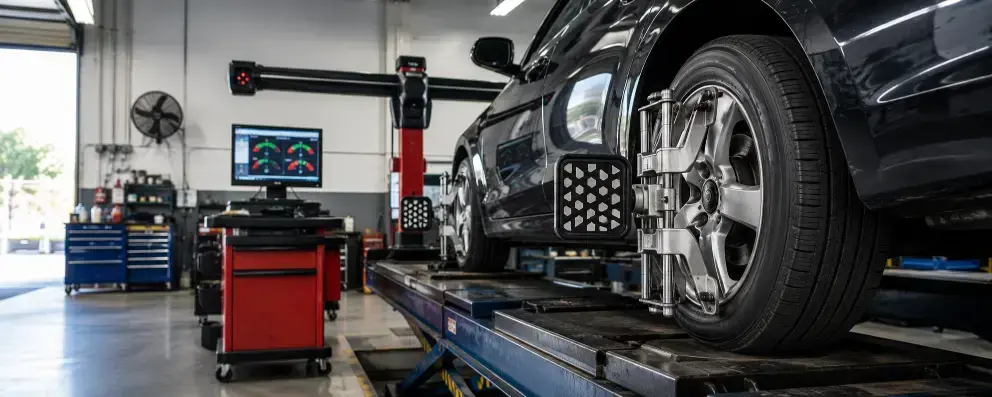
Attempting a rudimentary tracking measurement in your residential driveway does not offer the same safety margins as a modern industrial garage facility. Experienced mechanics do not just eyeball the tires; they utilize advanced digital imaging systems to measure alignment angles down to fractions of a millimeter. Professionals also perform a vital pre-alignment inspection to check for worn ball joints, brittle tie rods, and damaged control arms that make setting tracking impossible. Skipping this comprehensive diagnostic check means you might try to align wheels on a fundamentally loose suspension system.
The Geometry Specs — Camber, Caster, and Toe
When a licensed mechanic places your vehicle onto a computerized laser alignment rack, they are measuring three highly distinct angles built into your steering links:
Toe (Toe-In / Toe-Out)
This measures the exact direction the tires are pointing relative to the centerline of the vehicle when viewed from directly above. If your tires point inward toward each other (Toe-In) or outward away from each other (Toe-Out), they will slide down the road sideways, wiping out your tire tread within weeks.
Camber (Positive / Negative)
This is the inward or outward tilt of the wheel when viewed from directly in front of the vehicle. Excessive negative camber (top of the tire tilting inward) strains your internal wheel bearings and strips away the inner tire shoulders.
Caster
The forward or backward tilt of the steering axis when viewed from the side. Proper caster ensures your steering wheel naturally returns to the center position automatically after completing a turn and maintains high-speed highway stability.
Where Can You Get Professional Alignment Service in Burnaby
You do not have to guess about your vehicle tracking accuracy or deal with complex suspension adjustments on your own. Bringing your car to a certified local facility ensures your steering geometry is reset to exact manufacturer specifications using state-of-the-art equipment. Our experienced team uses elite diagnostic tools to maximize your driving comfort, eliminate steering drift, and protect your tires from uneven wear. Schedule a comprehensive, factory-approved wheel alignment in Burnaby with our top-tier mechanical team today.
How to Protect Your Steering System and Maximize Alignment Lifespan
Adopting a few mindful driving habits will keep your wheels tracking straight between your regularly scheduled service appointments. Avoid driving aggressively over deep road imperfections and slow down significantly when navigating speed bumps or transition gaps in construction zones. Periodically maintain correct tire inflation pressures to ensure even weight distribution across all four corners of your vehicle frame. Keeping your wheels properly balanced also prevents high-speed vibrations from loosening internal suspension hardware over time.
Rely on Certified Technicians for Complete Automotive Care in Burnaby
Preserving the performance, safety, and long-term resale value of your vehicle demands verified mechanical expertise and premium products. From routine fluid maintenance and tire rotations to advanced electronic troubleshooting and complex system repairs, choosing an established facility ensures total reliability. The professional team at our top-rated auto repair shop in Burnaby focuses on delivering transparent pricing and quality workmanship to keep your car performing at its peak.
Contact Our Local Facility to Book Your Repair Appointment Today
Do not take unnecessary chances with a crooked steering wheel, uneven tire tread wear, or deferred maintenance windows that endanger your vehicle’s life. Secure a fast, factory-approved solution that keeps your everyday commute stress-free and completely protects your automotive investment. Click over to our main digital booking portal right now to contact us and schedule your premium maintenance appointment today.
Frequently Asked Questions
Can misaligned wheels cause my steering wheel to vibrate?
No, standard wheel misalignment usually causes your car to pull to one side or creates uneven tread wear rather than causing direct steering vibrations. If you feel a distinct rhythmic shaking through the steering wheel at highway speeds, you are most likely dealing with out-of-balance tires or a warped brake rotor. It is best to have a certified technician diagnose the exact source of the movement.
How long does a professional wheel alignment service take
A standard professional alignment service takes between forty five to sixty minutes to complete in a fully equipped automotive garage. The process involves mounting digital laser sensors to all four wheels, measuring the current camber, caster, and toe angles, and adjusting the mechanical components to factory specifications. Technicians also perform a thorough steering component safety check.
Why does incorrect wheel tracking reduce my vehicle fuel economy
When your wheels are not perfectly parallel to each other, they continuously drag and scrub against the road surface instead of rolling smoothly. This structural misalignment creates massive rolling resistance, forcing your engine to work significantly harder and consume extra fuel to maintain highway speeds. Resetting the tracking angles eliminates this drag and restores your optimum fuel economy.
What happens if I ignore my scheduled alignment window
Driving past your maintenance window allows incorrect tracking angles to rapidly accelerate tire wear, often ruining a set of tires in just a few thousand kilometers. The continuous stress also places uneven loads on your wheel bearings, ball joints, and steering rack linkages. This prolonged neglect weakens your entire suspension system, resulting in much higher repair bills down the road.
Is a two-wheel alignment sufficient for modern cars?
No, most modern cars, trucks, and SUVs require a comprehensive four wheel alignment to guarantee safe handling and even tire wear. A four-wheel service measures and adjusts both the front and rear axle angles relative to the center line of the vehicle. Even if your car only has Front Wheel Drive, incorrect rear toe or camber angles will cause severe handling instability.
Does city stop-and-go driving alter alignment faster?
Yes, consistent stop-and-go driving in city environments subjects your suspension to much higher physical stress than steady highway cruising. Navigating tight parking garages, hitting recessed utility covers, climbing steep curbs, and encountering constant road construction all combine to accelerate alignment shifts. If you primarily drive in the city, you should inspect your tracking more frequently.
What is the main difference between a wheel alignment and tire balancing?
A wheel alignment corrects the underlying mechanical angles of your steering links and suspension components so that your tires roll parallel to each other and track straight. A professional tire repair service incorporates wheel balancing, which places small weights along the rim flange to correct natural heavy spots within the spinning rubber assembly itself, entirely removing high-speed steering vibrations.
Why is my car still pulling after getting a fresh alignment?
If your alignment specs match factory parameters but the car still pulls, you may be experiencing a “radial pull” caused by an uneven tire wear pattern that developed before the alignment was fixed. It could also indicate a sticking brake caliper or a worn internal steering gear valve body.
Can an alignment fix a clunking noise when I drive over speed bumps?
No. An alignment is strictly an adjustment of the suspension angles. If your vehicle is actively making clunking, popping, or groaning noises, it means a mechanical component like a ball joint, control arm bushing, or sway bar link is physically broken or worn out. Those parts must be replaced before an alignment can be performed.
How long can I drive on a vehicle that needs an alignment?
While the car will remain drivable, you should avoid stretching it out for more than a few weeks. Depending on how severely your toe or camber angles are skewed, a bad alignment can completely bald a perfectly good tire and expose its internal wires in less than a thousand miles of highway driving.
Key Takeaways
- Schedule a comprehensive wheel alignment check every ten thousand to twelve thousand kilometers
- Request an immediate inspection after harsh potholes, curb impacts, or component wear
- Ignoring incorrect tracking angles causes rapid, uneven tire wear and pulling steering
- Proper alignments restore factory handling precision and maximize your total fuel economy
- Booking a certified technician guarantees precise laser measurements and suspension checks