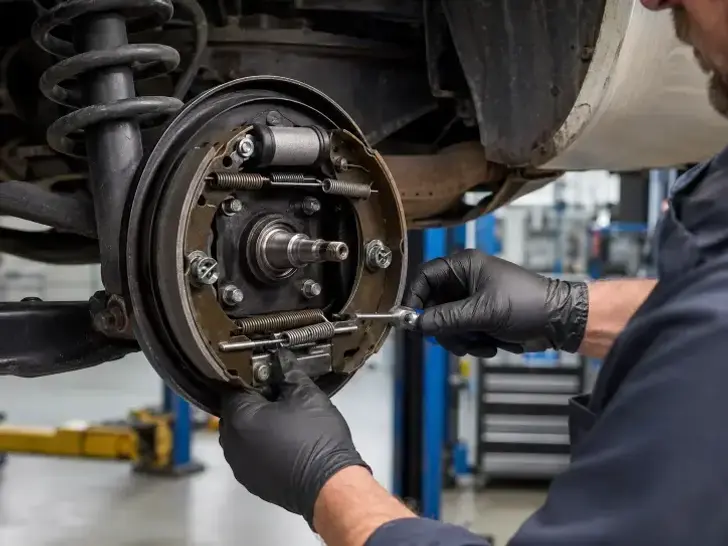
Brake shoes are the curved, friction-lined components used exclusively inside drum brake systems, which are typically found on the rear wheels of compact cars, trucks, and older vehicles. While modern front wheels rely on flat brake pads that clamp a spinning disc, brake shoes push outward against the inside of a spinning metal drum. On average, rear brake shoes last significantly longer than front padsusually between 80,000 and 120,000 kilometers because they handle only about 30% of your vehicle’s braking force. If you notice a scraping noise from your rear wheels, a loose parking brake, or a spongy pedal, it is time for a professional drum brake inspection.
Shoes vs. Pads Understanding the Difference
In the automotive world, the terms “brake pads” and “brake shoes” are frequently mixed up, but they refer to completely different components engineered for two entirely distinct braking systems.
Brake Pads (Disc Brakes)
Brake pads are flat blocks of friction material used in disc brake systems. Positioned inside a caliper, they clamp inward onto both sides of a shiny, exposed metal rotor. Disc brakes handle the vast majority of modern vehicle stopping power and are almost always found on your front wheels.
Brake Shoes (Drum Brakes)
Brake shoes are curved, crescent-shaped metal pieces lined with friction material on their outer
edge. They are tucked completely inside a sealed, bowl-shaped metal container called a brake drum. When you step on the pedal, hydraulic pressure forces the shoes to expand outward against the inner walls of the spinning drum to create stopping friction.
How a Drum Brake System Operates
The mechanical dance inside a drum brake assembly is beautifully simple but highly reliant on proper component synchronization. When you step on your vehicle’s brake pedal, fluid is pushed down into a small hydraulic cylinder located at the top of the brake assembly, known as the wheel cylinder.
As the fluid fills the cylinder, it pushes two small pistons outward in opposite directions. These pistons press directly against the tips of the curved brake shoes, forcing them to widen. The friction material on the shoes grips the inner surface of the spinning drum, slowing down your rear wheels.
When you lift your foot off the pedal, heavy-duty metal return springs snap the shoes back inward to their original resting position, allowing the wheels to spin freely again.
Why Do Drum Brakes Still Exist?
With disc brakes offering superior cooling and stopping power, it is common to wonder why many modern manufacturers still install drum brakes and shoes on the rear axle of economy cars, compact SUVs, and mid-size trucks.
The answer comes down to cost, efficiency, and engineering requirements:
Cost-Effective Durability
Rear wheels only handle roughly 30% of a vehicle’s total stopping workload. Because the mechanical stress is significantly lower on the rear axle, drum brakes provide plenty of stopping power for everyday driving while keeping vehicle manufacturing and consumer maintenance costs lower.
Built-In Parking Brakes
Drum brake shoes make incredible parking brakes. The mechanical design allows a steel emergency brake cable to easily pull the shoes tightly against the drum when you park. This mechanical connection holds a heavy vehicle locked in place on steep inclines much more reliably than a standard disc caliper system.
Warning Signs Your Brake Shoes Are Failing
Because drum brake systems are entirely sealed inside a metal housing, you cannot easily glance through your wheel rims to check the remaining thickness of the friction material. Instead, you have to listen and feel for these common behavioral warning signs:
- A Scraping or Shuffling Noise: If you hear a distinct scratching, shuffling, or scraping sound coming from your rear wheels as you slow down, the friction lining on your shoes has likely worn completely away. You are now grinding bare metal shoes against the metal drum.
- A Loose or Weak Parking Brake: If you pull up on your manual handbrake lever and it pulls all the way to the top click without holding the vehicle firmly on a hill, your rear brake shoes are thin or the internal self-adjuster mechanisms have seized up.
- A Pulsing Brake Pedal (Out-of-Round Drums): Over years of heavy driving, the intense friction heat can warp the round shape of your brake drums into an oval or “out-of-round” shape. When the shoes push outward against an uneven drum, you will feel a rhythmic vibrating or pulsing pulsing sensation through your brake pedal.
- Rear-End Grinding Under Hard Stops: Experiencing a harsh, structural crunching noise under heavy braking indicates severe friction material depletion. This demands immediate attention to avoid destroying your entire rear brake assembly.
The Complex Spring Kit and Wheel Alignment Protocol
Servicing a rear drum brake assembly is a highly technical task that requires a skilled touch. Unlike flat disc pads which simply slide into place, changing drum brake shoes requires managing a puzzle of high-tension return springs, hold-down pins, parking brake levers, and automatic star-wheel adjusters.
Whenever we replace worn shoes, our certified technicians completely disassemble this hardware, clean away baked-on brake dust, lubricate key contact pivot points, and install a brand-new hardware spring kit to guarantee the shoes retract flawlessly without dragging.
Because servicing rear drum brakes requires unbolting your wheels, pulling the drums, and adjusting the rear wheel geometry, your vehicle’s tracking parameters will shift slightly out of spec. To fully safeguard your new mechanical parts, pairing drum service with a computerized wheel alignment is a smart decision. Readjusting your steering and suspension linkages completely eliminates highway pulling, optimizes rolling fuel economy, and protects your tires from uneven wear.
Comprehensive Automotive Solutions at KMF Automotive
At KMF Automotive, we operate a full-service, independent mechanical workshop equipped to handle your vehicle’s entire maintenance ecosystem. Because a full drum brake overhaul requires our licensed technicians to remove the rear wheels and evaluate your full stopping loop, it opens up a highly efficient window to address other pending maintenance tasks without paying for overlapping diagnostic visits.
Our workshop floor handles everything required to keep your automobile dependable, safe, and efficient. If your vehicle is approaching its next routine service window, we provide factory-approved, premium oil changes using top-tier synthetic lubricants to preserve engine longevity. If your dashboard check engine light is glowing, our comprehensive brake repair service in Burnaby will fully restore your stopping confidence.
We provide deep technical expertise across all major automotive platforms and comfort systems. From restoring crisp, icy airflow with an expert air conditioning service in Burnaby to tracking down complex mechanical faults, we handle it all. If your manual gearbox is fighting your inputs up steep hills, our specialized clutch repair service in Burnaby balances your power delivery. Furthermore, for high-mileage engines, booking a preemptive timing belt repair in Burnaby provides absolute insurance against catastrophic internal engine valve damage. We treat your vehicle with the exact level of precision and honesty we would give our own.
Restoring Absolute Control and Peace of Mind
Driving with thin, worn brake shoes or frozen self-adjusters places an unsafe burden on your front brakes, drastically increasing your total stopping distances during an emergency. Opting for a professional drum brake overhaul completely eliminates rear dragging, restores a firm pedal feel, and ensures your parking brake holds perfectly. Trusting our experienced mechanics keeps your daily driving completely predictable, secure, and stress-free.
Schedule Your Drum Brake Service in Burnaby Today
Don’t ignore an unusual scraping sound from your rear wheels or a weak parking brake. Our certified team at KMF Automotive is fully prepared to provide an upfront, transparent evaluation of your vehicle’s shoes, drums, springs, and wheel cylinders.
Conveniently located at 7080 Macpherson Ave in Burnaby, BC (V5J 4N3)—just a brief walk from the Royal Oak SkyTrain Station—we proudly serve local car owners across the Lower Mainland with exceptional automotive craftsmanship. Call our friendly local shop today at 604-438-0222 or contact us online to schedule your service appointment or drop by for an expert powertrain consultation.
Frequently Asked Questions: Brake shoes
What is the main difference between a wheel alignment and tire balancing?
A wheel alignment corrects the underlying physical structural angles of your steering links and suspension components so that the tires roll perfectly parallel to each other and track straight down the road. Our professional tire repair service in Burnaby incorporates wheel balancing, which utilizes tiny weights on the rim flange to counteract natural heavy spots within the spinning tire assembly, completely removing high-speed steering wheel vibrations.
Why do brake shoes generally last longer than front brake pads?
Brake shoes are mounted on the rear axle, which handles only about 30% of your vehicle’s total stopping workload due to forward weight transfer during braking. Because the front brake pads handle the remaining 70% of the friction load, rear brake shoes naturally experience a much slower wear cycle, allowing them to last double the distance of front pads.
What happens if a wheel cylinder leaks fluid onto the brake shoes?
If the rubber seals on a wheel cylinder fail, pressurized brake fluid will leak out and coat the inside of the drum. This fluid completely saturates the porous friction material of the brake shoes. Once contaminated with oil, the shoes lose their ability to grab the drum, causing the vehicle to pull severely under braking or making the rear brakes lock up unexpectedly.
Can old brake drums be resurfaced, or must they be replaced?
If a brake drum has minor structural grooves or is slightly out-of-round, our mechanics can often resurface the inner wall on a precision shop lathe. This process cuts away a thin layer of metal to restore a perfectly flat, smooth surface. However, if the drum is worn past its maximum inner diameter safety limit stamped on the casing, it must be replaced.
What does the “star wheel” do inside a drum brake assembly?
Because brake shoes wear down over time, the physical gap between the shoe and the drum face grows wider. To compensate, a specialized geared screw mechanism called a star wheel adjuster expands slightly every time you reverse and step on the brakes. This automatic adjustment keeps the shoes positioned perfectly close to the drum for immediate pedal response.
Why do drum brakes suffer from “brake fade” faster than disc brakes?
Disc brakes have completely exposed rotors that quickly shed intense heat into the passing air. Drum brakes are completely sealed inside a metal bowl structure that traps thermal energy. Under prolonged heavy braking (such as driving down a mountain pass), that trapped heat cannot escape, causing the friction material to overheat and slide, leading to a loss of stopping power known as brake fade.
Key Takeaways: Brake shoes
- The Structural Core: Brake shoes operate inside a sealed drum on the rear axle, expanding outward to create stopping friction.
- Extended Lifespan Bounds: Because they handle a smaller braking load, a quality set of shoes can easily last between 80,000 and 120,000 kilometers.
- Spotting Rear Failures: Listen closely for rear shuffling noises, scraping sounds, or a weak parking brake lever that signals shoe depletion.
- The Hardware Rule: Always install a fresh return spring and pin kit when changing shoes to ensure the brakes release smoothly without dragging.
- Chassis Geometry Alignment: Deep rear axle brake work alters tracking foundations, making a computerized steering alignment highly recommended post-service.
- Trusted Independent Quality: Trusting your vehicle to an established independent facility ensures access to certified mechanics, specialized drum lathe tools, and transparent pricing.