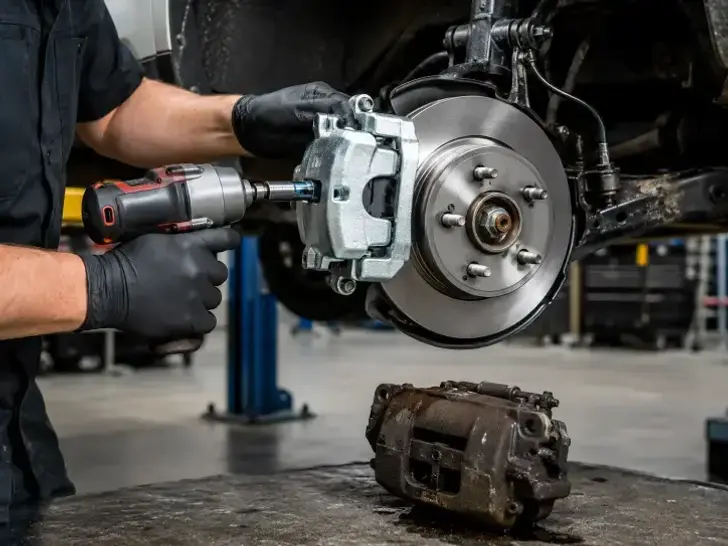
A hydraulic brake caliper is the physical clamp that forces your brake pads to squeeze against the spinning rotors to slow your car down. When a caliper fails, it usually seizes either “open” (giving you zero stopping power at that wheel) or “closed” (dragging continuously, which generates extreme heat, a heavy burning smell, and severe vehicle pulling). A standard caliper replacement takes roughly 1 to 2 hours per wheel and requires a complete hydraulic system line bleed. If you notice smoke coming from a wheel arch or a dangerously spongy brake pedal, contact a professional mechanical workshop immediately to secure your stopping safety.
The Heavy Clamp What Does a Brake Caliper Do?
To understand why a failing caliper is a critical safety issue, it helps to understand its mechanical role. Your braking system is a high-pressure hydraulic circuit. When you press down on the brake pedal, you push fluid down through steel lines into the caliper housing.
The caliper acts as a heavy housing straddling the spinning brake rotor. The incoming pressurized fluid forces an internal metal piston to extend outward. This piston pushes the inner brake pad flat against the rotor face, while the caliper body slides backward on guide pins to pull the outer pad against the opposite side. This high-pressure dual clamping action creates the intense friction needed to safely slow your vehicle down.
Why Do Brake Calipers Fail?
Brake calipers operate in one of the harshest environments on your vehicle. They are subjected to intense thermal expansion cycles exceeding 250°C while being continuously bombarded by road salt, water, mud, and abrasive metallic dust.
Caliper failure usually tracks down to two primary vulnerabilities:
1. Torn Rubber Dust Boots
The internal metal piston is protected from the elements by a flexible rubber dust boot. Over years of hard driving, this rubber can dry rot, crack, or get torn by road debris. Once the boot is compromised, moisture and grit seep directly into the tight metal cylinder bore. This causes the piston to develop structural rust, eventually locking it tightly in place.
2. Seized Slider Pins
Floating calipers rely on greased metal pins to slide back and forth evenly. If the protective rubber boots on these pins crack, the lubricating grease washes away, and rust takes over. The slider pins freeze solid, leaving the caliper unable to center itself. This forces one brake pad to press continuously against the spinning rotor while the other pad does zero work.
Critical Warning Signs of a Seized Caliper
When a caliper begins to fail and stick along its track, your vehicle will display immediate, hard-to-ignore behavioral red flags:
- The Vehicle Pulls to One Side: If a caliper seizes closed, that specific wheel is braking continuously. While driving down the highway, your car will pull hard toward the side with the stuck caliper.
- Extreme Wheel Heat and Burning Smell: A dragging brake pad creates immense friction heat. If you park after a short drive and smell a pungent, acrid chemical odor or feel intense radiant heat waving off the wheel rim, your caliper is stuck closed. In severe cases, the wheel may actively smoke.
- Severe Brake Pad Taper or Uneven Wear: If you perform a visual check and notice that the brake pads on the left wheel are thick, but the pads on the right wheel are worn completely down to the bare metal backing plate, a frozen caliper is actively riding the rotor.
- Active Brake Fluid Leaks: If the internal piston seal suffers structural tearing, high-pressure brake fluid will pool inside the rubber boot and drip down onto the inner wheel barrel, resulting in a soft, spongy brake pedal.
Why “Pad Slapping” Won’t Save a Bad Caliper
A common mistake when servicing brakes is trying to save money by installing fresh pads onto a wheel with a sticking caliper. This is a highly counterproductive approach that ends up costing significantly more in the long run.
If the internal piston or slider pins are rusted solid, a brand-new, thick brake pad will be held flat against the rotor face under continuous pressure. Within a matter of weeks, that intense, unyielding friction will completely burn through the expensive new pad material and warp the underlying steel rotor out of true flat spec.
When replacing worn brake pads, verifying that the caliper pistons retract smoothly using minimal hand tool pressure is a mandatory mechanical safety check. If the piston fights retraction, replacing the caliper assembly is the only safe path forward.
The Hydraulic Bleed and Suspension Realignment Protocol
Replacing a brake caliper requires completely opening your vehicle’s closed hydraulic loop. Our licensed technicians must unbolt the old flexible rubber fluid line, install the new caliper casting, and execute a comprehensive four-wheel brake fluid flush. This bleeding process ensures that all atmospheric air pockets introduced during the swap are fully purged, restoring a rock-solid, responsive pedal.
Because replacing a caliper involves working directly within your steering knuckles and unbolting heavy mounting brackets, your suspension geometry can shift slightly upon reassembly. To protect your mechanical investment, pairing major brake component replacement with a computerized wheel alignment is highly recommended. Realignment completely eliminates highway steering drift, minimizes rolling resistance, and keeps your front tires from scrubbing away their tread unevenly.
Full-Service Automotive Excellence at KMF Automotive
At KMF Automotive, we operate a full-service, independent mechanical workshop equipped to handle your vehicle’s entire maintenance ecosystem. Because a full caliper teardown requires our licensed mechanics to pull the wheels and inspect your full stopping loop, it opens up a highly efficient window to address other pending maintenance tasks without paying for overlapping diagnostic visits.
Our workshop floor handles everything required to keep your vehicle dependable, safe, and efficient. If your vehicle is approaching its next routine service window, we provide factory-approved, premium oil changes using top-tier synthetic lubricants to preserve engine longevity. If your dashboard check engine light is glowing, our comprehensive brake repair service in Burnaby will fully restore your stopping confidence.
We provide deep technical expertise across all major automotive platforms and comfort systems. From restoring crisp, icy airflow with an expert air conditioning service in Burnaby to tracking down complex mechanical faults, we handle it all. If your manual gearbox is fighting your inputs up steep hills, our specialized clutch repair service in Burnaby balances your power delivery. Furthermore, for high-mileage engines, booking a preemptive timing belt repair in Burnaby provides absolute insurance against catastrophic internal engine valve damage. We treat your vehicle with the exact level of precision and honesty we would give our own.
Restoring Absolute Control and Peace of Mind
Driving with a compromised brake caliper leaves you vulnerable to a sudden pull during an emergency highway stop or a loss of braking pressure entirely. Opting for a professional replacement completely eliminates drag, removes trapped air, and ensures a perfectly balanced stopping response. Trusting our experienced mechanics keeps your daily driving completely predictable, secure, and stress-free.
Schedule Your Brake System Service in Burnaby Today
Don’t ignore a burning smell from your wheels, an extreme vehicle pull, or a spongy brake pedal. Our certified team at KMF Automotive is fully prepared to provide an upfront, transparent evaluation of your vehicle’s calipers, pads, and rotors.
Conveniently located at 7080 Macpherson Ave in Burnaby, BC (V5J 4N3)—just a brief walk from the Royal Oak SkyTrain Station—we proudly serve drivers across the Lower Mainland with exceptional automotive craftsmanship. Call our friendly shop floor today at 604-438-0222 or contact us online to request a transparent price estimate or schedule your service appointment.
Frequently Asked Questions: brake caliper replacement
What is the main difference between a wheel alignment and tire balancing?
A wheel alignment adjusts your vehicle’s underlying suspension and steering links so that the tires roll perfectly parallel to one another and track straight down the road. Our professional tire repair service in Burnaby incorporates wheel balancing, which uses small weights on the rim flange to counteract natural heavy spots within the spinning rubber assembly itself, completely removing high-speed steering wheel vibrations.
Should brake calipers always be replaced in pairs?
While it isn’t legally mandatory like brake pads or rotors, it is highly recommended to replace calipers in axle pairs (both fronts or both rears). Calipers share the exact same age, mileage, and environmental wear conditions. If the piston seals on the left side have rusted and failed, the right side is usually not far behind. Replacing them in pairs ensures perfectly balanced stopping forces.
What is a “loaded” vs. an “unloaded” caliper assembly?
An “unloaded” caliper refers to just the bare metal hydraulic casting housing the piston, requiring you to source mounting brackets and friction pads separately. A “loaded” caliper assembly comes pre-assembled from the factory complete with a new mounting bracket, premium slider pins, rubber boots, and a matching set of pre-installed brake pads, reducing installation times.
Can a bad brake caliper ruin my vehicle’s wheel bearing?
Yes, absolutely. A caliper that is seized closed generates continuous, intense friction heat that quickly travels inward through the metal rotor hat and into the wheel hub assembly. This extreme thermal energy will liquefy and melt the specialized protective grease packed inside your wheel bearing, causing the bearing to whine, grind, and fail prematurely.
Why is there a “core charge” on automotive brake calipers?
Calipers are made of high-strength iron or aluminum castings that can be professionally remanufactured. When you purchase a new caliper, parts stores include a temporary financial deposit called a “core charge.” Once our mechanics complete the repair, we ship your old, worn caliper body back to the manufacturer to be cleaned, rebuilt, and recycled, and the core deposit is fully refunded.
What happens if air gets trapped in the lines during a caliper swap?
If the hydraulic system isn’t bled flawlessly after a caliper swap, trapped air bubbles will cause a soft, spongy pedal feel. Because air is highly compressible compared to brake fluid, pressing the pedal will simply squeeze the air bubble rather than forcing the caliper piston to clamp down. This results in a dangerous loss of instantaneous stopping power.
Key Takeaways: brake caliper replacement
- The Clamping Mechanism: Calipers utilize hydraulic pistons to force your friction pads against the spinning steel rotors to slow your vehicle.
- The Seizure Red Flags: Watch out for heavy vehicle pulling, extreme radiant heat coming off a single rim, or an acrid chemical burning smell.
- Say No to Pad Slapping: Installing fresh pads onto a seized caliper is a waste of money, as the stuck piston will wear down the new pad material in weeks.
- The Mandatory Line Bleed: Replacing a caliper opens the hydraulic network, requiring a full system fluid purge to remove all trapped air bubbles.
- Chassis Geometry Link: Major wheel-end disassembly shifts steering knuckles, making a subsequent computerized steering alignment highly recommended.
- Dealer-Grade Independent Work: Trusting your vehicle to an established independent repair center ensures access to certified technicians, advanced bleeder tools, and clear upfront pricing.