On average, a standard factory car clutch lasts between 100,000 and 150,000 kilometers (roughly 60,000 to 100,000 miles). However, because the clutch relies completely on physical friction to launch and shift your car, its true lifespan is dictated entirely by your driving habits and environment. A driver who spends their time on open highways can easily see a clutch past 200,000 kilometers, while frequent stop-and-go commuting or heavy hill driving can burn a clutch out in under 50,000 kilometers. At KMF Automotive, replacing a worn-out clutch kit takes between 4 and 8 hours of dedicated shop labor. If your manual drivetrain is starting to slip, contact our friendly team or visit our Burnaby facility today for an upfront fix.
The Friction Equation: How a Clutch Wears Down
For drivers who prefer the physical engagement of a manual transmission, the clutch pedal is the ultimate tool for controlling power. But because the clutch assembly is tucked completely out of sight between the engine block and the gearbox, it’s impossible to visually check how much life it has left without dropping the transmission.
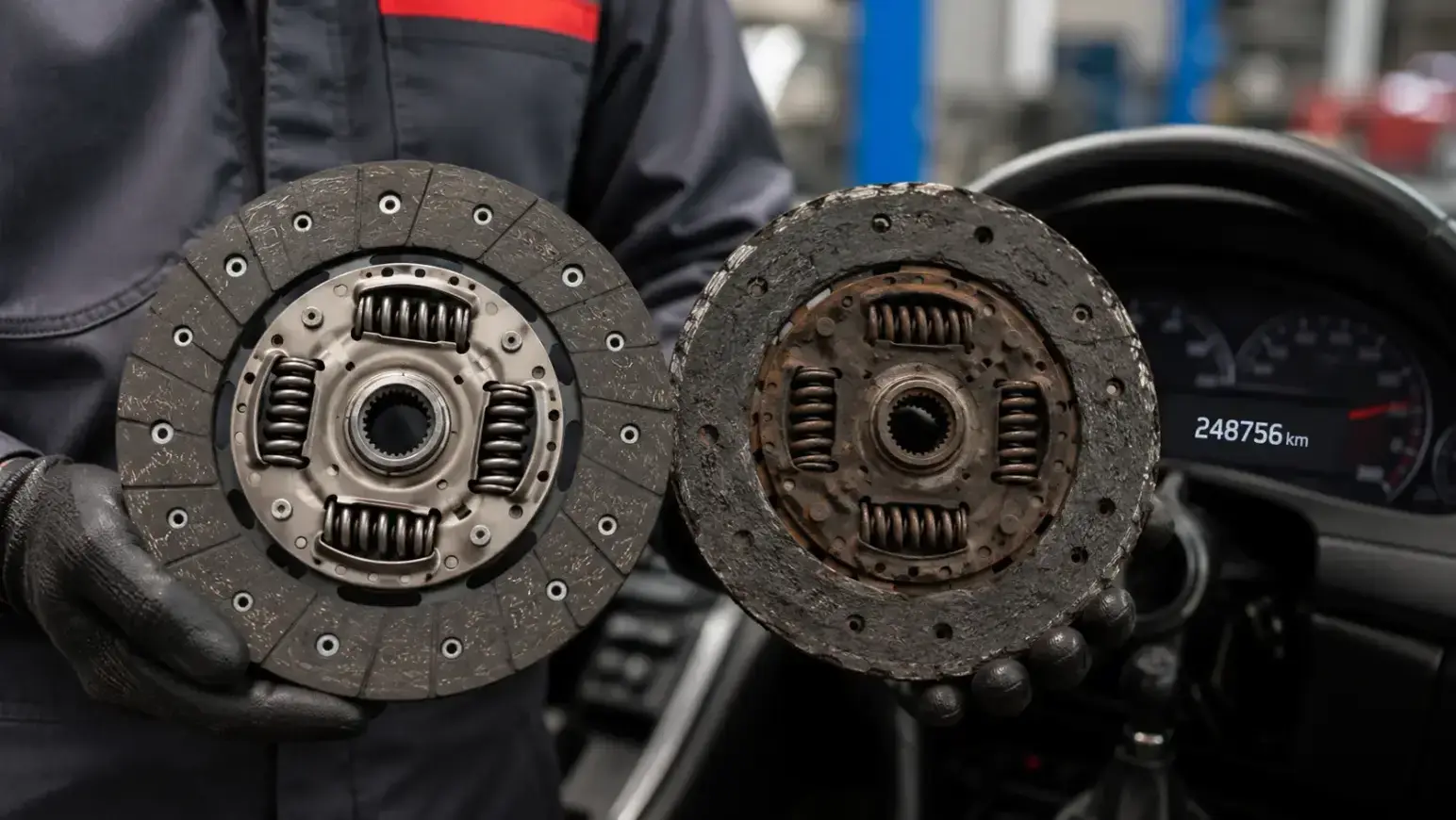
To understand how long a clutch will last, it helps to view it exactly like your vehicle’s brake pads. Your clutch assembly features a specialized clutch disc coated on both sides with high-friction material.
Every single time you press the pedal to launch from a stop or change gears, this friction material slips slightly against the spinning engine flywheel before fully biting and locking the drivetrain together. Because it is a wearable friction interface, a tiny amount of that material safely wears away every time the pedal is released.
What is the Average Lifespan of a Modern Clutch?
Under normal driving conditions with a driver who practices proper manual shifting techniques, a modern original equipment manufacturer (OEM) clutch assembly typically lasts between 100,000 and 150,000 kilometers.
If your daily commute consists primarily of smooth highway driving where you shift into top gear and stay there for dozens of kilometers at a time, the clutch undergoes very little structural wear. In these ideal scenarios, it is not uncommon for a well-maintained vehicle to cross the 200,000-kilometer milestone on its original factory clutch.
However, the odometer is only half the story. A car driven exclusively in dense city environments will wear its clutch out much faster than a highway commuter, even if they have identical mileage. Every stoplight, parallel parking maneuver, and traffic jam forces you to slip the clutch to get the vehicle moving, accelerating the natural wear cycle.
Bad Driving Habits That Can Destroy a Clutch Early
Because the human foot directly controls how long the clutch slips during gear changes, driver habits are the single biggest variable that can cause a clutch to fail prematurely, sometimes in less than 50,000 kilometers.
Riding the Clutch
One of the most common mistakes is resting your left foot lightly on the clutch pedal while driving down the road. Even a tiny amount of weight from your foot applies light pressure to the hydraulic system, causing the pressure plate to reduce its clamping force. This allows the clutch disc to slip invisibly against the flywheel, creating continuous heat that bakes the friction material.
Holding the Vehicle on Hills
When stopped on a steep incline, some drivers will balance the clutch and gas pedals to keep the car stationary instead of using the brake pedal. This generates extreme localized friction temperatures exceeding 300°C in a matter of seconds, rapidly glazing the disc lining and permanently warping the pressure plate springs.
Subtle Warnings That Your Clutch Is Reaching Its Limit
While you cannot visually inspect the clutch disc, your vehicle will give off clear behavioral warnings when the friction material has worn dangerously thin:
- Slipping Under Load: You step on the gas pedal to accelerate up a hill or pass a vehicle; your engine RPMs jump up quickly, and the engine roars, but your actual road speed does not match. The clutch disc can no longer hold the engine’s power.
- A Change in Pedal Engagement: As a clutch disc thins out, the physical point where the clutch begins to catch and move the car will move higher and higher up the pedal travel, eventually engaging only at the very top of the pedal release.
- A Pungent Burning Smell: If you smell a distinct, acrid burning odor that smells similar to overheated brake pads after backing up a driveway or launching on a hill, your clutch friction lining is actively melting from extreme heat.
Why You Must Address a Slipping Clutch Early
When a clutch begins to slip, many drivers try to stretch its life by driving incredibly gently. While this might avoid an immediate tow truck bill, it drastically inflates your final repair invoice.
When a clutch disc slips continuously, the intense thermal energy transfers directly into your engine’s heavy iron flywheel. If you bring your car to KMF Automotive at the very first sign of slippage, our mechanics can typically resurface your original flywheel on a precision shop lathe for an affordable price, restoring a perfectly flat face.
However, if you delay the repair for weeks, the prolonged heat will warp the flywheel metal, causing deep heat-checking and micro-cracks. A severely cracked flywheel cannot be safely saved and must be replaced entirely, adding hundreds of dollars in parts costs to your total invoice.
How Drivetrain Chatter Shifts Your Wheel Alignment
When an aging clutch pressure plate develops uneven spring tension or becomes warped from heat, it causes a symptom known as “clutch chatter.” This is a harsh, violent shuddering or shaking that ripples through the car’s floorboards and dashboard whenever you try to take off from a complete stop.
These heavy mechanical vibrations don’t stay confined to your transmission housing; they travel directly through your rubber engine mounts and down into your front steering knuckles and suspension subframe links. Over time, this constant chattering places sudden, irregular stress on your chassis geometry.
Because replacing a clutch requires our technicians to completely drop the transmission and unbolt major suspension links, pairing a fresh clutch kit with a computerized wheel alignment in Burnaby is an incredibly smart investment. Realigning your suspension back to factory settings eliminates highway steering drift, optimizes rolling efficiency, and keeps your tires from scrubbing away their tread unevenly on the pavement.
Full-Service Automotive Excellence at KMF Automotive
At KMF Automotive, we operate a full-service, independent mechanical workshop equipped to
handle your vehicle’s entire maintenance ecosystem. Because a full clutch overhaul requires our licensed technicians to safely drop the transmission out of the chassis, it opens up a highly efficient window to address other pending maintenance tasks without paying for overlapping disassembly labor.
Our workshop floor handles everything required to keep your automobile dependable, safe, and efficient. If your vehicle is approaching its next routine service window, we provide factory-approved, premium oil changes using top-tier synthetic lubricants to preserve engine longevity. If your dashboard check engine light is glowing, or if you notice an unusual squealing sound under hard braking, our comprehensive brake repair service in Burnaby will fully restore your stopping confidence.
We provide deep technical expertise across all major automotive platforms and comfort systems. From restoring crisp, icy airflow with an expert air conditioning service in Burnaby to tracking down complex mechanical faults, we handle it all. If your manual gearbox is fighting your inputs up steep hills, our specialized clutch repair service in Burnaby balances your power delivery. Furthermore, for high-mileage engines, booking a preemptive timing belt repair in Burnaby provides absolute insurance against catastrophic internal engine valve damage. We treat your vehicle with the exact level of precision and honesty we would give our own.
Schedule Your Clutch Inspection in Burnaby Today
Don’t wait for your slipping clutch to give out completely and leave you stranded on a busy road,
facing an emergency towing bill. Our certified mechanics at KMF Automotive are fully prepared to accurately test, diagnose, and resolve your transmission issues with transparent communication and honest, upfront pricing.
Conveniently located at 7080 Macpherson Ave in Burnaby, BC (V5J 4N3), just a brief walk from the Royal Oak SkyTrain Station, we proudly serve local car owners across the Lower Mainland with exceptional craftsmanship. Call our friendly local shop today at 604-438-0222 or contact us online to schedule your service appointment or drop by for an expert consultation.
Frequently Asked Questions: How long does a clutch last
What is the main difference between a wheel alignment and tire balancing?
A wheel alignment adjusts your vehicle’s underlying suspension and steering links so that the
tires roll perfectly parallel to one another and track straight down the road. Our professional tire repair service in Burnaby incorporates wheel balancing, which uses small, calibrated weights on the rim flange to counteract natural heavy spots within the spinning rubber assembly itself, completely removing high-speed steering wheel vibrations.
Does shifting into neutral at a stoplight make a clutch last longer?
Yes, absolutely. When you sit at a red light with the car in gear and your foot pressing the clutch pedal down to the floor, you are forcing the internal throw-out bearing to handle intense mechanical pressure. Shifting into neutral and releasing the pedal at long lights allows this bearing to rest, preventing it from drying out, whining, and failing prematurely.
Can a leaking fluid seal cause a clutch to fail early?
Yes. If your engine’s rear main crankshaft seal or the transmission’s input shaft seal begins to leak oil, that pressurized fluid will find its way into the dry bellhousing. Once engine oil coats the clutch disc’s friction material, it destroys its ability to bite. The clutch will slip wildly and glaze over, requiring a full replacement regardless of how much friction material is left.
Should I replace just the worn clutch disc or the whole kit?
You should always replace the entire assembly as a complete matched kit (clutch disc, pressure plate, and throw-out bearing). Because accessing the clutch requires dropping the entire transmission, the vast majority of your bill is labor. Saving a few dollars by reusing an old pressure plate is a massive gamble, as its internal springs fatigue over time and can cause the new disc to fail prematurely.
Is a vehicle’s clutch fluid separate from its braking system?
It varies by vehicle. On many modern cars, the hydraulic clutch system shares the exact same master fluid reservoir as the main braking system, utilizing standard DOT 3 or DOT 4 fluid. On other vehicles, there is a small, dedicated plastic reservoir mounted right next to the brake master cylinder. Over time, this fluid absorbs moisture and turns dark, requiring a routine system flush.
Why does a manual sports car clutch generally wear out faster?
High-performance sports cars feature engines that produce significantly more torque. This increased twisting force places much higher structural strain on the clutch friction material during quick gear changes. Additionally, performance clutches are often subjected to more aggressive driving habits, which generate rapid heat spikes that accelerate the wear cycle.
Key Takeaways: How long does a clutch last
- The Baseline Odometer Window: A properly driven factory manual clutch generally lasts between 100,000 and 150,000 kilometers before requiring replacement.
- Driver Habit Impact: Avoid riding the clutch pedal or holding the car on steep inclines using the drivetrain to prevent rapid friction material wear.
- Spotting Early Red Flags: Spiking engine RPMs accompanied by a lack of forward acceleration is a clear indicator that your clutch disc is slipping out of spec.
- Flywheel Maintenance Value: Addressing a slipping clutch early allows for affordable lathe resurfacing, saving you from a costly total flywheel replacement later.
- Chassis Reassembly Realities: Deep transmission teardowns shift your vehicle’s front suspension foundations, making a follow-up computerized alignment highly recommended.
- Trusted Independent Quality: Trusting your vehicle to an established independent repair center ensures access to certified technicians, advanced diagnostics, and clear upfront pricing.