When a manual clutch begins to fail, it will typically show clear warning signs: slipping gears, a sudden loss of acceleration when revving, grinding noises during shifts, or a soft, spongy pedal underfoot. At KMF Automotive, diagnosing a basic hydraulic line issue takes roughly 30 to 60 minutes, while a complete component replacement requires dropping the transmission, taking about 4 to 8 hours of precise shop floor time. Ignoring a failing clutch will rapidly ruin your engine’s flywheel and eventually leave you completely stranded on the side of the road. If your drivetrain is acting up in the Lower Mainland, contact our friendly team or visit our Burnaby facility today for an honest, upfront fix.
The Invisible Link: How Your Clutch Signals Wear
For drivers who love the control of a manual transmission, the clutch pedal is the direct, mechanical connection to the vehicle’s soul. However, because the clutch assembly is tucked completely out of sight inside the transmission bellhousing, you cannot visually check how much life it has left, like you can with your brake pads or tire tread. Instead, you must rely on your senses, listening to unusual noises, feeling changes in pedal resistance, and noticing shifts in engine behavior.
Your clutch relies on direct mechanical friction to transfer power from your engine’s spinning flywheel straight to the transmission input shaft. Because it is a wear item subjected to continuous heat and clamping pressures, the specialized friction material naturally thins out over time. When that lining drops past its functional thickness threshold, it begins to give off distinct behavioral warnings that a breakdown is on the horizon.
Red Flag #1: The Classic Slipping Clutch
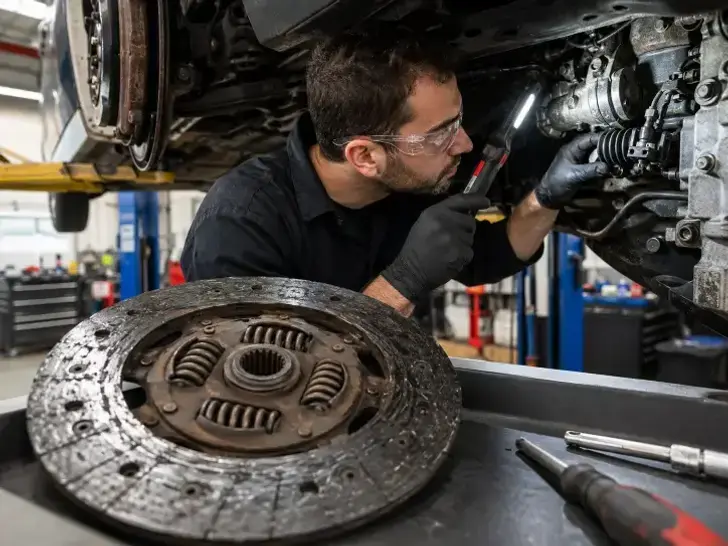
The absolute most common indicator of a failing clutch assembly is a phenomenon known as mechanical slippage. This happens when the friction disc’s lining has worn down so thin, or become so heavily glazed by extreme operating heat, that the pressure plate can no longer exert enough clamping force to hold it tight against the engine’s spinning flywheel.
RPMs Spike Rapidly, Car Barely Accelerates
You will notice this symptom most clearly when your vehicle is under heavy load—such as accelerating up a steep hill or trying to merge onto a fast highway. When you press down on the gas pedal, your engine’s RPMs will spike rapidly, and the motor will roar, but your actual road speed will barely increase. The engine is spinning fast, but because the clutch is slipping, that kinetic energy is being wasted as friction heat instead of moving your wheels.
Red Flag #2: Spongy, Sticky, or Dropped Pedals
The physical sensation beneath your left foot provides a direct window into the health of your clutch’s hydraulic control system. A healthy manual vehicle should offer a smooth, firm, and predictable amount of resistance from the moment you press the pedal until it reaches the floorboards.
- The Soft or Spongy Pedal: If the pedal feels unusually light, mushy, or offers almost no structural resistance when pushed, you likely have atmospheric air trapped inside the hydraulic lines.
- The Sticky or Dropped Pedal: If you push the clutch down to shift gears and it stays stuck flat against the floor carpet, or returns upward in a slow, jerky motion, a critical seal has failed inside your clutch master cylinder or external slave cylinder, causing an immediate loss of hydraulic pressure.
Red Flag #3: Grinding Gears and Auditory Warnings
Shifting through gears should always be a smooth, silent transition. If your vehicle begins making unusual mechanical noises when you operate the gearshift, it means the internal synchronization is being disrupted:
Grinding During Gear Changes
If you push the clutch pedal completely to the floor but hear or feel a harsh grinding sensation when moving the shift lever into gear, the clutch is suffering from incomplete disengagement. The clutch disc is failing to separate fully from the spinning flywheel, forcing the transmission gears to slam together at mismatched speeds.
Squealing or Chirping at Idle
If you notice a distinct high-pitched chirping or whirring noise whenever you lightly rest your foot on the clutch pedal, your throw-out (release) bearing is failing. This specialized bearing handles the physical pressure of releasing the clutch springs; when its internal lubrication dries out or its bearings wear down, it creates a loud metallic squeal that disappears only when the pedal is completely released.
The Financial Cost of Delaying Your Clutch Repair
Many drivers try to squeeze every last kilometer out of a slipping clutch by accelerating very gently to avoid high RPM spikes. While this might save you a towing fee in the short term, delaying the repair drastically increases your final mechanical bill.
When a clutch slips continuously, it generates intense localized friction temperatures exceeding 300°C. This extreme heat doesn’t just melt the clutch disc; it transfers directly into your engine’s expensive iron flywheel, causing the metal to warp, discolor, and develop deep structural micro-cracks.
If you bring your vehicle into KMF Automotive at the very first sign of slippage, our technicians can usually place your original flywheel onto a precision shop lathe, resurfacing it to a smooth finish for a fraction of the cost of a new part. However, if you drive on a slipping clutch for weeks, the flywheel will become too heat-damaged to save and must be replaced entirely, adding hundreds of dollars to your total parts invoice.
How Drivetrain Chatter Impacts Your Steering and Alignment
When a clutch pressure plate becomes warped or its internal dampening springs break, the clutch will engage violently and unevenly. This creates a severe undercar symptom known as “clutch chatter”—a harsh, rhythmic shuddering or shaking that ripples through the entire vehicle dashboard and floorboards whenever you try to launch from a complete stop.
These heavy mechanical vibrations don’t just stay confined to your gearbox; they travel directly through your engine mounts and down into your front suspension subframe and steering knuckles. Over time, this constant mechanical shaking can loosen suspension hardware and throw your wheel’s steering geometry out of spec.
If your vehicle has been suffering from heavy clutch chattering or launch vibrations, it is highly wise to pair your transmission repair with a precise computerized wheel alignment in Burnaby. Restoring your chassis alignment eliminates steering pulls, maximizes your highway rolling efficiency, and ensures your tires don’t scrub away their tread unevenly on the pavement.
Complete Auto Care Solutions at KMF Automotive
At KMF Automotive, we operate a full-service, independent mechanical workshop equipped to handle your vehicle’s entire maintenance ecosystem. Because a full clutch overhaul requires our licensed technicians to safely drop the transmission out of the chassis, it opens up a highly efficient window to address other pending maintenance tasks without paying for overlapping disassembly labor.
Our facility handles everything required to keep your automobile dependable, safe, and efficient. If your vehicle is approaching its next routine service window, we provide factory-approved, premium oil changes using top-tier synthetic lubricants to preserve engine longevity. If your dashboard check engine light is glowing, or if you notice an unusual squealing sound under hard braking, our comprehensive brake repair service in Burnaby will fully restore your stopping confidence.
We provide deep technical expertise across all major automotive platforms and comfort systems. From restoring crisp, icy airflow with an expert air conditioning service in Burnaby to tracking down complex electrical faults, we handle it all. If your manual gearbox is fighting your inputs, our specialized clutch repair service in Burnaby balances your power delivery. Furthermore, for high-mileage engines, booking a preemptive timing belt repair in Burnaby provides absolute insurance against catastrophic internal engine valve damage. We treat your vehicle with the exact level of precision and honesty we would give our own.
Schedule Your Driveline Inspection in Burnaby Today
Don’t wait for your slipping clutch to give out completely and leave you stranded on a busy highway facing an expensive emergency towing bill. Our certified mechanics at KMF Automotive are fully prepared to accurately test, diagnose, and resolve your transmission issues with transparent communication and honest, upfront pricing.
Conveniently located at 7080 Macpherson Ave in Burnaby, BC (V5J 4N3), just steps away from the Royal Oak SkyTrain Station, we proudly serve local car owners across the Lower Mainland with dependable automotive craftsmanship. Call our friendly local shop today at 604-438-0222 or contact us online to book your appointment or drop by for a professional inspection.
Frequently Asked Questions: signs clutch is failing
What is the main difference between a wheel alignment and tire balancing?
A wheel alignment adjusts your vehicle’s underlying suspension and steering links so that the tires roll perfectly parallel to one another and track straight down the road. Our professional tire repair service in Burnaby incorporates wheel balancing, which uses small, calibrated weights on the rim flange to counteract natural heavy spots within the spinning rubber assembly itself, eliminating high-speed steering wheel vibrations.
How can I test if my car’s clutch is slipping at home?
A simple test is to find a safe, open area or a slight uphill incline. Drive the car at roughly 30 km/h, shift into a high gear (like 4th gear), and firmly press down on the gas pedal. In a healthy car, the engine RPMs will slowly rise as the car struggles to accelerate. If the clutch is failing, the engine RPMs will instantly spike upward while the car’s physical speed remains completely unchanged.
What causes a strong burning smell after driving a manual car?
A distinct, pungent burning odor that smells similar to burnt brake pads indicates that your clutch disc is slipping severely and overheating. The friction material is literally baking due to the intense thermal energy generated as it slides against the spinning flywheel, signaling an immediate need for professional mechanical service.
Can a failing clutch make it difficult to pull the car out of gear?
Yes, absolutely. If your clutch hydraulic master or slave cylinder is leaking fluid internally, pressing the pedal will not build enough physical pressure to fully separate the clutch disc from the engine. Because the drivetrain remains under partial engine tension, it will feel like the shift lever is physically jammed or locked into gear when you try to pull it into neutral.
Is a vehicle’s clutch fluid separate from the brake fluid system?
On many modern vehicles, the clutch hydraulic system shares the exact same fluid reservoir as the main braking system, utilizing standard DOT 3 or DOT 4 brake fluid. On other vehicles, there is a small, dedicated plastic reservoir mounted right next to the brake master cylinder. Over time, this fluid turns dark as it absorbs moisture and requires a complete system flush.
How many kilometers should a standard manual clutch kit last?
Under ideal driving conditions with experienced drivers, a premium factory clutch assembly can easily last between 100,000 and 150,000 kilometers. However, regular heavy towing, frequent stop-and-go commuting in heavy traffic, or bad driving habits like “riding the pedal” can cause a clutch to burn out in less than 50,000 kilometers.
Key Takeaways: signs clutch is failing
- The Slippage Warning: Spiking engine RPMs accompanied by zero vehicle acceleration under load is the definitive indicator of a worn-out friction disc.
- Hydraulic Pressure Drop: A spongy, soft, or completely dropped pedal that sticks to the floor pan points directly to a failing master or slave cylinder seal.
- Incomplete Disengagement: Harsh gear grinding during shifts means the clutch disc is failing to cleanly separate from the spinning engine flywheel.
- The Flywheel Prevention Rule: Addressing a slipping clutch early allows for affordable lathe resurfacing, preventing a costly total flywheel replacement later.
- Vibration Damage Risk: Severe launch chattering sends destructive harmonic pulses through your engine mounts and suspension links, shifting alignment angles.
- Trusted Independent Inspection: Visiting a dedicated local automotive repair shop provides access to precision transmission tooling, clear diagnostics, and upfront pricing.