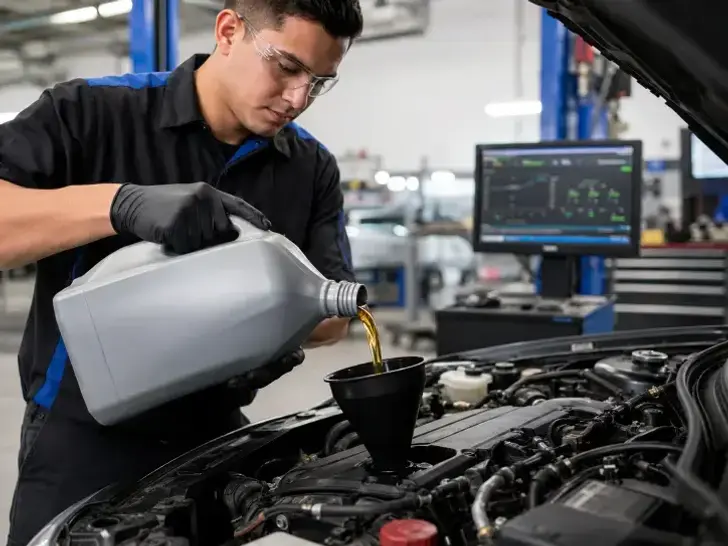
How often you should change your engine oil depends on three main factors: your vehicle’s engine layout, the type of oil it uses, and your everyday driving conditions. As a standard industry rule for modern passenger vehicles, an oil change is required every 8,000 to 16,000 kilometers (5,000 to 10,000 miles) or every 6 to 12 months whichever milestone comes first. However, if your daily commute involves frequent stop-and-go gridlock traffic or short trips, your engine operates under “severe” parameters and demands more frequent service. At KMF Automotive, a premium warranty-approved oil change takes under an hour. Contact our Burnaby shop floor today to secure your engine’s health.
The Oil Type Matrix Chemistry Dictates the Timeline
The primary factor determining how far you can drive between service appointments is the chemical composition of the oil poured into your crankcase. Modern vehicle manufacturers build tightly engineered engines that rely heavily on specific molecular lubrication weights:
Full Synthetic Oil
Engineered inside a laboratory, full synthetic lubricants feature uniform molecular structures and advanced additive packs. They resist high-temperature thermal breakdown, prevent sludge formation, and flow flawlessly in freezing temperatures, meaning they safely protect your engine across extended distances.
Synthetic Blend Oil
A precise mixture of synthetic and conventional mineral base stocks. This formulation offers improved protection for mid-size SUVs, trucks, and high-mileage engines compared to standard conventional oil, without the premium cost of a full synthetic.
Conventional Mineral Oil
Refined directly from crude oil, conventional mineral fluids degrade faster under heavy engine heat and carry fewer protective additives. They are typically used in vintage vehicles or older engine models built before 2010.
“Normal” vs. “Severe” Driving Realities
Most drivers assume their routine daily commute qualifies as “normal driving,” but automotive manufacturers explicitly classify standard city driving under severe operating conditions.
You must shorten your oil change interval and follow the severe service schedule if your driving routine regularly involves:
- Frequent Short Trips: Commuting distances under 8 kilometers prevent your engine from reaching its optimal operating temperature ($90^\circ\text{C}$ to $105^\circ\text{C}$).
- Stop-and-Go Gridlock: Extended idling along busy routes like Kingsway or Marine Way strains your oil since the engine is running but no cooling air flows through the grill.
- Thermal Extremes: Operating your car through freezing winter slush or hot summer traffic.
- Heavy Workloads: Regularly pulling a trailer or driving on unpaved roads where fine dust particles can bypass your air filter.
Why Short Trips Destroy Oil: When an engine does not sustain full operational heat, normal combustion moisture condensation builds up inside the crankcase. Instead of boiling off harmlessly through the PCV valve, this water mixes with the oil, creating a milky, acidic sludge that degrades your engine’s internal components.
Telling Warning Signs Your Car Is Starving for Fresh Oil
While tracking your odometer is the most dependable path, your vehicle will actively display physical and visual alerts if your oil has broken down or dropped past safe levels:
- Dark, Gritty Fluid on the Dipstick: Fresh engine oil is a clear, translucent amber-gold color. If you pull the dipstick and the oil looks like thick, opaque black coffee or feels gritty when rubbed between your fingers, it is fully saturated with carbon debris and must be swapped.
- The Dashboard Oil Pressure Light: If an amber or red oil can icon lights up on your instrument cluster, pull over safely and shut off the engine immediately. This indicator means your engine has lost its critical lubricating oil pressure, risking complete mechanical seizure within minutes.
- Loud Mechanical Ticking or Knocking: When engine oil gets too thin, old, or low, internal metal components lose their protective hydraulic cushion. You will hear an audible ticking sound from the upper valve train or a deep metallic knocking from the engine block.
What Does an Oil Life Monitoring System Actually Do?
The vast majority of modern consumer vehicles feature an automated digital “Oil Life” percentage tracker on the instrument cluster. It is critical to understand that this system does not actually look at or analyze the cleanliness of your physical oil.
Instead, the vehicle’s engine control unit runs a continuous mathematical algorithm. It tracks how many cold starts you perform, your average driving speeds, ambient outdoor air temperatures, and engine load metrics. The computer then uses this data to estimate how fast the oil is wearing out.
If you frequently idle or take short trips, the monitor will count down to 0% much faster than if you strictly drive steady highway kilometers. If your dashboard displays a “Service Engine Soon” or “Maintenance Required” message, your oil has reached its structural limit.
The Critical Filter Swap and Steering Alignment Connection
A proper oil service is completely incomplete without installing a brand-new, high-efficiency oil filter. The filter captures tiny fragments of carbon, metal filings, and ambient road dirt carried by the circulating oil. Reusing an old, clogged filter forces clean new oil to bypass the filtration element entirely, circulating contaminated oil right back through your pristine engine bearings.
Because an oil service requires raising your car on a commercial lift and removing the underbody aerodynamic splash shields, it provides our technicians with a perfect window to inspect your underlying suspension joints, steering tie rods, and front tires.
If our visual inspection identifies uneven tire tread wear, pairing your service with a computerized wheel alignment in Burnaby is a highly recommended safety step. Readjusting your suspension links back to factory specifications eliminates highway tracking drift, maximizes your rolling fuel tracking efficiency, and stops your tires from scrubbing away their rubber prematurely.
Comprehensive Automotive Solutions at KMF Automotive
At KMF Automotive, we operate a full-service, independent mechanical workshop equipped to handle your vehicle’s entire maintenance ecosystem. Because a routine oil change brings your vehicle into our facility, it opens up a highly efficient window to address other pending maintenance tasks without paying for overlapping diagnostic visits.
Our workshop floor handles everything required to keep your automobile dependable, safe, and efficient. If your brakes are squealing or displaying a soft pedal feel, our comprehensive brake repair service in Burnaby will fully restore your stopping confidence. If your vehicle is exhibiting complex running issues, our licensed technicians can pinpoint the exact wheel sensor or wiring issue triggering your ABS light on your vehicle.
We provide deep technical expertise across all major automotive platforms and comfort systems. From restoring crisp, icy airflow with an expert air conditioning service in Burnaby to tracking down complex mechanical faults, we handle it all. If your manual gearbox is fighting your inputs up steep hills, our specialized clutch repair service in Burnaby balances your power delivery. Furthermore, for high-mileage engines, booking a preemptive timing belt repair in Burnaby provides absolute insurance against catastrophic internal engine valve damage. We treat your vehicle with the exact level of precision and honesty we would give our own.
Restoring Engine Protection and Total Peace of Mind
Allowing old, broken-down engine oil to run past its service life leaves your vehicle highly vulnerable to accelerated cylinder wear, expensive timing chain stretch, and internal engine sludge buildup. Opting for a professional, warranty-approved fluid and filter change completely removes the risk of contamination, keeps your engine running smoothly, and ensures your daily commutes remain efficient and worry-free.
Schedule Your Professional Oil Change in Burnaby Today
Don’t stretch out your maintenance windows or compromise your engine’s lifespan by settling for unverified guesswork. Our certified team at KMF Automotive is fully prepared to provide upfront, transparent fluid services tailored specifically to your vehicle’s factory make and model guidelines.
Conveniently located at 7080 Macpherson Ave in Burnaby, BC (V5J 4N3) just a brief walk from the Royal Oak SkyTrain Station we proudly serve local car owners across the Lower Mainland with exceptional automotive craftsmanship. Call our friendly local shop today at 604-438-0222 or contact us online to schedule your service appointment or drop by for an expert consultation.
Frequently Asked Questions: how long does an oil change take
What is the main difference between a wheel alignment and tire balancing?
A wheel alignment corrects the physical structural angles of your steering links and suspension components so that the tires roll perfectly parallel to each other and track straight down the road. Our professional tire repair service in Burnaby incorporates wheel balancing, which utilizes tiny weights on the rim flange to counteract natural heavy spots within the spinning tire assembly, completely removing high-speed steering wheel vibrations.
If I barely drive my car, do I still need an oil change twice a year?
Yes. Engine oil breaks down and degrades simply from exposure to the air inside your engine block, even if the car sits parked inside a garage. Atmospheric moisture mixes with stagnant oil, causing it to lose its protective properties and turn acidic over time. You should change your oil at least twice a year regardless of low mileage.
Can switching from conventional oil to full synthetic cause engine leaks?
No, this is an old automotive myth. Modern full synthetic oils are fully compatible with rubber seals and gaskets. If an older engine begins leaking after a synthetic swap, it is simply because the synthetic oil’s superior cleaning additives washed away old, crusty sludge deposits that were physically blocking an existing pre-existing hole in a worn gasket.
Why is my vehicle burning through oil between routine service visits?
Many modern engines are engineered with low-tension piston rings to improve fuel economy, which can naturally consume a small amount of oil over thousands of kilometers. However, excessive oil consumption typically indicates worn valve stem seals, a clogged PCV valve forcing oil into the combustion chamber, or an active external mechanical leak.
What happens if I accidentally put the wrong weight of oil into my car?
Using the wrong viscosity (such as putting heavy 10W-30 into an engine designed for ultra-thin 0W-20) can restrict fluid flow through small internal oil passages. This starves variable valve timing components, lowers your fuel efficiency, and increases cold-start friction wear. The oil should be drained and refilled with the correct factory weight.
Can a dirty engine air filter affect my oil quality?
Yes, absolutely. If your engine’s primary air filter is torn or heavily clogged, dirt particles and ambient road grit will pull straight past the element and enter the cylinders. This grit blows past the piston rings and drops directly into your oil pan, quickly turning your clean engine oil into an abrasive grinding paste that accelerates component wear.
Key Takeaways: how long does an oil change take
- The Baseline Blueprint: Expect to change modern full synthetic oil every 10,000 to 16,000 kilometers or at least once a year, whichever comes first.
- The Severe Shift: Standard stop-and-go city commuting along Kingsway qualifies as a severe driving condition, requiring shorter oil change intervals.
- Always Swap the Filter: Never skip replacing your oil filter during a service; a dirty filter forces old debris back into your clean engine oil.
- Visual Check Realities: Pull your dipstick monthly; if the oil looks like opaque black coffee or feels gritty, its protective additives are fully depleted.
- Chassis Geometry Inspections: Raising your car for an oil change offers an excellent opportunity to check your front end, making a follow-up steering alignment highly efficient if uneven tire wear is found.
- Independent Trust Frameworks: Trusting your vehicle to an established independent repair center guarantees warranty-approved fluids, certified mechanics, and completely upfront pricing.