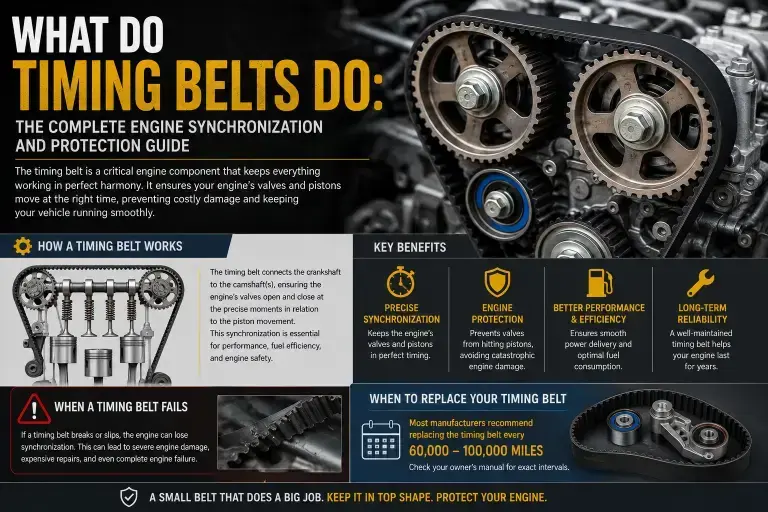
A timing belt is an internal engine component that synchronizes the rotation of your engine’s crankshaft and camshaft. This continuous synchronization ensures your engine’s valves open and close at precise intervals relative to piston movement. Without a properly functioning timing belt, an internal combustion engine cannot run, and a snapped belt on an interference engine can cause total internal valve and piston destruction.
What Do Timing Belts Do Inside Your Engine
To understand what timing belts do, it helps to examine the core mechanical cycle of an internal combustion engine. The crankshaft converts the up and down motion of your pistons into rotational force that turns your wheels. Meanwhile, the camshaft controls the opening and closing of the intake and exhaust valves that let fuel in and fumes out. The timing belt connects these two shafts, ensuring they rotate in perfect harmony so that valves open at the exact microsecond a piston moves away, avoiding a dangerous collision. If you want to explore how overall engine care maintains vehicle safety, visit the KMF Automotive homepage for a complete overview of our certified repair standards.
How Timing Belts Maintain Engine Valve Precision
The mechanics behind what timing belts do rely on precision-molded teeth embedded along the inner surface of heavy-duty synthetic rubber. Unlike smooth accessory drive belts that rely strictly on tension friction, a timing belt’s teeth lock directly into the notched sprockets of the crankshaft and camshafts. This positive displacement design eliminates slipping. By locking these components together at a fixed ratio, your engine maintains precise fuel injection timing, optimal cylinder compression, and smooth exhaust cycles.
Understanding Interference vs Non-Interference Engine Designs
The severity of a timing belt failure depends heavily on your vehicle’s internal cylinder architecture:
- Interference Engine Design: In these high-efficiency engines, the valves and pistons travel through the exact same physical space inside the cylinder at different times. If the timing belt snaps, the camshaft stops turning while the pistons keep moving, smashing directly into open valves and causing multi-thousand-dollar engine destruction.
- Non-Interference Engine Design: In this layout, there is enough physical clearance between fully opened valves and the piston at its highest point. If a belt breaks, the engine simply stalls safely without crashing internal metallic components together.
When Are Timing Belt Symptoms Too Severe to Ignore
Recognizing warning signs of timing belt fatigue early protects you from sudden engine failure on the highway. If you hear a rhythmic ticking sound coming from the front engine cover or a high-pitched squeal from aging tensioner bearings, your timing system requires immediate mechanical attention. Engine misfires, rough idling, lost acceleration power, and oil leaks contaminating the rubber belt are critical indicators that the belt is slipping or degrading rapidly, making a professional check essential.
Why Replacing the Water Pump and Tensioner Assembly Is Critical
When servicing a timing belt, certified mechanics always recommend replacing the surrounding hardware as a complete system. Complete service assemblies, such as the Gates PowerGrip Timing Belt Kit or the SKF Timing Belt and Water Pump Kit, include a fresh belt, hydraulic tensioner, idler pulleys, and a new water pump. Because accessing the timing belt requires disassembling the front section of the engine, replacing the water pump and tensioners concurrently eliminates duplicate labor costs and prevents a seized bearing or failing pump seal from ruining your new belt.
Where Can You Get Professional Timing Belt Service in Burnaby
You do not have to guess about your engine’s timing health or risk expensive mechanical failure on the road. Bringing your car to a trusted local garage ensures your internal components and tensioners are inspected with absolute precision using specialized factory alignment tools. Our experienced team evaluates your timing assembly, checks for oil leaks, and restores factory precision using high-quality OEM replacement parts. Schedule a comprehensive, factory-approved timing belt repair in Burnaby with our expert mechanical team today.
How to Protect Your Engine and Maximize Belt Lifespan
Adopting proactive vehicle care habits helps prevent premature timing belt degradation and keeps your engine running smoothly. Address front engine oil leaks, camshaft seal leaks, or coolant drips immediately, as petroleum fluids rapidly soften and break down synthetic rubber compounds. Avoid aggressive cold engine revving, and adhere strictly to your manufacturer’s scheduled replacement windows. Regularly checking your external drive belts also prevents frayed serpentine belt debris from lodging behind your protective timing cover.
Rely on Certified Technicians for Complete Automotive Care in Burnaby
Preserving the performance, safety, and long-term resale value of your vehicle demands verified mechanical expertise and premium products. From routine fluid maintenance and brake services to advanced electronic troubleshooting and complex timing belt replacements, choosing an established facility guarantees total reliability. The professional team at our top-rated auto repair shop in Burnaby focuses on delivering transparent pricing and quality workmanship to keep your car performing at its peak.
Contact Our Local Facility to Book Your Repair Appointment Today
Do not take unnecessary risks with squealing tensioners, engine misfires, or deferred maintenance windows that jeopardize your engine’s survival. Secure a fast, factory-approved solution that keeps your everyday commute stress-free and completely protects your automotive investment. Click over to our main digital booking portal right now to contact us and schedule your premium maintenance appointment today.
Frequently Asked Questions: what do timing belts do
What happens immediately when a timing belt snaps while driving
When a timing belt breaks while driving, the camshaft stops spinning instantly, causing all engine valves to freeze in place. The engine will stall immediately, and you will lose power steering and power brake assistance. If your vehicle has an interference engine, the momentum of the moving vehicle will force the pistons into the frozen valves, causing massive internal damage.
Is a timing belt the same thing as a serpentine belt
No, a timing belt and a serpentine belt perform entirely different jobs. The timing belt sits behind a protective timing cover and synchronizes internal engine components like the crankshaft and camshaft. The serpentine belt is visible on the outside of the engine and powers external accessories such as the alternator, air conditioning compressor, and power steering pump.
How often should you inspect or replace a timing belt
Most vehicle manufacturers recommend replacing a timing belt every 100,000 to 160,000 kilometers or every 6 to 10 years, whichever comes first. Even if your vehicle has low mileage, synthetic rubber naturally degrades, hardens, and cracks over time due to ambient atmospheric conditions and engine heat cycles.
Can a worn timing belt cause an active check engine light
Yes, a worn or loose timing belt can jump a tooth on the camshaft sprocket, causing the engine’s mechanical timing to fall out of sync. The engine control unit will detect the mismatch between the crankshaft position sensor and camshaft position sensor, triggering a check engine light alongside error codes for timing misalignments or cylinder misfires.
What is the average repair time for a timing belt replacement
A standard professional timing belt replacement takes between 4 to 8 hours in a fully equipped automotive repair facility. The process involves removing drive belts, engine mounts, and front timing covers, locking the camshafts, replacing the water pump and tensioners, setting exact factory timing marks, and verifying system operation under load.
Is it safe to drive with a squealing timing belt tensioner
No, driving with a squealing or loose timing belt tensioner is extremely dangerous. A failing tensioner pulley can seize or lose hydraulic pressure suddenly, allowing the timing belt to slip off its alignment teeth or snap entirely, leading to immediate engine failure while driving.
Key Takeaways: what do timing belts do
- A timing belt coordinates the precise movement between engine valves and pistons
- The reinforced rubber belt uses molded teeth to prevent slippage on engine sprockets
- Interference engines suffer catastrophic valve damage if the timing belt breaks while driving
- Routine replacement every 100,000 to 160,000 kilometers prevents unexpected breakdowns
- Professional service includes replacing the belt, water pump, tensioners, and idler bearings