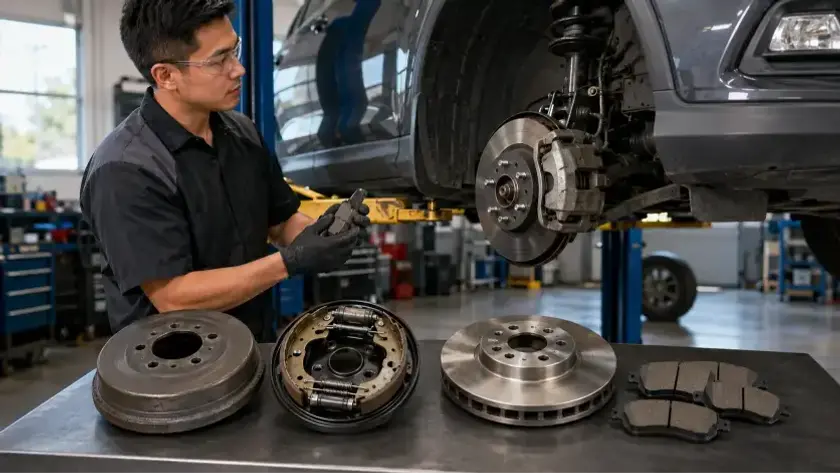
Most vehicles use disc brakes on the front and either disc or drum brakes on the rear. Disc brakes use pads and rotors. Drum brakes use shoes and drums. Both need regular inspection and service. Electronic parking brakes and ABS add additional components that also require attention over time. KMF Automotive in Burnaby has serviced every type of brake system since 1989 at 7080 Macpherson Ave. Call 604-438-0222 to book.
What are the types of brakes?
Your vehicle’s braking system is not one single design. It is a combination of different brake types working together to bring your car to a safe, controlled stop. Understanding the different types of brakes on your vehicle helps you make sense of service recommendations, warning signs, and why certain repairs are needed at different intervals.
The main types of brakes found on passenger vehicles today are disc brakes, drum brakes, and the parking brake or handbrake system. Most modern vehicles also include an anti-lock braking system, or ABS, which adds electronic sensors and a hydraulic modulator to the main brake system. Some newer vehicles are also fitted with electronic parking brakes that replace the traditional cable-operated handbrake with a motor-driven mechanism.
At KMF Automotive in Burnaby, every type of brake system is inspected, serviced, and repaired. A thorough brake inspection in Burnaby assesses every brake type present on your specific vehicle so nothing is missed.
How do the different types of brakes work?
Each type of brake uses a different mechanism to convert your vehicle’s forward motion into heat and bring it to a stop. Here is a clear explanation of how each one works.
Disc brakes
- Disc brakes are the most common type of brake on modern passenger vehicles and are almost universally found on the front axle of every car on Burnaby roads.
- The main components are the brake rotor, the brake caliper, and the brake pads.
- When you press the brake pedal, hydraulic fluid pressurises the caliper and pushes the brake pads inward against both sides of the spinning rotor.
- The friction between the brake pad material and the rotor surface generates the force that slows the wheel.
- Disc brakes handle heat better than drum brakes because the rotor is exposed to airflow, which cools it down faster between stops.
- Performance under repeated heavy braking, such as on Burnaby hills and in stop and go traffic, is significantly better with disc brakes than with drum brakes.
- Disc brake maintenance involves pad replacement when friction material wears below the safe minimum, rotor resurfacing or replacement when surface condition requires it, and caliper service when pins or pistons need attention.
Drum brakes
- Drum brakes are an older design still commonly found on the rear axle of many passenger cars, trucks, and vans.
- The main components are the brake drum, the brake shoes, and the wheel cylinder.
- When you press the brake pedal, hydraulic pressure pushes the wheel cylinder outward, forcing the curved brake shoes against the inside surface of the rotating brake drum.
- The friction between the shoe lining and the drum generates the force that slows the rear wheel.
- Drum brakes are enclosed, which makes them self-cleaning in some conditions but also means they retain heat and moisture more than disc brakes.
- Rear drum brakes typically handle less stopping load than front disc brakes because the front brakes do approximately 70 percent of the stopping work on most vehicles.
- Drum brake maintenance involves brake shoe replacement when lining thickness wears below safe limits, drum resurfacing or replacement when the interior surface is scored or worn out of round, and wheel cylinder service when leaks are found.
Parking brake and handbrake systems
- The parking brake, also called the handbrake or emergency brake, is a separate mechanical system from the hydraulic service brakes.
- On vehicles with rear drum brakes, the parking brake typically operates by pulling a cable that activates the rear brake shoes mechanically without hydraulic pressure.
- On vehicles with rear disc brakes, the parking brake may use a small secondary drum mechanism inside the rear rotor hub, a cable-operated caliper, or, on newer vehicles, an electronic parking brake motor.
- The parking brake is designed to hold the vehicle stationary when parked, not to stop a moving vehicle.
- Parking brake cables can stretch, corrode, or snap over time and require periodic inspection and adjustment.
- Electronic parking brake systems have electric motors at the rear calipers that apply and release the brake via a switch. These require specific diagnostic tools for service and release.
Anti-lock braking system
- ABS is not a separate type of brake but an electronic system that works alongside the main disc and drum brakes.
- ABS uses wheel speed sensors at each corner to monitor how fast each wheel is rotating during braking.
- If the ABS control unit detects that a wheel is decelerating faster than the others and is about to lock up, it briefly reduces hydraulic pressure to that wheel to allow it to keep rotating.
- This prevents wheel lockup and allows the driver to maintain steering control during emergency braking situations, significantly reducing stopping distances on wet Burnaby roads.
- ABS components that need periodic attention include the wheel speed sensors, which can fail and trigger the ABS warning light, and the hydraulic control unit in cases of system failure.
Electronic parking brakes
- Electronic parking brakes, found on many newer vehicles, use electric motors integrated into the rear brake calipers to clamp the brake mechanically when activated.
- They are applied and released via a button or switch inside the vehicle rather than a manual lever.
- When servicing rear brakes on a vehicle with electronic parking brakes, the caliper pistons cannot be manually compressed in the same way as conventional calipers. They require a specific diagnostic tool to retract the piston electrically before new pads can be installed.
- KMF Automotive has the equipment and training to service vehicles with electronic parking brake systems correctly.
Why does understanding brake types matter for service decisions?
Because different brake types wear at different rates, produce different warning signs, and require different service procedures. Knowing what type of brakes are on your vehicle helps you interpret the sounds and sensations you experience and communicate them accurately when you call KMF Automotive.
Squealing from the front of the vehicle during normal braking almost always points to front disc brake pad wear. Squealing or grinding from the rear may indicate rear disc pads or rear drum brake shoe wear depending on your vehicle’s configuration. A soft pedal with normal pad and shoe condition points to the hydraulic system, the brake fluid, the master cylinder, or brake lines rather than the friction components.
A driver whose rear wheels skid before the fronts during heavy braking likely has a brake bias issue or ABS concern that needs diagnosis. A driver whose electronic parking brake warning light is on needs specific diagnostic attention rather than a conventional cable inspection.
At KMF Automotive in Burnaby, brake repair and service in Burnaby is tailored to the specific brake types on your vehicle. Every inspection covers every brake type present so the service recommendation is accurate and complete.
Which types of brakes does my vehicle have?
The combination of brake types on your vehicle depends on the make, model, year, and trim level. Here is a general guide.
- Front axle: Almost all modern passenger cars, SUVs, and trucks use disc brakes on the front axle. This has been the standard for front brakes for decades.
- Rear axle: Many smaller and older vehicles still use drum brakes on the rear axle. Larger vehicles, performance vehicles, and newer cars typically use disc brakes on the rear as well.
- Parking brake: Vehicles with rear drum brakes almost always use a cable-operated drum parking brake. Vehicles with rear disc brakes use one of several rear parking brake designs. Newer vehicles increasingly use electronic parking brakes.
- ABS: Virtually all vehicles manufactured after 2004 in Canada are required to have ABS as standard equipment.
- Electronic parking brake: Common on vehicles manufactured after approximately 2015, particularly in European brands, luxury vehicles, and mid- to upper-range mainstream vehicles.
If you are unsure which combination of brake types your vehicle has, the KMF Automotive team can confirm the configuration during a brake inspection and explain the service implications for each type. Book your brake system inspection in Burnaby today.
Common myths about types of brakes
Myth 1: “Disc brakes are always better than drum brakes.” Disc brakes outperform drum brakes in high-temperature conditions, repeated heavy braking, and wet weather braking response. But rear drum brakes on vehicles designed to use them perform adequately for the lower rear braking load they are expected to handle. The presence of rear drum brakes does not indicate an inferior or unsafe vehicle. It indicates a design choice appropriate for that vehicle’s intended use.
Myth 2: “ABS makes stopping distances shorter in all conditions.” ABS prevents wheel lockup and maintains steering control during emergency braking, which can reduce stopping distances significantly on wet or slippery surfaces. On dry pavement, ABS may slightly increase stopping distance compared to a driver who can perfectly modulate brake pressure without locking wheels. The primary safety benefit of ABS is steering control retention, not purely shorter stopping distance.
Myth 3: “Drum brake shoes last longer than disc brake pads so they do not need checking as often.” Drum brake shoes do often last longer than front disc brake pads because rear drum brakes handle less stopping load. However, the enclosed drum environment means that worn shoes can damage the drum surface significantly if left unaddressed. Drum brakes should be inspected on the same annual schedule as disc brakes.
Myth 4: “Electronic parking brakes are just like regular handbrakes and can be serviced the same way.” Electronic parking brakes require specific diagnostic equipment to retract the caliper piston before brake pad replacement can be performed. Attempting to compress the piston manually without the correct tool damages the electronic motor inside the caliper and can result in an expensive caliper replacement. KMF Automotive has the correct equipment for electronic parking brake service.
Myth 5: “My vehicle only has one type of brake so only one type of service is needed.” Almost no vehicle uses a single brake type across all four corners. The combination of front disc, rear disc or drum, parking brake system, and ABS means most vehicles have at least three different brake-related systems that all require periodic inspection and maintenance. A complete brake service addresses every type of brake present on your vehicle.
Services We Offer
KMF Automotive is a full-service auto repair shop in Burnaby. The team at 7080 Macpherson Ave handles every type of brake system on every type of vehicle to keep you safe and running properly.
| Service | Description | Best Use Case | Book Now |
|---|---|---|---|
| Brake Inspection | A thorough examination of the entire brake system, including pads, rotors, shoes, fluid levels, and all components. Recommended regularly to ensure vehicle and passenger safety. | Annual maintenance, pre-purchase checks, or any time braking feels off. | Brake inspection Burnaby |
| Brake Pad Replacement | Removal of worn friction pads and installation of new pads on front, rear, or all four corners. Pads must be replaced when worn below safe thickness. | Squealing brakes, reduced stopping power, or scheduled maintenance. | Brake pad service Burnaby |
| Brake Rotor Service | Resurfacing or full replacement of brake rotors that have become worn, scored, or warped over time. | Pulsation through the pedal, vibration when braking, or grooved rotor surfaces. | Rotor repair Burnaby |
| Hydraulic Brake Fluid | Removal of contaminated brake fluid and replacement with fresh fluid to restore proper hydraulic braking performance. | Soft or spongy pedal, discoloured fluid, or every two years as preventive maintenance. | Brake fluid flush Burnaby |
| Brake Shoes | Replacement of worn brake shoes in drum brake systems that press against the drum to slow or stop the vehicle. | Rear drum brake vehicles with reduced stopping power or grinding from the rear. | Brake shoe service Burnaby |
| Electronic ABS Sensors | Inspection and replacement of sensors that monitor wheel speed and activate the anti-lock braking system when needed. | ABS warning light, ABS not engaging correctly, or sensor fault codes present. | ABS sensor service Burnaby |
| Power Brake Booster | Diagnosis and replacement of the booster that amplifies pedal force to make braking easier and more responsive. | Hard or stiff brake pedal, or noticeably increased effort required to brake. | Brake booster repair Burnaby |
| Wheel Alignment | Adjustment of wheel angles to manufacturer specifications to restore straight tracking, even tire wear, and proper handling. | Vehicle pulling to one side, uneven tire wear, or after hitting a curb or pothole. | Wheel alignment Burnaby |
| Exhaust and Muffler Repair | Inspection, repair, and replacement of exhaust components including mufflers, pipes, and catalytic converters. | Loud rumbling noise, exhaust smell inside the vehicle, or visible rust or damage under the car. | Exhaust Repair Burnaby |
| Oil Change | Drain and replacement of engine oil and filter to keep your engine properly lubricated and running clean. | Every 5,000 to 8,000 km depending on oil type and vehicle, or as recommended by your manufacturer. | Oil change Burnaby |
| Tire Repair | Inspection, patching, and replacement of tires that are damaged, punctured, or worn below safe tread depth. | Flat tire, slow leak, uneven wear, or tires approaching the end of their service life. | Tire repair Burnaby |
| Timing Belt Replacement | Inspection and replacement of the timing belt that synchronises your engine camshaft and crankshaft rotation. | Manufacturer-recommended interval, usually every 100,000 to 160,000 km, or if the belt shows cracking or fraying. | Timing belt Burnaby |
| Clutch Repair | Diagnosis and repair or replacement of clutch components including the disc, pressure plate, and flywheel in manual transmission vehicles. | Slipping clutch, difficulty shifting, grinding when engaging gears, or a high clutch engagement point. | Clutch repair Burnaby |
| AC Services | Inspection, recharge, and repair of your vehicle air conditioning system to restore proper cooling performance. | Weak or warm airflow from vents, unusual smells when AC is on, or AC not engaging at all. | AC service Burnaby |
Types of Car Brakes Explained in Burnaby Today
Understanding the types of brakes on your vehicle is not just interesting information. It helps you interpret warning signs correctly, ask the right questions when you call a shop, and make better decisions about service timing. KMF Automotive at 7080 Macpherson Ave in Burnaby services every type of brake system, from conventional disc and drum brakes to ABS sensors and electronic parking brakes. The team has been doing it honestly since 1989. Book your brake inspection today and know exactly what type of brakes you have and what condition they are in.
Book Your Brake Inspection Today
KMF Automotive is open Monday to Friday, 9:00 AM to 5:00 PM. Call 604-438-0222, email [email protected], or use the contact page to book. A complete inspection covering every type of brake system on your vehicle, with honest findings and clear recommendations from a Burnaby team with over 35 years of experience.
Contact KMF Automotive Book My Brake Inspection
Frequently Ask Questions: Types of Brake
What types of brakes does my car have?
Most modern passenger cars have disc brakes on the front axle and either disc or drum brakes on the rear. Almost all vehicles manufactured after 2004 in Canada have ABS as standard. Newer vehicles increasingly have electronic parking brakes. The KMF Automotive team can confirm the exact brake configuration on your vehicle during an inspection.
What is the difference between disc brakes and drum brakes?
Disc brakes use brake pads that clamp against a flat rotating rotor disc. Drum brakes use curved brake shoes that press outward against the inside of a rotating drum. Disc brakes handle heat and repeated braking better and are used on the front axle of virtually all modern vehicles. Drum brakes are still common on the rear axle of many cars and trucks.
Do drum brakes need the same service as disc brakes?
Drum brakes need regular inspection on the same annual schedule as disc brakes. Brake shoe thickness is measured, drum interior surface condition is assessed, and the wheel cylinder is checked for leaks. The components and procedures are different from disc brakes but the inspection frequency is the same.
What does ABS do and does it need servicing?
ABS prevents wheel lockup during emergency braking by automatically modulating hydraulic pressure to each wheel. The wheel speed sensors that make ABS work can fail over time and trigger an ABS warning light. KMF Automotive tests ABS sensor function during brake inspections and replaces faulty sensors when needed.
Can KMF Automotive service electronic parking brakes?
Yes. KMF Automotive has the diagnostic equipment needed to retract electronic parking brake caliper pistons correctly before brake pad replacement and to test the system after service. Electronic parking brakes require specific tools that not every shop has.
What types of brake service does KMF Automotive provide in Burnaby?
KMF Automotive services disc brakes, drum brakes, parking brake systems, electronic parking brakes, and ABS sensor systems. This covers brake pad replacement, rotor service, brake shoe replacement, drum service, wheel cylinder repair, ABS sensor replacement, and brake fluid flushing across all brake types.
Key Takeaways: Types of Brake
- Most vehicles use disc brakes on the front and either disc or drum brakes on the rear. ABS is standard on virtually all modern vehicles. Electronic parking brakes are increasingly common on newer models.
- Disc brakes use pads and rotors. Drum brakes use shoes and drums. Each type wears differently and produces different warning signs when service is needed.
- Drum brakes should be inspected annually on the same schedule as disc brakes even though brake shoes often last longer than front disc pads.
- ABS sensors can fail and require replacement. The ABS warning light is the primary indicator that the system needs diagnostic attention.
- Electronic parking brakes require specific diagnostic equipment that not every shop has. KMF Automotive is equipped to service these systems correctly.
- Understanding which brake types your vehicle has helps you interpret warning signs and communicate accurately when booking service at KMF Automotive.
- KMF Automotive has serviced every type of brake system in Burnaby since 1989 at 7080 Macpherson Ave, open Monday to Friday, 9 AM to 5 PM.